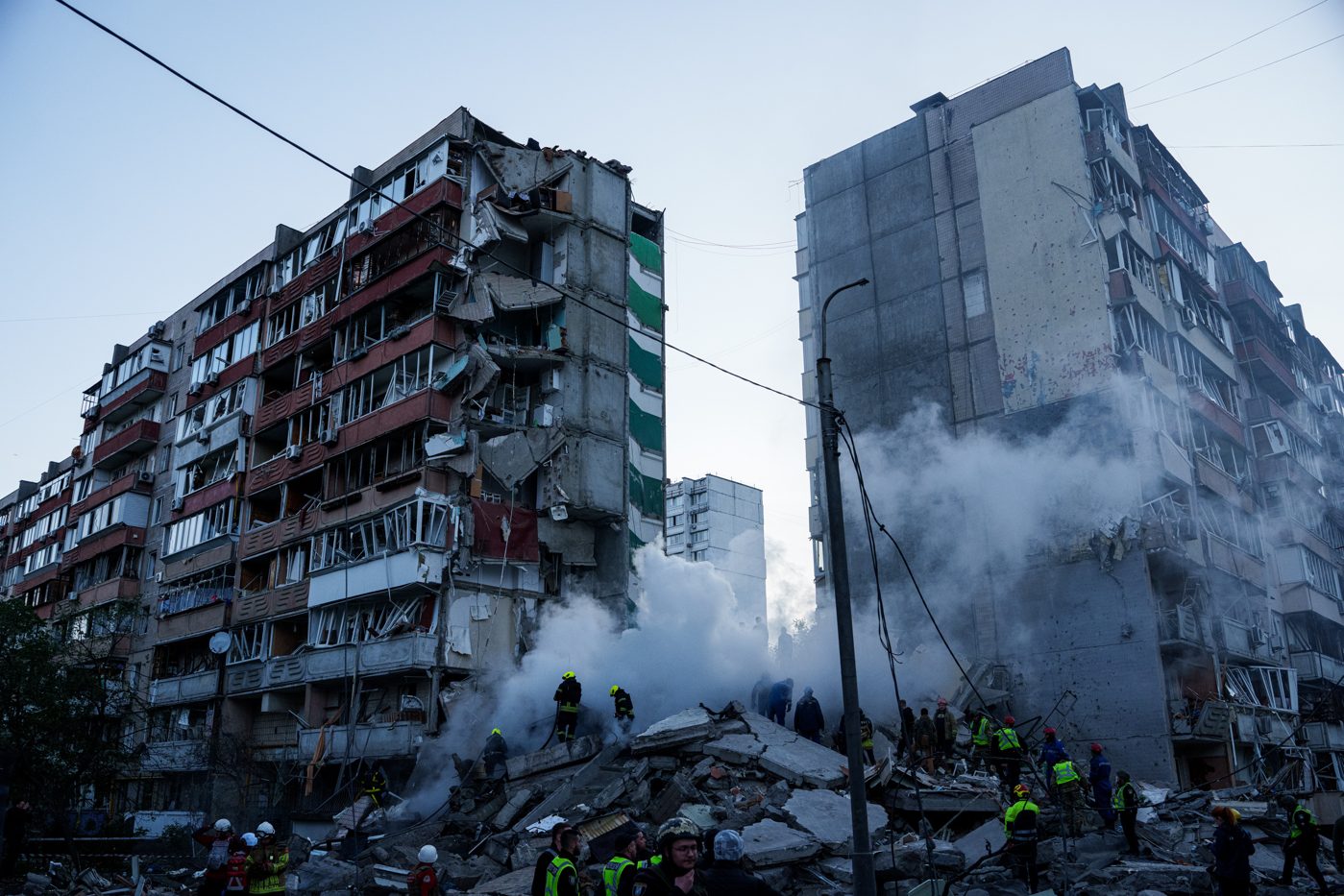
As of 2026-05-14 12:02 UTC, the most important fact about Russia's latest barrage on Ukraine is not any one casualty figure, because those counts were still changing as rescuers worked through collapsed buildings in Kyiv.[1][2] The stronger signal is operational: Ukrainian officials and wire reports described a two-day strike sequence in which Russia launched more than 1,560 drones, followed overnight by 56 missiles and hundreds more drones, with Kyiv as the main target.[2][3][4]
That makes the May 14 attack more than another entry in the war's grim strike ledger. It is a saturation story. The reported volume of drones, decoys, cruise missiles, ballistic missiles, and aeroballistic missiles forced Ukraine to defend many layers of airspace at once while still absorbing direct hits at dozens of locations.[3][4][5] The battlefield question for the next week is therefore not only how much damage was done in Kyiv, Kharkiv, Kremenchuk, Chornomorsk, and other cities. It is whether Ukraine's layered defenses can keep converting very large Russian salvos into survivable outcomes without burning through scarce interceptors, crews, and repair capacity.
Image context: the cover uses a real AP photo from the Kyiv rescue scene, not a map, chart, or symbolic war graphic.[1] That is the correct visual here because the article's core tension is exactly that: hundreds of airborne targets become one apartment block, one rubble pile, one rescue operation, and one local water-and-power disruption.
Facts on the File
| Item | What was reported | Confidence note |
|---|---|---|
| Timing | The combined overnight strike followed a rare large daytime drone attack on Wednesday, May 13, and continued into early Thursday, May 14.[1][2][5] | Strong. Reported by AP, Reuters, and Ukrainian outlets citing official accounts. |
| Scale | President Volodymyr Zelenskyy said Russia had launched more than 1,560 drones against Ukrainian cities and communities since the start of Wednesday.[2][3] | Strong for the official Ukrainian claim; still an official wartime figure rather than independently counted by reporters. |
| Overnight package | Ukrainian Air Force reporting cited by Ukrainian outlets described 731 aerial attack weapons overnight: 56 missiles and 675 UAVs.[4][5] | Strong for the Air Force's preliminary accounting; subject to revision after battle-damage assessment. |
| Interceptions and hits | Air-defense units were reported to have shot down or suppressed 693 targets, including 41 missiles and 652 drones; officials also reported direct hits by 15 missiles and 23 drones at 24 locations.[1][4][5] | Strong for the official preliminary air-defense readout; exact classifications may be revised. |
| Casualties | AP reported four people killed and 33 wounded in Kyiv, while the Reuters file carried by BusinessWorld reported at least 11 people killed overall, including five in Kyiv, and about 40 wounded there.[1][2] | Medium. The numbers were moving as rescue work continued, so they should be read as time-stamped, not final. |
| Damage pattern | Reports described a collapsed section of a nine-story residential building in Kyiv, damage at about 20 Kyiv locations, disruption to water supplies, and strikes affecting energy, port, residential, and civilian infrastructure elsewhere.[1][2][3] | Strong in direction; site-level totals may change as local authorities update assessments. |
What Changed Overnight
The attack moved the news focus from a single incoming wave to a sustained pressure cycle. AP described Thursday as the third straight day of large-scale Russian aerial attacks after a May 9-11 ceasefire period requested by U.S. President Donald Trump.[1] Reuters, in the version carried by BusinessWorld, framed the two-day sequence as Russia's largest aerial attack over such a period since the start of the war.[2] Those are not identical claims, but they point in the same direction: the current Russian pattern is not a one-off strike, but a method of loading Ukraine's defenses repeatedly.
The Air Force details explain why that matters. According to Ukrainian reporting on the Air Force readout, the overnight package included Kinzhal aeroballistic missiles, Iskander-M/S-400 ballistic missiles, Kh-101 cruise missiles, Shahed-type attack drones, Gerbera, Italmas, Banderol loitering munitions, Parodiya decoys, and other UAVs launched from Russian territory and occupied Crimea.[4] That mix is designed to complicate detection, prioritization, and interception. A defender has to decide what is lethal, what is a decoy, what is aimed at a city, what is aimed at infrastructure, and what must be engaged before it reaches terminal range.
Kyiv was the visible center of the overnight strike. Zelenskyy, according to Ukrinform, said the main target was Kyiv and that damage was reported at 20 locations across the city, including residential buildings, a school, a veterinary clinic, and other civilian infrastructure.[3] AP reported a collapsed apartment-block section in the Darnytsia neighborhood, destroyed apartments, rescued residents, and people still believed missing.[1] Reuters described emergency crews cutting through concrete at a nine-story residential building and noted water-supply disruption in Kyiv.[2]
The national map was broader. AP listed Kremenchuk, Bila Tserkva, Kharkiv, Sumy, and Odesa among cities targeted in the bombardment.[1] Ukrinform's summary of Zelenskyy's statement named energy infrastructure in Kremenchuk and port and residential areas in Chornomorsk.[3] The operational pattern is therefore not simply "Kyiv was hit." It is that Kyiv took the main blow while other regions were also forced to spend defensive attention, repair crews, grid capacity, and emergency response.
Why It Matters Now
The first impact is humanitarian and immediate. The collapsed residential building is not incidental evidence; it is the event's clearest measure of consequence.[1] Large salvo statistics can make the attack sound abstract. The AP photographs and site reporting make it concrete: rescue workers, exposed apartments, shattered neighboring windows, and residents pulled from damaged homes.[1] As long as people remain missing or trapped, the casualty count remains provisional.
The second impact is military. If the official Ukrainian figures hold, Ukraine neutralized a large share of the overnight package.[1][4][5] That should not be mistaken for strategic comfort. A defender can perform well and still be under stress if the attacker keeps increasing the number, complexity, and frequency of targets. The relevant metric is not only interception rate; it is how many direct hits still get through, how many interceptors are consumed, how many mobile-fire groups are exhausted, how many repair crews are forced into repeat deployments, and how quickly Russia can regenerate another wave.
The third impact is diplomatic. The attack landed while Trump was in China for a summit with Xi Jinping, and both AP and Reuters noted Ukrainian officials' argument that Moscow's action undercut talk of a war moving toward an end.[1][2] That does not mean the strike was caused by the summit. It does mean the timing gives Kyiv a direct message to partners: Russia's aerial campaign is not pausing while diplomacy proceeds. Air-defense supply, not just peace language, remains the live constraint.
The 24-Hour, 7-Day, and 30-Day Impact
In the next 24 hours, the decisive updates are rescue and casualty revisions. The open questions are how many people remain missing at the Kyiv building, whether local services remain disrupted, and whether the official strike-location count changes after debris and direct-hit assessments are consolidated.[1][2][4]
Over the next 7 days, the key signal is whether Russia follows this sequence with another mass strike or shifts back to smaller regional attacks. A pause would not undo the damage, but repeated large waves would suggest Russia is trying to make saturation itself the strategy: force Ukraine to defend every night, then attack energy, ports, housing, and morale while crews and interceptors are stretched.
Over the next 30 days, the watch item moves to partners. If this strike produces accelerated air-defense deliveries, ammunition announcements, or clearer commitments on Patriot, IRIS-T, NASAMS, interceptor-drone, and electronic-warfare support, Kyiv can treat the attack as evidence in a supply campaign. If partner response stays rhetorical, the practical burden remains on Ukraine's existing defensive inventory.
Scenarios
Base case: Russia continues mixed missile-and-drone pressure but alternates between huge salvos and smaller attacks. Ukraine keeps intercepting or suppressing most targets, but direct hits still create civilian casualties, infrastructure outages, and demand for more air-defense ammunition.[1][2][4]
Upside case: the visible scale of the May 14 strike speeds partner decisions on interceptors, short-range air-defense systems, and electronic-warfare support. In that case, the attack becomes a catalyst for replenishment rather than just another depletion event.
Downside case: Russia repeats the large-salvo pattern before Ukraine can fully replenish. The risk is not one spectacular failure of air defense, but cumulative fatigue: more decoys, more ballistic threats, more simultaneous regional targets, and more repair work pushed onto already strained cities.[3][4][5]
Action Checklist
For readers tracking the war, treat early casualty figures as provisional unless they are time-stamped. The AP and Reuters counts differed because the rescue picture was moving, not because the event was in doubt.[1][2]
For policymakers and defense planners, separate the two problems. Civilian recovery needs immediate rescue, utilities, medical, and shelter support. Air defense needs sustained supply: interceptors, mobile-fire capacity, electronic warfare, radar, repair crews, and training pipelines.
For analysts, the falsifier is clear. If later official and independent reporting shows the May 14 package was far smaller than the current Ukrainian and wire-service accounts indicate, the saturation framing weakens. If the reported scale holds, the better reading is that Russia is testing whether repeated mass aerial attacks can impose costs even when most targets are intercepted.
Sources
- Associated Press, "Russia hammers Ukraine with drones and missiles as Trump meets Xi in China" (May 14, 2026).
- Reuters via BusinessWorld, "Russia unleashes heaviest wartime drone assault on Ukraine, hits Kyiv" (May 14, 2026).
- Ukrinform, "Zelensky on Russian night attack: Kyiv main target of strike; damage reported at 20 locations" (May 14, 2026).
- UNN, "Russia attacked with three 'Kinzhal' missiles; 41 out of 56 missiles and 652 out of 675 drones neutralized" (May 14, 2026).
- Hromadske, "At least one dead, 31 wounded in Kyiv as Russia fires 56 missiles and 675 drones across Ukraine" (May 14, 2026).