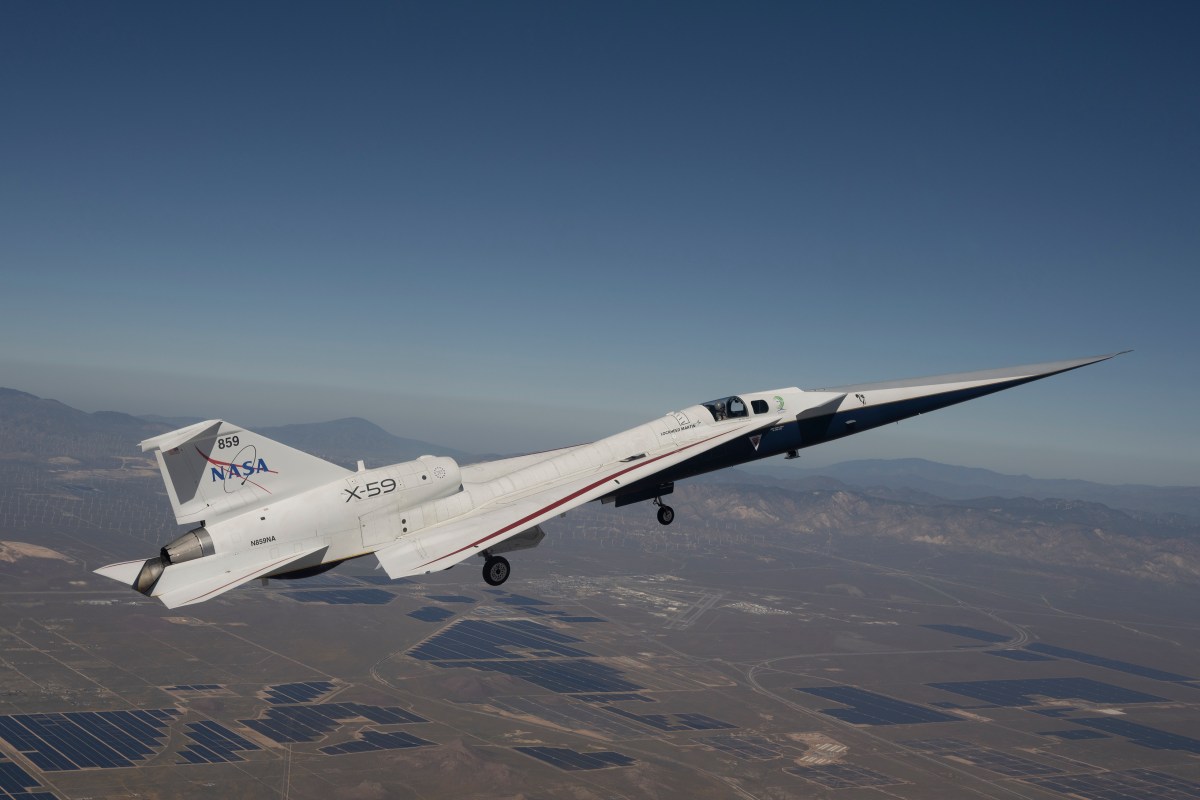
As of 2026-03-25 10:08 UTC, NASA's X-59 has crossed an important but still early threshold: the quiet-supersonic research aircraft is back in the air after its October 2025 debut, yet the March 20 milestone is better understood as a campaign restart than a regulatory breakthrough. NASA says the aircraft's second flight kicked off a 2026 series of dozens of tests, but a cockpit vehicle-system warning brought the sortie back to base after takeoff at 10:54 a.m. PDT and landing at 11:03 a.m. PDT.[1]
That distinction matters because X-59 is not just an airplane story. NASA's stated mission is to move from flightworthiness to acoustic evidence, then to community-response data that U.S. and international regulators can use when weighing future noise thresholds for commercial supersonic flight over land.[2] The U.S. rulebook still contains a hard baseline: civil aircraft cannot operate above Mach 1 domestically except under specific authorization conditions.[3] So the live question after the second flight is not whether X-59 can fly at all. It can. The question is how quickly NASA can resume the test ladder that leads from one experimental aircraft to a rulemaking-grade data package.[1][2][3]
What happened on March 20
NASA's own description is straightforward. The aircraft completed its second flight near Armstrong Flight Research Center in Edwards, California, and the agency still characterized the day as productive because the team collected additional data and landed safely.[1] Project manager Cathy Bahm framed the early landing as a manageable interruption rather than a campaign reset, while pilot Jim "Clue" Less described the event as the beginning of a long flight campaign.[1]
The operational context also matters. X-59's first flight on Oct. 28, 2025 lasted 67 minutes, reached about 12,000 feet, and topped out around 230 mph while the team kept the landing gear down, a standard early-test precaution.[4] That first flight proved the aircraft could leave the runway, fly, and transition into Armstrong's test ecosystem. The March 20 flight is the next rung: not yet the quiet-boom proof phase, but the point where NASA starts building cadence in 2026.[1][4]
Why the decisive milestone still sits later
NASA's mission map makes the sequence unusually clear. After basic flight testing comes Phase 2: Acoustic Validation, in which NASA flies X-59 over the supersonic test range around Armstrong and Edwards to prove the technology works in real atmospheric conditions and within the National Airspace System.[2] After that comes Phase 3: Community Response Testing, in which the aircraft flies over U.S. communities and residents provide data about what they hear and how they perceive the quieter sonic thump.[2]
That community-response step is the real bridge between engineering success and policy consequence. NASA says it plans to deliver those data to regulators so they can consider acceptable noise thresholds for commercial supersonic flight over land.[2] In other words, the aircraft itself is not the policy endpoint. It is the measurement platform that has to survive enough routine, instrumented flying to make the future regulatory argument credible.
The support structure behind the airplane
NASA has spent the past several months strengthening that support chain. In December 2025, two retired U.S. Air Force F-15s arrived at Armstrong to support ongoing supersonic flight research, including X-59 testing.[5] NASA says one aircraft will re-enter service as an active research aircraft, while the other will supply parts for sustainment.[5] The agency also says its modified F-15 fleet can operate safely up to 60,000 feet, while X-59 is expected to cruise around 55,000 feet, which explains why chase and data-collection capacity matters so much once the program moves beyond low-altitude introductory sorties.[5]
This is also why the March 20 warning light should be read in operational context rather than only as a one-flight anecdote. NASA has already arranged contractor support for the later community-overflight phase and described extra structural components and subsystems as a way to minimize downtime during higher-tempo operations.[6] That does not erase technical risk, but it does show that the agency has been planning for the throughput problem, not merely for one symbolic first flight.[5][6]
Facts that matter now
- Second flight status: completed on March 20, 2026, with an early return to base after a cockpit vehicle-system warning.[1]
- Immediate program posture: NASA still says the flight begins a 2026 campaign of dozens of tests.[1]
- First-flight baseline: 67 minutes, about 12,000 feet, and about 230 mph on Oct. 28, 2025.[4]
- Regulatory baseline: U.S. civil aircraft over Mach 1 remain restricted absent authorization under 14 CFR 91.817.[3]
- Policy pathway: acoustic validation first, community response testing after that, then delivery of data to regulators.[2]
- Operational enablers: added F-15 chase and sustainment support arrived in December 2025.[5]
Decision impact by horizon
Next 24 hours
The near-term issue is not public excitement; it is fault isolation. If NASA characterizes the cockpit warning as a contained vehicle-system issue and quickly returns the aircraft to test status, the March 20 flight will read as a short sortie inside a normal experimental program.[1]
Next 7 days
The more meaningful signal will be cadence. One resumed flight does more to preserve the 2026 test narrative than any celebratory language after a safe landing. If the campaign keeps moving, the story stays on envelope expansion. If the gap widens, attention shifts from acoustics and policy to reliability and maintenance throughput.[1][5]
Next 30 days
The medium-horizon question is whether NASA can protect the sequencing that turns X-59 into a regulatory instrument: more envelope-expansion flights, then acoustic validation, then community-response work.[2] Any sustained delay does not just push one aircraft schedule. It pushes the data package that regulators would eventually need if overland supersonic rules are to change.[2][3]
Scenario map
Base case: NASA resolves the warning quickly, resumes flight testing, and keeps 2026 centered on envelope expansion and validation. In that case, March 20 remains a brief interruption inside a progressing campaign.[1][2]
Upside case: return-to-flight happens quickly enough that the program builds real cadence, with chase-aircraft support and sustainment capacity helping NASA move toward the acoustic and community phases on schedule.[2][5][6]
Downside case: the warning points to a broader systems or integration problem, or repeated short sorties start consuming schedule margin. Then the program's headline shifts from "quiet supersonic evidence is coming" to "the measurement platform is still trying to stabilize."[1][5]
Action checklist
- Treat the second flight as a campaign restart, not as the rule-changing milestone itself.[1][2]
- Watch for NASA language about return-to-flight timing and whether the issue remains isolated.[1]
- Keep the current legal baseline in view: overland Mach 1 operations remain restricted unless specifically authorized.[3]
- Measure progress by movement toward acoustic validation and community-response testing, because that is where NASA says the regulatory payload sits.[2]
Invalidation condition
The core claim here is that the decisive gate still sits after the March 20 flight, in the phases that generate acoustic and community-response evidence.
That claim weakens quickly if NASA restores cadence and reaches the later testing phases faster than expected. It strengthens if repeated technical interruptions keep the program from turning second-flight symbolism into a reliable stream of regulator-usable data.[1][2][5]
Sources
- Jennifer M. Dooren, "NASA's X-59 Experimental Supersonic Aircraft Makes Second Flight" — March 20 second-flight timing, early return, and 2026 test-campaign status.
- NASA, "Quesst: The Mission" — program phase map from acoustic validation to community response testing and regulator data.
- Cornell Legal Information Institute, "14 CFR § 91.817 - Civil aircraft sonic boom" — current U.S. restriction on civil overland Mach 1 operations without authorization.
- NASA, "NASA's Quesst Mission Marks X-59's Historic First Flight" — October 2025 first-flight baseline for duration, altitude, and speed.
- NASA, "NASA Adds Two F-15 Aircraft to Support Supersonic Flight Research" — chase, sustainment, and altitude support around the X-59 campaign.
- NASA, "NASA Awards Contract for X-59 Community Overflight Operations" — support planning for the community-response phase and reduced downtime during high-tempo operations.