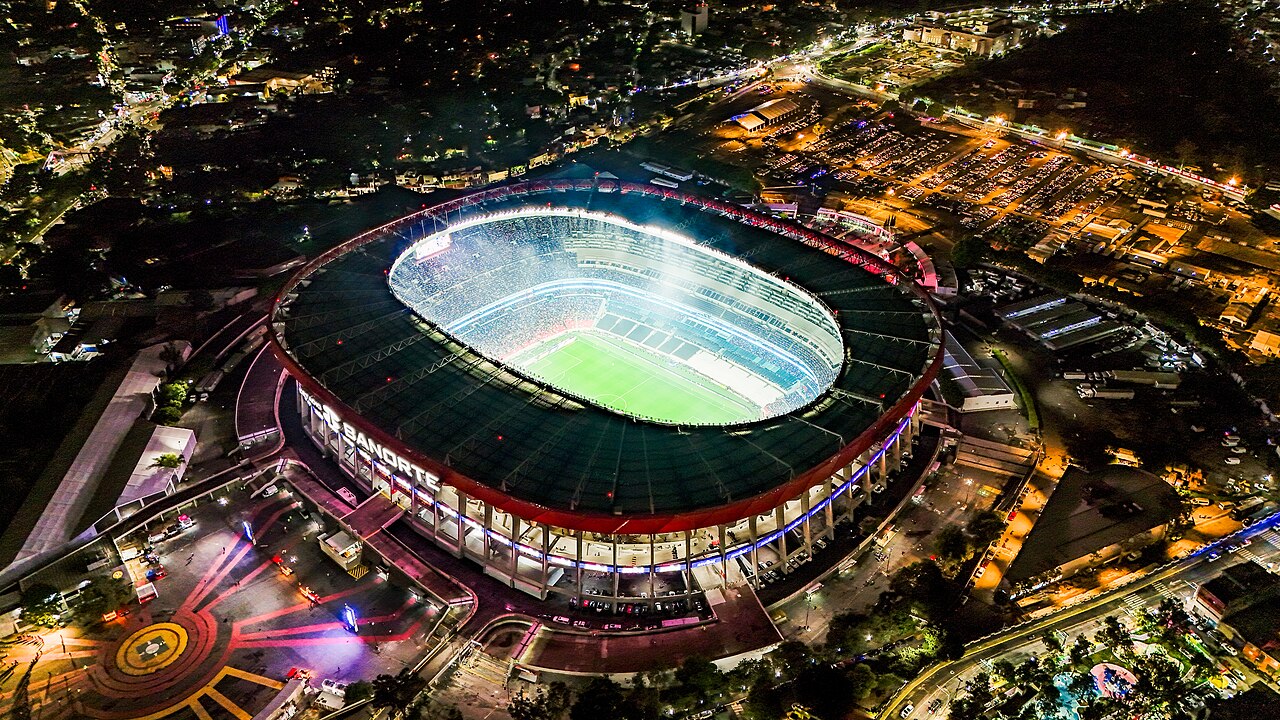
As of 2026-06-09 12:03 UTC, the useful news about the 2026 World Cup is not only that the first whistle is two days away. It is that the tournament has already become an operating clock. FIFA's updated schedule puts the first match, Mexico against South Africa, at Mexico City Stadium on Thursday, June 11, 2026, followed by a 104-match tournament across 16 host cities in Canada, Mexico, and the United States through the July 19 final in New York New Jersey.[1][2]
That scale changes the story. The largest World Cup is not merely a larger bracket; it is a rolling public-systems test. Stadium gates, fan zones, drones, private aircraft, commercial airports, transit agencies, local police, intelligence briefings, heat planning, and crowd movement all have to work in sequence. A failure in one layer may not stop the football, but it can change the lived event for visitors and residents.
Fact File
| Item | What is known now | Confidence note |
|---|---|---|
| Opening match | FIFA says Mexico plays South Africa at Mexico City Stadium on June 11, with kick-off at 13:00 local time.[1] | High; direct FIFA schedule release. |
| Tournament scale | FIFA lists 104 matches across 16 host cities in three countries, ending with the final at New York New Jersey Stadium on July 19.[1][2] | High; direct FIFA sources. |
| Opening-day crowd timing | FIFA says the Mexico City opening ceremony begins 90 minutes before kick-off and gates open four hours before the match.[2] | High; direct FIFA operational guidance for fans. |
| U.S. airspace controls | FAA lists U.S. venue dates, drone restrictions around stadiums and fan-event sites, and special air-traffic procedures for match periods.[3] | High for U.S. sites; pilots still must check current NOTAMs. |
| U.S. security funding and readiness | FEMA says it has invested nearly $900 million for U.S. host-city security, including $625 million through the FIFA World Cup Grant Program and $250 million for counter-drone capability.[4] | High as a FEMA advisory; local execution may vary by city. |
| Transit support | FTA announced $100.3 million for public transit systems in U.S. host cities, covering planning, capital, and operating costs tied to matches and public events.[5] | High for funding notice; not proof that every route will run smoothly. |
| Intelligence coordination | ODNI says NCTC convened federal, state, and local partners and will provide host cities with threat and screening support before and during the tournament.[6] | High for federal coordination claim; threat details are necessarily limited. |
What Changed
The tournament has crossed from planning horizon into execution. FIFA's schedule was not new this morning, but the calendar now matters differently. A 13:00 local kick-off in Mexico City means crowd movement starts in the morning, with gates opening four hours before the match and ceremony programming beginning 90 minutes before play.[1][2] For fans, that is an arrival instruction. For the city, it is a traffic, transit, security, sanitation, medical, broadcast, and hospitality sequence.
The same logic repeats across the U.S. schedule. FAA's World Cup safety page lists dates for each U.S. stadium and separately names fan-event locations where drone operations are prohibited within specified limits unless authorized.[3] The point is not simply "no drones." It is that informal habits around stadium flyovers, downtown content capture, private aircraft, and event-week sightseeing now run into tournament-specific airspace controls. FAA also warns private pilots to expect strict traffic-management initiatives around match periods, including flight-plan timing rules and restrictions on airborne changes.[3]
Security preparation is also moving from headline assurance to practical friction. FEMA's May advisory says federal work has included training and exercise support for state, local, and tribal governments, with more than 238,000 training attendees, and names special-event safety, sports-venue management, emergency response coordination, and mass-casualty events as focus areas.[4] ODNI's release adds the intelligence layer: counterterrorism, narco-trafficking, cyber threats, malign influence, screening, vetting, and real-time information sharing across host cities.[6] Those are not visible to most spectators when they work well. They become visible when queues lengthen, bag rules surprise people, local alerts fail, or agencies send mixed messages.
Decision Impact
Next 24 hours: anyone attending the opener should treat official timing as an operating constraint, not a suggestion. The Mexico City match has a four-hour gate window and a ceremony 90 minutes before kick-off.[2] That compresses the period when many fans will want to arrive, buy food, find seats, and clear security. The better assumption is early movement and local official updates, not a normal league-match rhythm.
Next 7 days: U.S. host cities begin entering match and fan-zone restriction windows. FAA's listed dates show overlapping pressure: Los Angeles, Santa Clara, Seattle, Dallas, Houston, Atlanta, Foxborough, Miami, Kansas City, East Rutherford, and Philadelphia each have venue windows, while several downtown fan sites have their own drone limits.[3] Visitors who fly private aircraft, use drones for media, or rely on rideshare near secured districts should expect local rules to narrow late.
Next 30 days: the operational question becomes whether the system can reset repeatedly. A single opening match can be heavily rehearsed. A 104-match tournament creates fatigue risk: hot days, delayed flights, crowded transit, multilingual alerts, fan-zone staffing, cybersecurity monitoring, medical coverage, and law-enforcement coordination must recur without assuming yesterday's success guarantees tomorrow's capacity.[3][4][5][6]
Scenarios
Base case: the opening week is busy but orderly. Fans who follow official venue, transit, and aviation guidance absorb the new procedures; local agencies use the early matches to tune crowd flow and alerts; and the tournament's complexity remains mostly backstage.[2][3][4]
Upside case: the North American format proves operationally useful because pressure is distributed. Sixteen host cities and three countries make the event harder to coordinate, but they also prevent every match from overwhelming one national transport and security system. If local fan zones, transit plans, and federal coordination work as intended, the scale becomes a showcase rather than a bottleneck.[1][4][5][6]
Downside case: the friction accumulates at the edges. Drone violations, private-aircraft delays, heat stress, bag-rule confusion, cyber incidents, local protest activity, or airport bottlenecks do not need to be catastrophic to degrade the event. The risk is a tournament that remains safe on paper while becoming hard to move through in practice. That is the uncertainty boundary: the official preparation is real, but crowd behavior and city-by-city execution are still live variables.[3][4][6]
Action Checklist
- Use FIFA's match timing as the starting point, then check the host city's current transit, venue, weather, and emergency-management channels before departure.[1][2][4]
- If flying or operating drones near U.S. host cities, check FAA TFRs and NOTAMs rather than relying on a saved itinerary or a general drone app notice.[3]
- Build extra time around fan zones as well as stadiums; FAA lists separate fan-event restrictions, and FEMA warns visitors to review local guidance for venue rules, transportation, alerts, suspicious activity, and heat.[3][4]
- Treat public transit funding as capacity support, not a guarantee of empty trains or buses. FTA's notice funds planning, capital, and operations, but local agencies still own the match-day plan.[5]
- Watch the first weekend for operational tells: queue length, gate communication, heat response, road closures, airport delay patterns, and whether local alerts reach visitors in time.
The narrow conclusion is that the football calendar has become a civic calendar. The World Cup's most important early result may not be the score in Mexico City. It may be whether fans can move through a three-country, 16-city tournament without discovering the operating plan only after they are already in the queue.[1][2][3][4][5][6]
Sources
- FIFA, "Updated FIFA World Cup 2026 match schedule reveals venues and kick-off times for all 104 matches" (schedule release).
- FIFA, "FIFA World Cup 2026 opening ceremony set to deliver star-powered celebration in Mexico City" (May 8, 2026).
- Federal Aviation Administration, "FAA's Safety Plan for FIFA World Cup 2026."
- FEMA, "FEMA Coordinating with Federal, State, Local and Private-Sector Partners to Ensure Safety During FIFA World Cup 2026" (May 6, 2026 PDF).
- Federal Transit Administration, "Trump's Transportation Secretary Announces $100 Million in Funding to Enhance Public Transportation in 2026 FIFA World Cup Host Cities" (March 3, 2026).
- Office of the Director of National Intelligence, "ODNI Hosts Symposium with Law Enforcement to Ensure Security of 2026 FIFA World Cup" (2026).
- Wikimedia Commons, "File:Estadio Azteca 2026 - 03.jpg" (photograph by ProtoplasmaKid, May 13, 2026).