In Christchurch in 1893, Kate Sheppard pasted sheets of signatures end to end and wound the paper around a piece of broom handle. That made it possible for one man to carry the work of thousands of people into New Zealand’s House of Representatives. When John Hall, an MP who supported women’s suffrage, let the roll run down the aisle, it struck the far wall. Even the members sitting at the back had some idea of what had arrived.[1]
Look above the signatures and the petition acquires a deadline. The women asked to vote at the “ensuing General Election,” in the words printed on the form that circulated in 1893. An MP could agree that women deserved a vote and still expect to face an exclusively male electorate the next time he stood. Those three words made him answer for the interval.[2][3]
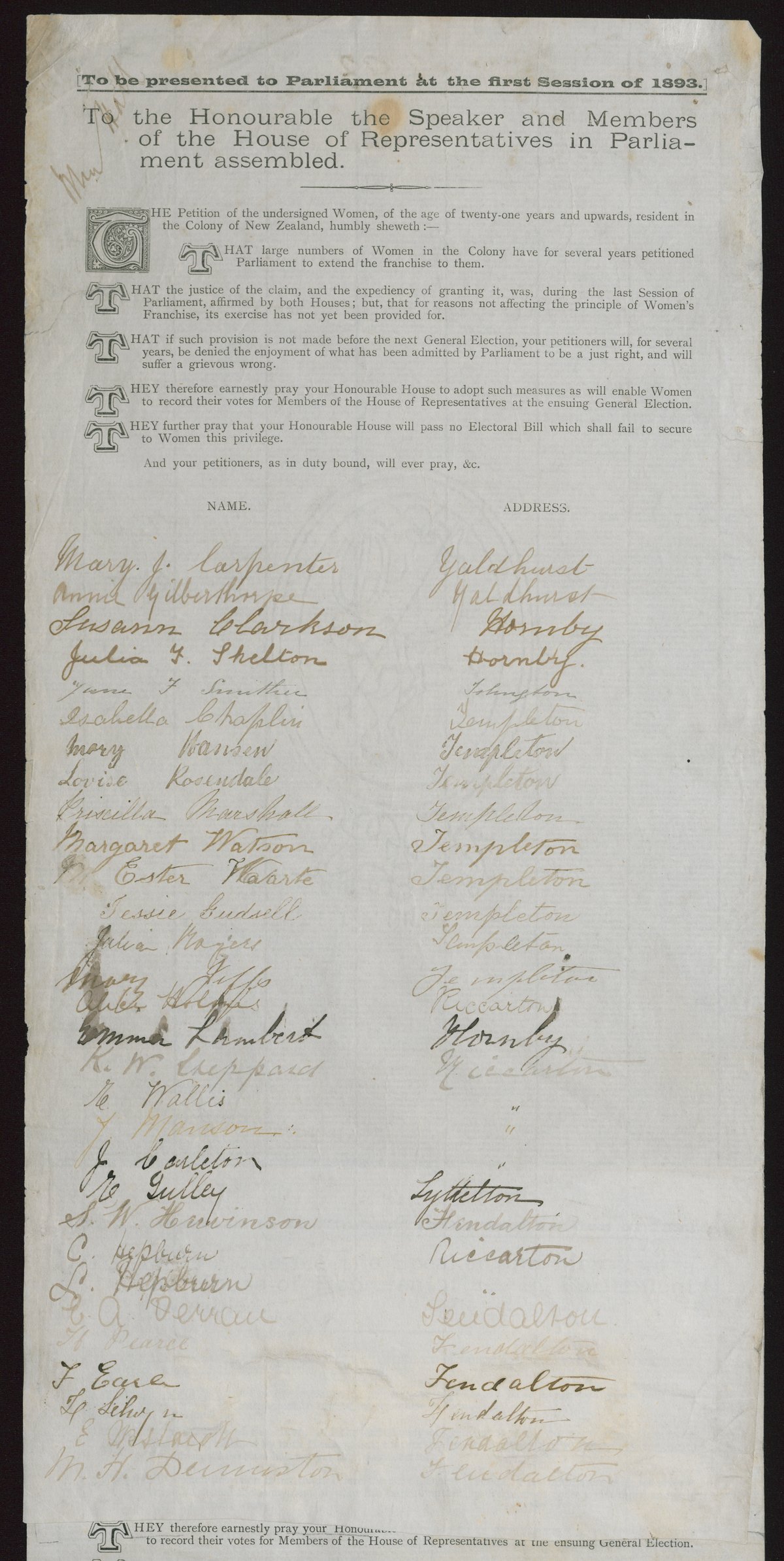
How a supporter could cost women an election
Sheppard and the other organisers had reason to be exact. In 1891, after Hall’s suffrage bill won a majority at its second reading in the House, the cabinet tried to postpone its effect until after the election. When that failed, ministers backed an amendment that would also allow women to sit in Parliament. It sounded generous. The ministers expected the upper chamber, the Legislative Council, to balk at the larger measure. The bill fell there by seventeen votes to fifteen.[3]
In 1892 the House again passed a bill that would let women vote. This time the Council added a provision for postal voting. A woman living far from a polling place had a real interest in how she could cast her ballot. Yet the dispute over precisely that question allowed the bill to founder between the chambers. Twice, a woman following proceedings could have watched a majority in the House vote for her enfranchisement. She was still ineligible to vote for any of the men who had supported it.[3]
The preamble on the 1893 petition kept an account of those proceedings. It reminded members that the House itself had already recognised the justice of the claim. That gave a canvasser a specific proposition to put to a neighbour. Signing meant asking Parliament to finish something its elected members had publicly agreed to do, in time for an election in which the signature’s owner could take part.[2]
Whose names reached Christchurch
Supporters gathered names at meetings and went from door to door. Each sheet could travel wherever a canvasser had acquaintances or could find a willing listener. In Christchurch, the paste and broom handle reversed the process. People who had signed in different towns could now make a single appearance in the debating chamber. Archives New Zealand counts 25,519 signatures on the surviving roll, including some men’s. The figure of nearly 32,000, often associated with the campaign, takes in twelve other petitions submitted that year. Those twelve are lost.[1][5]
Even the surviving names take work to read. On sheet 304, a woman from Ōtaki signed as Mary Bevan. Archives New Zealand also identifies her as Mere Ruiha Hakaraia. Someone searching only for the latter name could pass over her signature. There is a further limit to what the roll can tell us about Māori women’s political ambitions. In May 1893, Meri Te Tai Mangakāhia addressed the Māori parliament, Te Kotahitanga, seeking for women both the vote and the right to sit there. Her audience and her request were different from Hall’s. A count of signatures bound for Wellington could never adequately measure support for the case she put to that assembly.[3][5]
The votes the roll could reach
Hall’s colleagues could see how many people were prepared to put their names to the demand. The decisive count in September involved just thirty-eight men. As the bill approached its final vote in the Council, Premier Richard Seddon telegraphed a councillor to try to secure its defeat. Two opposition councillors who had wanted postal voting took offence at his interference and backed the bill. On 8 September it passed the Council, twenty to eighteen.[3]
That narrow margin helps put the scene with the broom handle in proportion. We know why those two men switched sides. Attributing their votes to the sight of the roll would give the petition credit for the one transaction in this story that its organisers could scarcely have arranged. Their achievement was to make delay a question that any signatory could put to a legislator who called himself a supporter. Which election did he have in mind?[2][3]
Governor Lord Glasgow signed the Electoral Act on 19 September. More than 109,000 women enrolled for the 1893 election, several times the number who had signed even the full set of petitions. For Mary Bevan’s generation, the difference lay in what happened to a name once it went down on paper. On Hall’s roll it asked a member of Parliament to act. On the electoral roll it entitled its owner to help choose one.[1][3][5]
Sources
- Archives New Zealand, The Women’s Suffrage Petition
- New Zealand women’s suffrage petition, 1893, text and signatures on sheet 165
- Manatū Taonga, A brief history of women and the vote in New Zealand
- Archives New Zealand, digitised first sheet of the 1893 petition, via Wikimedia Commons
- Archives New Zealand, He Tohu Rangatira, Māori Women and the 1893 Suffrage Petition