
Two young men have a delivery to make. There is wire to get down a factory aisle, and on either side of them women are already at work. Later, a man and a woman take the same route and stop beside one worker. The women at the machines have been moving their hands all along. Watch who can move their feet, though, and a second subject emerges from a little film called Girls Winding Armatures. The aisle has a job of its own. [1][2]
On April 19, 1904, G. W. “Billy” Bitzer filmed the winding room at the Westinghouse Electric and Manufacturing Company in East Pittsburgh, Pennsylvania. His employer, the American Mutoscope and Biograph Company, was making a series for Westinghouse. Later that year, visitors to the Louisiana Purchase Exposition in St. Louis could watch the Pittsburgh factories at work on screen. A visitor could also encounter Westinghouse equipment elsewhere on the grounds. Indeed, the company helped supply the generators that powered the fair. The distance between a woman handling wire in Pennsylvania and a fairgoer standing under an electric light in Missouri gives some idea of what the filmmakers had to explain. [1][3][4]
A factory small enough to visit
Taking an actual visitor through the East Pittsburgh works would have been a considerable undertaking. The main plant employed some 9,000 people and had more than two million square feet of floor space. A tour on film could follow a more manageable route. One reel could show men shaping a great iron ring, another a room of women making windings. Each group got a title and a few minutes of attention. An audience could take in the variety of work under the Westinghouse name while sitting in one place. [3][4]
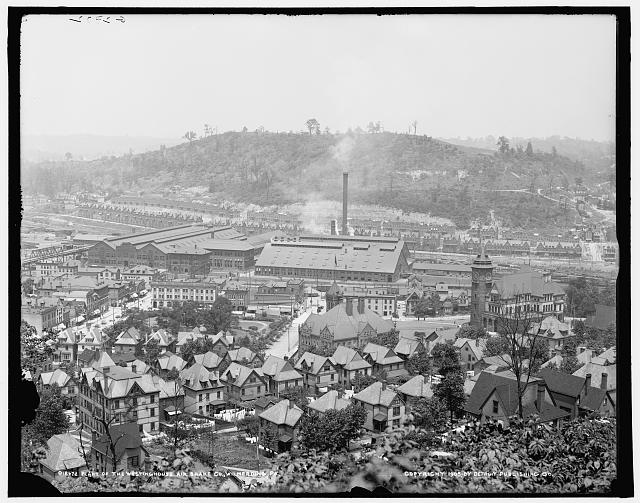
Even getting an indoor scene onto film took some electrical ingenuity. Bitzer's crew used Cooper Hewitt mercury vapor lamps for factory interiors. These lamps came from another Westinghouse company. Their greenish light, an odd choice for anyone hoping to look well in person, worked for photography. A spectator saw shades of gray. In a series intended to show what the Westinghouse companies could make, one of their products was already doing its work on the spectator's behalf, just outside the picture. [3][4]
The Library of Congress holds the film in its Paper Print Collection. For copyright deposit, moving pictures could be submitted as sequences of positive images printed on paper. In its account of putting the Westinghouse collection online, the Library describes making film prints, copying them to videotape and digitizing them. The Library's upload below brings that sequence of still photographs back to something close to the length of a brief visit to the shop. [1][3]
Follow the delivery
Pick one seat and try to stay with its occupant. The title offers a name for what she does. An armature is part of an electrical machine, and the winding gives the current a path through it. On screen, though, the wire is difficult to follow for long. There are too many hands doing similar things in too small a space. The delivery is easier to read. The two men pushing spools down the open strip of floor make visible a condition of every winding job in the room. Somebody has to keep wire coming to the people who use it. [1][2]
That movement changes the scale of the picture. Follow a single pair of hands and the work seems to consist of a short action that one person can repeat. Follow the spools and the same task extends beyond the reach of the woman doing it. There is a stock of material somewhere, a way to move it through the shop, and space deliberately left clear beside the seats. A photograph of the room could have recorded all that empty floor. It takes the delivery to show how much work the empty floor does. [1]
The stop beside one seat
On a second viewing, follow the supervisors. A man and a woman walk the aisle together, looking at the work. For a while they stay beside one station. Their pause singles out a worker whom a spectator might otherwise have lost in the row. The silent footage gives us no access to their conversation. Instruction, inspection and help with a difficulty could all look much the same from Bitzer's position. What we can see with some precision is who has the opportunity to look over several people's work, and who has to keep her eyes on the piece in front of her. [1][2]
The woman making that round complicates the title. A fair visitor who remembered only the word “girls” might recall a roomful of interchangeable workers. Following one woman along the aisle supplies a distinction the title leaves out. Women appear on both sides of the act of supervision. We can pick out a difference in authority at the very moment it is exercised, even though the film gives neither woman a name. [1][2]
Westinghouse had reasons to welcome a public view of an orderly shop. Its Electric and Manufacturing Company publicized the facilities it provided for employees, down to the washrooms and drinking water. The historian Karen C. Lund places such provisions alongside management's interest in retaining workers and discouraging union organization. There is little in these few minutes to tell us how the seated women felt about the arrangement. There is quite a lot to tell us about the effort it took to maintain it. The next time the spools come down the aisle, watch the seats on either side. Those women can keep working through the delivery. For a company showing its factory to the world, that continuity was a handsome thing to exhibit. For the people in the picture, it was somebody's work to make it happen. [1][3]
Sources
- Library of Congress, “Girls Winding Armatures,” American Mutoscope and Biograph Company film photographed by G. W. Bitzer, April 19, 1904
- David Bear, The Westinghouse Legacy, “Girls winding armatures,” scene description and catalog reference
- Karen C. Lund, Library of Congress Information Bulletin, “Inside an American Factory,” on production, labor and preservation
- Hannah Pfeifer, Library of Congress, “Meet Me in St. Louis,” on the exhibition, lighting and Detroit Publishing Company photograph