At 8:51 on the morning of November 18, 1883, a Union Pacific employee east of Wallace, Kansas, was supposed to turn the minute hand forward to nine. West of Wallace, a colleague watching for 8:01 had to turn the hand back to eight. Those instructions, issued four days earlier by S. T. Smith, general superintendent of the Kansas Division, describe the same instant. How could two watches already fifty minutes apart both need correcting? [1]
The answer begins with a possessive. Writing from Kansas City on November 14, Smith called Jefferson City time “our present standard.” A railway could already have standard time in the sense that a string of stations kept the same clock. The trouble came where one such string met another. On November 17, the Commercial and Financial Chronicle estimated that North American railroads had been working with some fifty-four standards. A passenger changing lines could carry a perfectly good watch and still have to ask what a departure time meant. [1][2]
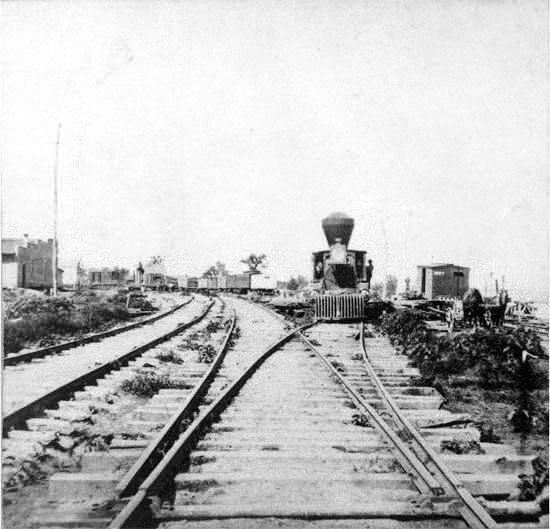
The arithmetic at Wallace
Read Smith's order from the destination backward. On the stretch toward Denver, crews would keep the time of the 105th meridian, which Denver already observed. East of Wallace, they would keep the time of the 90th meridian. Fifteen degrees of longitude account for one hour of the earth's rotation. A crew crossing the division point could therefore keep the minute hand where it was and change the hour. Wallace mattered because Smith named it as the place where crews would change reckoning. A trainman could find that place on his run without knowing his longitude. [1]
Getting the hands into that convenient relation took some awkward arithmetic just once. Imagine laying the two old watches side by side. One reads 8:51, the other 8:01. Push the first ahead nine minutes and pull the second back one. The ten minutes gained between them bring their separation to a full hour. Now the minute hands agree. Smith spelled out both starting readings in the order because a man waiting to make the change had only his old watch to tell him when. [1]
Permission to move
Then comes an instruction for the crew whose train was already on the road. At the first telegraph office they reached after the change, trainmen had to compare watches with the time sent down the wire. Kansas City supplied the signal for the eastern stretch. Wallace supplied it for the run toward Denver. A train that stopped to correct its time had to wait for the dispatcher's “O.K.” before proceeding. The person carrying the watch could move its hands. Only the dispatcher could release the train. [1]
That last distinction gives the order much of its force. Two people can each follow a printed conversion correctly and still disagree if one watch was slow to begin with. At the telegraph office a crew could check the result against a clock outside the train. Smith even specified what should happen the following morning. At ten in the east and nine in the west, and daily thereafter, the offices would send the time again. Sunday's unusual piece of arithmetic would become an ordinary part of the working day. [1]
Passengers elsewhere could see the benefit in a waiting room. In Jersey City, the New York Times reported, the Pennsylvania Railroad took down a clock labeled for New York and removed the Philadelphia sign over another clock. The latter needed only a minute's pause to bring it onto the new time. One face could now answer the question for both cities. In Kansas, the two sides of Wallace still needed different hours. What the passenger in Jersey City and the trainman at Wallace had gained in common was the ability to carry a minute reading from one place to the next and know what it meant. [1][4]
Sources
- S. T. Smith, Kansas Division general order, November 14, 1883. Union Pacific Railroad Collection, Library of Virginia. Transcribed by the University of Nebraska–Lincoln.
- The Commercial and Financial Chronicle, November 17, 1883. Contemporary account of the railway time standards, digitized by the Federal Reserve Bank of St. Louis.
- Alexander Gardner, Railroad yard at Wyandotte, Kansas, 1867. Kansas Geological Survey, Alexander Gardner Rephotographic Project.
- The New York Times, “Turning Back the Hands,” November 1883. Reproduced by the American Social History Project in Who Built America?