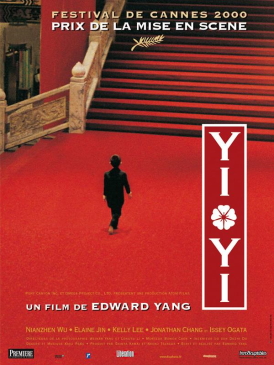
Edward Yang’s Yi Yi is often introduced as a “family drama,” which is accurate and still too small. At 173 minutes, the film builds a city-scale moral geometry where people share apartments, elevators, offices, restaurants, schools, and funeral halls, yet keep missing one another at crucial angles.[1] The title subtitle—A One and a Two—already suggests counting, sequence, and relation rather than isolated character arcs. What looks like everyday life in Taipei becomes a rigorous inquiry into partial vision: who sees what, from where, and too late by how much.
This is where the film’s craft carries unusual force. Yang is not primarily interested in plot surprise. He is interested in framing limits. Windows, reflective surfaces, corridor depth, and off-axis staging keep reminding the viewer that understanding is always incomplete, always positioned, always vulnerable to timing.
Image context: the hero image is the official poster for Yi Yi (2000), used here as the film-identification visual for this analysis.[2]
1) The film’s core device is not confession, but perspective management
Many family melodramas move by revelation: hidden affairs, buried motives, dramatic admissions. Yi Yi does use revelation, but the stronger mechanism is perspectival drift. The camera repeatedly places characters in the same architectural field while separating them by glass, doorframes, or depth planes, so emotional distance appears before anyone speaks.
In practical terms, this means scenes do not begin with “what happened” but with “from which angle are we allowed to perceive what happened.” The effect is quiet and cumulative. We are rarely granted a sovereign view. We are asked to work through obstruction.
Yang-Yang’s photography thread makes this explicit. His impulse to photograph the backs of people’s heads so they can see “what they cannot see” is not a cute side motif; it is the film’s ethical thesis in miniature.[1] Adults in the film repeatedly act from frontal certainty while living from partial information. The child notices the blind side as structure.
2) Glass and reflection: Taipei as a city of doubled images
Across offices and apartment interiors, reflective surfaces produce layered frames where characters appear both present and deferred. This is not decorative modernity. It changes how causality feels. We watch a person and their reflected trace share the same image but not the same emotional clarity, which gives ordinary dialogue a delayed afterimage.
The NJ–Sherry line benefits most from this visual grammar. Their reunion is written as a possible rerouting of midlife regret, yet Yang stages much of their interaction through partitions and transitional spaces that keep closure provisional. Even in their most intimate exchanges, image composition resists full merger. The film keeps asking whether recovered feeling can survive the practical architecture of already-made lives.
This is why Yi Yi feels devastating without becoming hysterical. Rather than amplify conflict through cutting speed or musical insistence, Yang lets urban surfaces absorb and refract it. Regret arrives as spacing.
3) Blocking as class and labor map
The film is not built on poverty spectacle, yet it is deeply economic in its movement logic. NJ’s work crisis, partnership pressure, and Japan trip are never abstract “career stress”; they are staged through meeting rooms, hotel lobbies, restaurant tables, and commuting rhythms that make managerial life look like continuous negotiation under polite lighting.[1]
Ota’s presence sharpens this dimension. In industry terms, the film is set at the edge of a hardware business model wobbling toward software-era pressure, and NJ’s professional decisions are bound to that transition.[1] Yang never lectures about globalization, but the corporate spaces, travel routes, and bilingual interactions quietly mark a Taiwanese middle-class family as already living inside cross-border capital time.
The result is a sober materialism: emotional crises unfold through payroll anxiety, client dependency, and opportunity cost. The movie’s tenderness never abandons institutional texture.
4) Temporal scale: weddings and funerals as one continuous corridor
Yi Yi opens around a wedding and closes around a funeral. In weaker hands, that symmetry can become literary neatness. Here it works because the middle is built from uneven durations: sudden accidents, routine school humiliations, drifting conversations, and delayed decisions that only become legible near the end.
Min-Min’s retreat, Ting-Ting’s adolescent confusion, NJ’s late encounter with a past life, and Yang-Yang’s observational awakening are not parallel subplots arranged for tidy comparison. They are temporal frequencies sharing one household. Yang’s direction keeps these frequencies from collapsing into a single “message,” which is why the ending lands as recognition rather than thesis.
Yang-Yang’s funeral speech is the emotional key, and the film earns it by formal preparation. After two-plus hours of partial views, his language reframes limitation as relational duty: if no one can see the whole, then each person owes others the angle they uniquely hold.[1]
5) Why this close reading still matters in 2026
The film premiered at Cannes on 14 May 2000, where Edward Yang won Best Director.[1][3] More than two decades later, critical aggregation remains unusually strong (Metacritic 94; Rotten Tomatoes 97%), and the film’s international afterlife includes restorations and recurring theatrical re-releases.[1][4][5] Box Office Mojo currently lists worldwide gross around $1.84M, with a large long-tail component through later runs rather than an initial blockbuster spike.[5]
Those numbers are small beside franchise economics, but they match the film’s real durability pattern: Yi Yi grows through rewatch communities, repertory circulation, and critical pedagogy rather than opening-weekend velocity. Its method—slow observation, spatial ethics, ordinary-life scale—has become more valuable in an image culture optimized for immediate legibility.
In a feed era where “hot takes” reward frontal certainty, Yang’s cinema keeps insisting on the opposite discipline: before judgment, relocate your angle.
What to watch on a rewatch
- Track scenes where characters share one frame but occupy different depth planes; ask who can actually hear or read the other.
- Note every use of reflective surfaces and whether reflection increases understanding or delays it.
- Follow how professional spaces (office, hotel, negotiation tables) alter NJ’s emotional posture compared with domestic spaces.
- Watch how often key decisions happen off-screen and become visible only through aftermath.
- Re-listen to Yang-Yang’s final speech as a statement of cinematic method, not only character feeling.
Read this way, Yi Yi becomes more than an acclaimed family chronicle. It becomes a technical manual for ethical looking: a film that turns framing into responsibility.
Sources
- Wikipedia — Yi Yi
- Wikipedia file record — Yi Yi poster (Yiyiposter.jpg)
- Wikipedia — 2000 Cannes Film Festival
- Metacritic — Yi Yi
- Box Office Mojo — Yi Yi
- Festival de Cannes film page — YI YI (A One and a Two)