If you strip Parasite down to pure film mechanics, the first thing you notice is that class conflict is not carried by speeches; it is carried by elevation. The Kim family starts below street level in a banjiha, climbs into the Park house by passing as service professionals, and then falls—literally, through staircases and floodwater—back into a lower zone that the film has prepared from the opening frame.[1] The famous twists matter, but the deeper achievement is structural: Bong Joon Ho and cinematographer Hong Kyung-pyo make vertical movement behave like a moral and economic meter.
This is why the movie has lasted past awards-season memory. It is not only a social allegory. It is one of the cleanest recent examples of narrative built from architectural grammar.
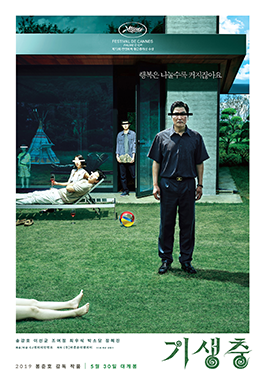
Image context: the hero image is the official theatrical poster for Parasite, used as film-identification artwork for this analysis.[2]
The house is a three-layer machine, not a single location
Most commentary describes the Park residence as “modernist” and stops there. In craft terms, the key is zoning. The film constructs three operative layers:
- the Park family’s visible living level (glass, lawn, controlled light)
- the service circulation layer (kitchen, utility paths, driver routes)
- the hidden bunker layer (sealed labor and debt memory)
The script gradually forces each character to cross boundaries between these layers while pretending the boundaries do not exist.[1] The result is tension without constant overt conflict. Every successful deception is framed as a temporary permit to occupy an upper zone. Every failure becomes a routing problem: who gets sent down, who is trapped below, and who can still move between floors.
From a direction standpoint, this is efficient because space does part of the storytelling work that dialogue usually handles. Instead of repeatedly telling us “they are unequal,” the film makes inequality physically navigable, then revocable.
Stair choreography turns plot points into body memory
The movie’s most talked-about staircase sequence is the rain-night descent from the Park district back to the Kims’ neighborhood. It works because it is not one staircase; it is a chain of descending vectors. The camera keeps finding another drop, another underpass, another grade change, so the scene plays as economic gravity rather than a one-off transition.[1]
By the time the family reaches the flooded semi-basement, the audience has already felt the social distance in repeated downward motion. This is a smart editing choice because it front-loads emotion into movement before the flood images arrive.
In reverse, the Park family’s everyday relation to stairs is casual and elective. They can call people upward when they need service and send people back down when they want privacy. That asymmetry is the class engine in practical terms: one family controls vertical access, the other rents it scene by scene.
Lens distance and blocking: intimacy for workers, composure for owners
Hong Kyung-pyo’s camera strategy helps preserve this hierarchy. When the Kim family is improvising, frames tend to feel tighter and socially crowded; when the Park family occupies its routines, compositions often open into cleaner, more stable geometries.[1] The tonal effect is immediate: labor is pressure; wealth is clearance.
This is also where performance direction and production design lock together. The Kim family’s scenes reward quick lateral adjustments—shared glances, handoffs, micro-signals—because survival depends on synchronized improvisation. In the Park zone, movement reads as slower and more declarative. Time belongs to those who can afford delay.
The film does not need to announce this contrast. It is encoded in shot duration, actor spacing, and where bodies are allowed to pause.
Weather as class exposure technology
The rain sequence is often praised for spectacle, but the stronger craft choice is unequal consequence. The same storm that produces atmospheric inconvenience for one household produces housing catastrophe for the other. The film stages this difference with logistical clarity: the Park family cancels a trip and plans a garden party the next day, while the Kims salvage soaked belongings in emergency shelter conditions.[1]
That asymmetric aftermath turns weather into a social diagnostic tool. It also keeps the script from becoming abstract. “Inequality” is not discussed as policy language here; it is rendered as drainage infrastructure, floor height, and who can reset by morning.
For craft practitioners, this is a strong reminder that external events become narratively meaningful only when their impact is distributed unevenly across characters.
The smell motif is written as spatial politics, not just insult
One of the film’s most painful threads is the recurring “smell” cue. It lands hardest because the script ties odor to place and transit, not to personal hygiene clichés. The implied source is prolonged exposure to lower, damp, constrained living conditions and the shared transportation circuits of precarious labor.[1]
In cinematic terms, smell is impossible to show directly, so Bong builds it as reaction choreography: pauses, glances, small recoil gestures, conversational detours. This converts an invisible condition into a repeated social signal. By the later acts, the signal is doing double work—humiliation in the moment, and cumulative rage in memory.
The craft lesson is simple and difficult: when a motif cannot be photographed, it can still be made legible through consistent behavioral staging.
Why the ending feels inevitable without feeling mechanical
Parasite has a famously explosive climax, yet the ending does not read as arbitrary because the film has already installed its causal tracks: hidden occupancy, managed access, layered resentment, and trigger moments where upper-zone entitlement meets lower-zone precarity.[1] The final violence is shocking, but structurally it is an overload failure in a system running beyond safe capacity.
That is where editing rhythm matters. The film alternates long deception arcs with sudden phase shifts, so the audience experiences both design and rupture. The rupture feels earned because the design was visible all along.
Industry scale: why this craft model traveled globally
The movie’s formal clarity helped it cross language and market boundaries. On a reported budget around $11.4 million, Parasite reached roughly $263 million worldwide according to Box Office Mojo, an unusual scale-up for a Korean-language social thriller.[3] Its awards path—Palme d’Or at Cannes and then Best Picture/Best Director/Oscars wins in 2020—confirmed that the film’s architecture translated across taste communities that usually do not overlap.[1][4]
Those outcomes are market facts, but they also validate a craft hypothesis: when social analysis is encoded in concrete cinematic systems (space, motion, blocking, consequence), the argument travels better than when it relies on local political shorthand.
What to watch if you rewatch
On a return viewing, track the film as a routing map rather than a suspense puzzle:
- Mark every vertical transition (up/down) and ask who controls it.
- Note when a character is framed with a clean exit route versus trapped circulation.
- Watch how quickly scenes shift after a boundary is crossed (especially doorways and stairs).
- Compare rain-night physical movement with party-day social movement.
- Observe how often humiliation cues appear before overt conflict.
Seen this way, Parasite becomes less a “twist movie” and more a precision machine: class is never just theme, it is the rule set governing who may occupy which level, for how long, and at what eventual cost.
Sources
- Wikipedia — Parasite (2019 film)
- Wikipedia file record — Parasite poster
- Box Office Mojo — Parasite title page
- The 92nd Academy Awards (Oscars.org)
- Wikipedia — 2019 Cannes Film Festival