The headline hook of Anatomy of a Fall is simple enough to fit into one sentence: a man dies outside an Alpine chalet, and his wife stands trial.[1] The film that Triet and Arthur Harari built from that premise is structurally stranger and far more useful than a standard “did she do it” machine. Over 152 minutes, the script keeps relocating the center of gravity from physical evidence to language evidence: what was said, in which language, under which pressure, with what translation loss, and for what audience.[2]
That design decision is why the film ages well after first viewing. The mystery is not only the death event. The larger mystery is how institutions narrate private life when certainty is unavailable.
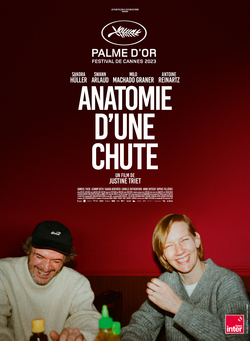
Image context: the hero image is the official theatrical poster for Anatomy of a Fall (2023), used here to identify the film under discussion.[2]
1) The opening acoustic conflict already defines the film’s power map
Before the trial architecture appears, the film stages one small domestic interruption that becomes a blueprint for everything after it. During Sandra’s interview at the chalet, Samuel blasts steel-drum “P.I.M.P.” from upstairs, forcing the conversation to stop.[3][4] On paper that beat looks anecdotal. In function, it introduces the article’s central mechanism: whoever controls the soundscape controls the narrative frame.
The legal process later performs the same move at larger scale. Testimony, cross-examination, and replayed audio do not just document events. They allocate authority. A private conflict is converted into admissible sequence, with each speaker compelled to become legible inside a formal system.
2) The trial does not discover truth; it manufactures narratable truth
Much of the prosecution strategy depends less on proving a complete causal chain than on presenting a coherent story a court can hold.[4] The film’s courtroom scenes are therefore not only legal scenes; they are live workshops in narrative construction. The question is never just “what happened on the day of the fall.” The question is “which version can survive institutional grammar.”
This is where Triet’s approach intersects with real legal theater: interpretation pressure is unevenly distributed. The accused writer’s career, marriage, and temperament are repeatedly translated into motive language that sounds objective but is heavily value-laden.[4][5] The movie’s intelligence lies in refusing to pretend that these translations are neutral.
3) Multilingual speech is treated as legal risk, not cosmopolitan texture
The multilingual setup is often praised as realism, and it is. Sandra is German, lives in France, and shifts between French and English depending on context and emotional load.[2][4] But the deeper effect is procedural. In court, language switching alters precision, tone, and perceived credibility. A phrase that feels defensive in one language can sound analytic in another; a hesitation can register as dishonesty or as translation lag.
Triet has spoken directly about building this linguistic asymmetry into the role.[4] The courtroom then weaponizes it. Rather than providing neutral access to facts, language becomes one more contested site where power is negotiated.
4) The audio-recorded argument replaces flashback certainty with evidentiary ambiguity
The film’s most destabilizing sequence is the long replay of Sandra and Samuel’s recorded domestic fight.[3][6] Crucially, this is not presented as omniscient flashback truth. It is a captured fragment, replayed in court, interpreted by competing parties, and heard through institutional framing.
That formal choice matters. Many courtroom dramas deliver late visual revelation that settles moral arithmetic. Anatomy of a Fall does the opposite. It gives the audience high-intensity material and then denies full closure on intention. The recording expands understanding of the marriage while preserving uncertainty around causation. Suspense is sustained by interpretive burden, not by withheld plot gimmick.
This is also where editing becomes thematic, not merely technical. Laurent Sénéchal has described building a simple external form that can hold complex internal tensions.[6] The result is a pacing model where information accumulates without collapsing into certainty.
5) Why the screenplay win is the right signal
At the 96th Academy Awards, the film received five nominations and won Original Screenplay.[1][7] That outcome tracks the film’s real achievement. Its core innovation is writing architecture: constructing a legal narrative that keeps ethical and epistemic uncertainty active instead of prematurely resolved.
The Cannes trajectory points the same direction. The film arrived with Palme d’Or momentum, then translated festival prestige into broad cross-market conversation without flattening itself into a conventional thriller.[1]
If there is one portable lesson for contemporary courtroom cinema, it is this: ambiguity can be a structural feature rather than an unresolved bug. Triet’s film does not evade judgment because it lacks craft. It withholds final certainty because the medium-specific question it asks is larger than guilt mechanics: when private life is litigated in public language, what counts as truth, and who gets to author that truth in the first place?
Sources
- Festival de Cannes press release: 2024 Oscars nominations and Cannes-selected films
- Wikipedia production and release record for Anatomy of a Fall
- Film Comment interview with Justine Triet
- The Hollywood Reporter interview with Justine Triet
- BFI Sight and Sound review (psychodrama and courtroom framing)
- Frame.io interview with editor Laurent Sénéchal
- Oscars 2024 ceremony page