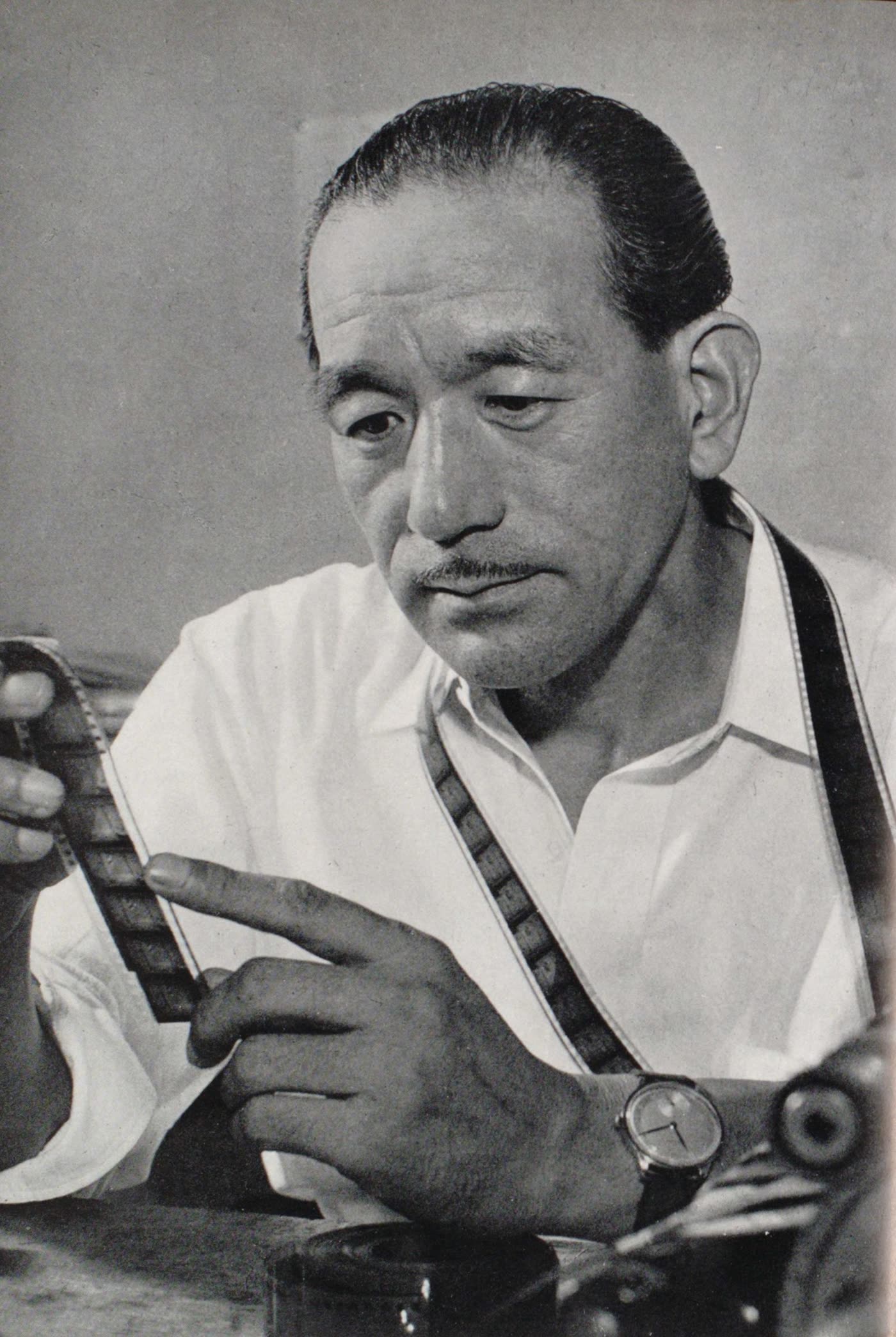
Yasujiro Ozu is often reduced to a single visual shorthand: the low camera, as if the viewer were seated on a tatami mat.[1][2] The shorthand is useful, but it is too small for the method. Ozu's real directorial force comes from how that low vantage works together with two other controls: transitional "pillow shots" that let objects and spaces carry emotional aftertaste, and ellipses that remove the loudest dramatic beats so that consequence arrives indirectly.[2][3] Across Late Spring, Tokyo Story, Good Morning, and An Autumn Afternoon, he keeps returning to the same problem: how do you show family pressure without turning every scene into a confrontation?[1][3][4]
That is why Ozu still feels modern. Many contemporary filmmakers borrow the surface markers, the centered corridors, the kettles, the laundry poles, the calm rooms, but the transferable lesson is structural rather than decorative. He makes the ordinary legible by controlling where pressure is placed, where it is delayed, and where it is never shown at all.
Image context: the cover uses a 1953 portrait photograph of Ozu by Shigeru Tamura, preserved by Japan's National Diet Library. For a director-led essay, that archival portrait is the right anchor because the argument follows a mature working method across multiple films rather than one single frame or poster image.[5][6]
1) Floor level is a social contract, not a gimmick
The famous low camera matters because it changes the moral distance between viewer and character. Ozu's later films repeatedly place the camera at seated height, keep movement to a minimum, and let conversations unfold frontally enough that the viewer is pulled into the room rather than invited to inspect it from above.[2][3] This is not just "Japanese atmosphere." It is a way of stripping hierarchy out of the image. Parents, daughters, widowers, in-laws, and neighbors are all given the same calm plane in which to speak, hesitate, evade, or absorb disappointment.
That visual leveling has a direct dramatic effect. In Hollywood family melodrama, a crisis often asks for escalation through camera emphasis: push in, isolate, underline. Ozu tends to do the opposite. He holds a stable room, lets the bodies occupy it, and trusts slight shifts in posture or timing to carry the scene. The result is that social feeling becomes measurable in centimeters and seconds. A daughter pouring tea for a guest, a father turning his head a fraction too late, a son remaining seated when courtesy suggests he should rise: each small action acquires force because the frame has already removed noise.
2) Pillow shots do emotional bookkeeping
The term "pillow shot," popularized by critics and discussed directly in the BFI essay on Ozu's transitional images, points to the short, seemingly modest shots of corridors, laundry, smokestacks, empty hallways, rails, harbor edges, kettles, and building exteriors that sit between scenes.[2] These are often described as pauses. That misses their harder function. They are a bookkeeping system for feeling.
Ozu uses them to register what conversation cannot carry cleanly. After a difficult exchange, the film cuts away from faces and lets a room, a street, or a line of telephone poles absorb the pressure. The image does not explain the emotion, but it prevents the previous scene from sealing itself too neatly. In Tokyo Story, BFI notes how the longest run of pillow shots around the mother's decline produces an elegiac drift without forcing the audience through one climactic display.[2] In the later work more broadly, as Senses of Cinema argues, the cutaways and reduced camera movement become part of a larger program of reduction: fewer emphatic devices, more attention to what remains in the air after speech stops.[3]
That is why Ozu's empty spaces never feel empty. They are still charged by the people who have just left them, or by the change those people have not yet accepted.
3) The major event often happens offscreen
Ozu's family dramas are full of decisive events, marriages arranged, illnesses worsening, disappointments hardening, generations drifting apart, but he often removes the expected dramatic center from view.[3][4] Senses of Cinema's discussion of Tokyo Story is especially useful here: the film is built from layered ellipses, from skipped persuasions to withheld announcements to major shocks that arrive secondhand.[3] Viewers hear that something has changed, then live with the aftermath rather than the spectacle.
This is one reason his films can feel both gentle and severe. Gentle, because they rarely force actors into theatrical breakdown on cue. Severe, because the audience is denied the comfort of cathartic display. The mother in Tokyo Story becomes gravely ill; the film does not turn that turn into a manipulative centerpiece.[2][3] In Late Spring, the emotional devastation is not housed in one speech but in the spacing around conversations, in who sits where, in the vase after the daughter has been guided toward marriage.[1][2][4]
The effect is cumulative. Ozu teaches the viewer to read consequence in delay. By the time a character says what matters, the important emotional movement has often already happened elsewhere.
4) His plots move through adjustment, not revelation
Wikipedia's overview is basic but useful on one point: Ozu returns again and again to family, marriage, and intergenerational tension, especially in the major late films for which he is best known.[4] What matters artistically is how he moves through those recurring subjects. His scenes do not usually hinge on discovering hidden information. They hinge on accepting a rearrangement that everyone partly understood before anyone admitted it.
That is why his comedies and dramas belong to the same directorial system. Good Morning may be lighter on the surface than Late Spring or An Autumn Afternoon, but it is still built on the same observational discipline.[1][2][4] Politeness, embarrassment, obligation, and small rebellions all become readable through repetition. Ozu does not need a twist because he is interested in thresholds: the moment a household rhythm can no longer hold, the moment a child sees adult hypocrisy, the moment a parent recognizes that care and control have diverged.
For directors, this is a practical lesson in scene design. If the room is legible and the behavior is precise, revelation can be replaced by adjustment. Drama can arrive not as surprise, but as a rebalancing everyone must live inside.
5) Why Ozu still teaches in 2026
Ozu's reputation has long since moved beyond national canon status. Tokyo Story has repeatedly appeared near the top of Sight and Sound's all-time polls, and in 2012 it topped the directors' poll, a sign that filmmakers continue to treat his work as an active workshop rather than a museum object.[4] That continuing authority does not come from reverence alone. It comes from method.
He offers a durable answer to a problem that has only grown sharper in the present: how do you make domestic life cinematic without overproducing it? Ozu's answer is to reduce, choose a stable vantage, cut to spaces that continue the feeling, and trust ellipsis to let viewers meet the film halfway.[2][3] The technique scales from period family drama to contemporary apartment stories, from festival cinema to restrained television direction. What changes is costume and architecture. What remains is the logic of pressure distribution.
That is the deepest reason Ozu stays alive for directors. He proves that stillness is not the absence of event. It is an arrangement in which very small events become impossible to ignore.
Sources
- BFI, "Where to begin with Yasujiro Ozu" (2024).
- BFI, "The enigmatic 'pillow shots' of Yasujiro Ozu" (updated 2023).
- Chris Fujiwara, "Ozu, Yasujiro." Senses of Cinema, Great Directors issue 26.
- Wikipedia, "Yasujirō Ozu."
- National Diet Library, "小津安二郎|近代日本人の肖像" (portrait record).
- Wikimedia Commons, "File:Yasujiro Ozu by Shigeru Tanura.jpg."