
Black Narcissus is one of the best arguments cinema has ever made for fake space.[2][3][4] Michael Powell and Emeric Pressburger never took their cast to the Himalayas; instead they built the palace-convent at Pinewood, used matte paintings and glass shots for the cliffs and distances, and let Jack Cardiff's Technicolor cinematography turn altitude into a psychological condition.[2][4][5] That artificiality is not a limitation the film heroically overcomes. It is the mechanism that makes the film dangerous.
Criterion's short video essay "Observations on Film Art: BLACK NARCISSUS" is worth watching precisely because it starts from craft rather than plot.[1] Instead of treating the movie as a prestige literary adaptation with some remarkable visuals attached, the video shows how visual design does the dramatic work. The nuns arrive with a civilizing mission, a schedule, and a theology of restraint. The film answers by giving them a world that looks orderly only until color, wind, and depth begin to act like adversaries.[1][3]
That is the point to hold before pressing play: in Black Narcissus, the convent is not a neutral setting where temptation happens. The convent is a machine built to leak. Painted backgrounds, impossible ledges, velvet reds, chalky whites, and rooms that feel both sealed and exposed all combine to turn discipline into strain.[1][3][4]
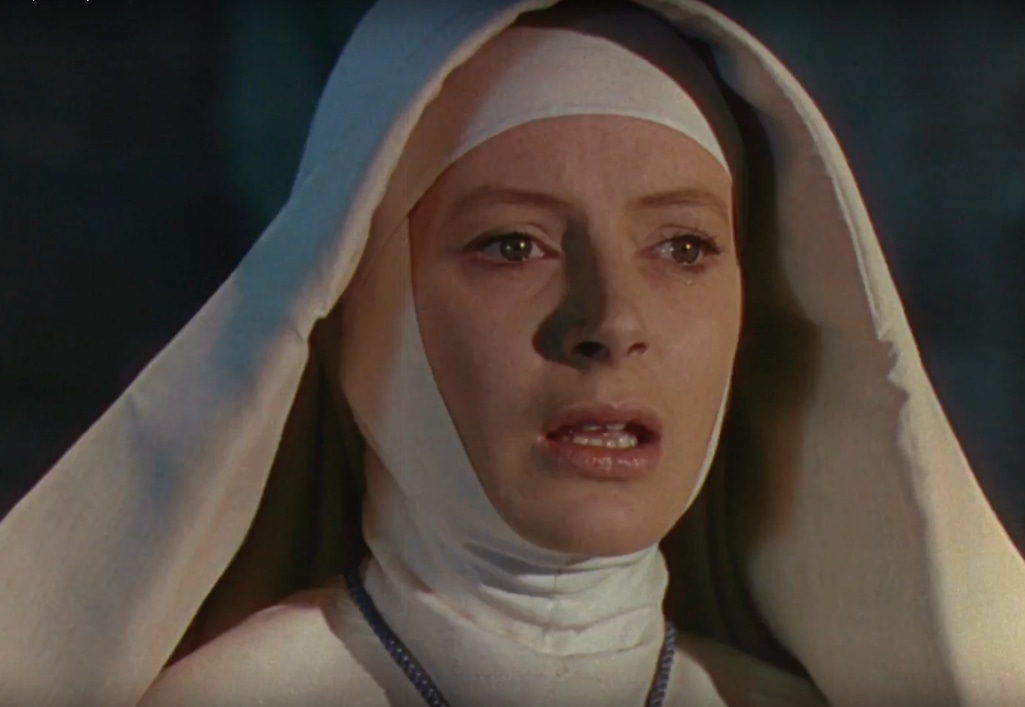
Image context: the cover uses a trailer still of Deborah Kerr as Sister Clodagh from Wikimedia Commons. A real film still is the right image here because the article is about how Kerr's composed face, habit, and posture are placed under pressure by the film's aggressively fabricated environment.[6]
False mountains are the source of the movie's truth
The video is strongest in its opening movement, when it insists that the film's painted surfaces should be read as active dramatic choices rather than quaint studio-era cheats.[1] Around the early minutes, the essay walks through how the palace balconies and precipices are assembled so that the nuns are always framed against a depth they cannot master.[1] The cliffs look less geological than theatrical, and that is exactly why they work. Powell and Pressburger are not chasing documentary plausibility. They are building a stage where distance itself behaves like temptation.
This matters because the story is about people who believe control can be exported. Sister Clodagh and her small order come to Mopu with routines, educational plans, medical duty, and a belief that discipline can be made portable.[2][5] The palace they inherit immediately resists that confidence. As BFI notes in its seventy-fifth-anniversary reconsideration, the film's atmosphere depends on an unstable mix of erotic charge, imperial fantasy, and sensory excess.[4] The farther the missionaries try to formalize the place, the more the place dissolves their categories.
Color is not decoration here. It is a command structure that fails.
The Criterion video repeatedly returns to Cardiff's color design, and that emphasis is correct.[1] Black Narcissus won Academy Awards for color cinematography and art direction, but the awards can make the palette sound ornamental if you are not careful.[2] The achievement is harder than beauty. White habits, red lipstick, dark wood, blue night, and the impossible violet-pink of the mountain light do not merely make the film lush. They sort moral and emotional pressure in the frame before anyone says what they want.
The cleanest example is Sister Ruth. By the time the film lets her step toward scarlet, the color shift feels less like character information than like a formal verdict.[1][3] The film has already taught the eye how white is supposed to behave within this convent system. When that arrangement breaks, the image registers the collapse before dialogue can catch up. Kent Jones's Criterion essay on the film's sensory logic gets at the same point from another angle: the movie is interested in how repressed desire, memory, and environment stop being separable categories.[3] The palette is the membrane through which that confusion travels.
This is why the movie still feels strange in 2026. Contemporary prestige cinema often uses color to signal mood with tasteful precision. Black Narcissus uses color more aggressively. It makes the world feel overripe, overdesigned, almost too saturated to live in. The result is not realism with a heightened finish. It is an image system that behaves as if inner life has already spilled into walls, fabrics, and sky.
Space keeps changing scale, and that instability is the whole drama
One of the essay's most useful observations is that the film keeps alternating between enclosure and abyss.[1] Rooms seem crowded by ritual and hierarchy; cut outward and the ledges look frighteningly open. The nuns are either packed inside rules or exposed to distances that mock rules. There is very little middle ground. That repeated spatial swing is why even calm conversations carry stress.
MoMA's program notes describe the film as one of Powell and Pressburger's most extravagant achievements, and the extravagance is structural rather than merely visual.[5] Every part of the mission is asked to function in a place that constantly changes scale under perception. A schoolroom becomes a stage for colonial misunderstanding. A bell tower becomes a site of erotic panic. A corridor feels like a cloister until a gust of wind turns it into a threshold. The movie never lets architecture settle into background.
Viewed this way, Deborah Kerr's performance becomes even more impressive. She does not compete with the scenery by enlarging herself to match it. She does the opposite. Sister Clodagh tries to preserve administrative clarity, vocal control, and straight lines of conduct while the film keeps bending the world around her. The acting is powerful because it stays narrow while the movie grows feverish. Her restraint gives the artifice something hard to scrape against.[3][6]
What to watch for after the video ends
On a rewatch, ignore the temptation to treat the movie as a simple descent-from-restraint story. Watch instead for how the film allocates pressure. Notice how often faces are set against painted depth, how frequently the soundtrack and the wind make stillness impossible, and how the palace carries traces of an earlier sensual life that the mission can occupy but never neutralize.[1][4][5] The video's key contribution is to remind you that the movie's emotional truth is not trapped behind its stylization. The stylization is the truth.
That is why Black Narcissus remains so contemporary. It understands that institutions often fail not when they meet obvious opposition, but when they enter environments whose sensual and historical logic they have already misread. Powell and Pressburger take that insight and make it visible in cloth, pigment, void, and weather. Nothing in the film is realistic in the narrow sense. Almost everything in it feels exact.
Sources
- CRITERION, "Observations on Film Art: BLACK NARCISSUS," YouTube video essay.
- Ronald Haver, "Black Narcissus." The Criterion Collection.
- Kent Jones, "Black Narcissus: Empire of the Senses." The Criterion Collection.
- BFI, "Black Narcissus at 75: exoticism and eroticism in Powell and Pressburger's masterpiece."
- MoMA, "Black Narcissus. 1947," exhibition/program page.
- Wikimedia Commons, "File:Deborah Kerr 3.jpg" — trailer still from Black Narcissus.