Spoiler note: this essay discusses the film's ending and the change in the trapped man's attitude toward escape.
Hiroshi Teshigahara's Woman in the Dunes begins like a story about misfortune and gradually reveals itself as a film about systems. A schoolteacher and amateur entomologist goes to the coast looking for insects, misses the last bus, accepts a night's shelter in a house at the bottom of a sand pit, and wakes to find the rope ladder gone. Janus Films summarizes the setup as an urban collector stranded with a young widow whose home sits inside a dune hollow, while BFI describes the villagers' trap and the woman's constant work keeping the house from being swallowed by sandstorms.[1][2] The premise is simple. The form is not.
The film's great achievement is that sand never remains scenery. It behaves like weather, labor demand, erotic pressure, clock, prison wall, commodity, and camera subject. Sight and Sound's account of the ending notes that the trapped man is forced to dig sand for use in cement in exchange for water, food, and basic supplies.[3] That practical arrangement matters because it keeps the allegory from floating away. The pit is not only an existential image. It is a worksite.
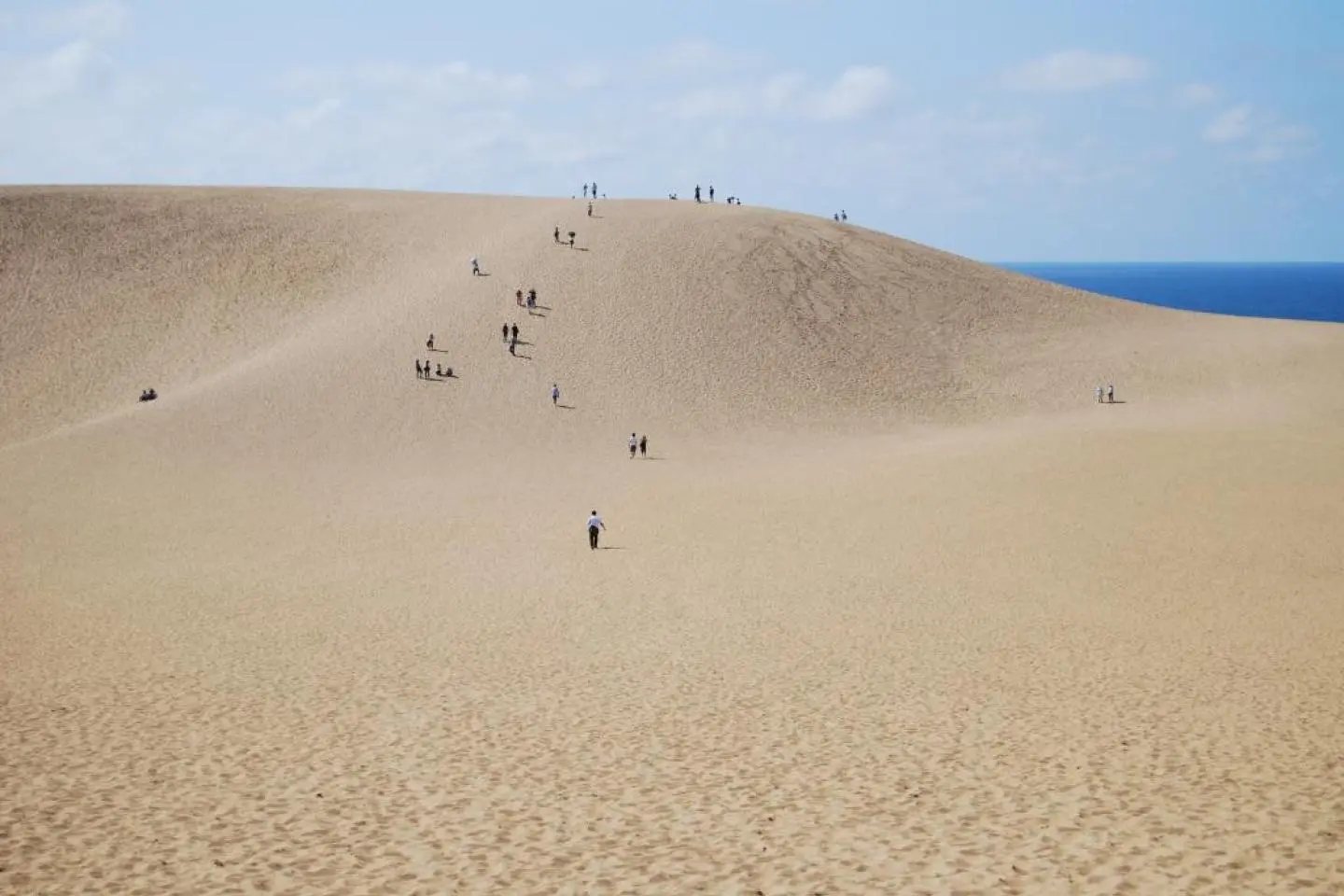
Sand is filmed as matter before it is read as metaphor
The temptation with Woman in the Dunes is to decode it too quickly. The man is modern alienation. The pit is society. The shovel is Sisyphus. The woman is accommodation. None of those readings is useless, but the film earns them through physical detail first. Teshigahara and cinematographer Hiroshi Segawa keep returning to grains, slopes, skin, sweat, insects, wood, and water. The viewer understands the argument through texture before language.
Gregory Stephens's Kinema essay is useful on this point because it records Teshigahara's admission that the sand walls had to exceed ordinary physical possibility for the film to make its pressure visible.[6] That contradiction is the craft secret. The image is physically heightened and sensorially convincing. Teshigahara does not copy a real dune. He builds the dune that the story needs: steep enough to be jail architecture, fine enough to enter every pore, unstable enough to make every movement temporary.
That is why the opening insect hunt matters. The man arrives as a classifier. He wants to name, collect, and secure a specimen that will make his own name endure. The film then traps him inside a world that cannot be stabilized by naming. Sand resists the habits of classification. It shifts under foot, covers tools, fills rooms, abrades skin, and changes the meaning of time. The collector becomes the collected.
Vertical space makes power visible
The pit has one of the cleanest spatial designs in postwar cinema: bottom and top, ladder and absence, house and village, work and command. The man is not sealed in a dark cell. He can look up. He can hear and sometimes see the villagers. He can understand that another social order exists only a few metres away. That visibility is cruel because it turns escape into a repeated visual promise.
Sight and Sound's description of the missing ladder captures the film's central reversal: hospitality becomes captivity overnight.[3] After that, every upward glance is political. The villagers do not need to be constantly violent because they control the line between levels. They can remove the ladder, ration water, withhold food, and watch from above. The pit makes domination look almost administrative.
The woman occupies a more complicated position. She is trapped too, but she has adapted to the pit's demands. BFI's recommendation stresses that she spends nearly all her time preventing the house from being consumed by sand.[2] The man initially reads this as passivity or ignorance. The film slowly exposes his arrogance. She understands the system because she survives inside its maintenance schedule. She knows when to shovel, when to conserve water, when a roof will give way, and when argument wastes strength.
That knowledge does not make the system just. It makes it durable. The film's cruelty lies in showing that oppression does not always require spectacular force once it has arranged the environment correctly. People can be made to participate in their own containment because the alternative is immediate collapse.
The body becomes the film's measuring instrument
The close-ups of skin and sand are among the film's most unsettling images because they collapse landscape into bodily sensation. Sand coats arms, faces, hair, mouths, and bedding. It does not stay outside the self. Harvard Film Archive's program note describes the film as a symbolic erotic drama that uses extreme close-ups until characters seem to become part of the landscape.[5] In Senses of Cinema's director profile, Maximilian Le Cain makes a related claim: Teshigahara found vivid cinematic equivalents for Kobo Abe's strange prose world, with abstract dune compositions giving geology an alarming presence.[4] The phrase is exact: geology becomes presence.
This is also why the film's erotic charge is inseparable from discomfort. The man and woman are not framed inside romance as release from the pit. Their bodies are where the pit keeps working. Touch, sweat, anger, bargaining, shame, dependence, and desire all happen under the same falling sand. The film refuses to let intimacy become a clean private zone.
Toru Takemitsu's score and sound design deepen that pressure. Even when the image seems still, the sound world keeps scraping, pulsing, and suspending resolution. Stephens's essay argues that the film treats sand as a third main character and notes Teshigahara's later remark that sand has its own identity.[6] Whether one accepts that claim literally or as critical shorthand, it describes the viewing experience. The sand acts. It interrupts sleep. It demands labor. It changes the rhythm of speech. It forces the characters into relation.
The ending is not surrender in the simple sense
The film's ending can look bleakly paradoxical. The man discovers a water-gathering device, then chooses not to use a chance to leave immediately. Sight and Sound reads the ending through the pressure of a society that demands faith in its own transactions and forces the man to reconsider modern freedom from inside the pit.[3] Kinema's Sisyphus framing also matters here because the film keeps asking whether repetitive labor is only punishment or whether attention to the work can alter the terms of survival.[6] The ending is strongest when seen as a shift in attention rather than a neat moral conclusion.
At the start, the man wants recognition from outside: a named insect, a certificate, proof that he is more than an ordinary functionary. At the end, he has made a small technical discovery inside the pit. Water can be drawn from the sand. The discovery is not liberation, but it changes the frame of his captivity. He has stopped seeing the pit only as a place where life is denied and begun seeing it as a place whose rules can be studied.
That is disturbing because it risks accommodation. It is also the film's most exact account of how humans survive systems they did not choose. The man does not become free in any satisfying political sense. He finds a problem inside the larger problem and attaches himself to it. The water device gives him agency at the scale the pit permits.
The final missing-person notice therefore cuts two ways. Society above has turned him into a bureaucratic absence. The pit below has turned him into a worker, partner, technician, prisoner, and possibly inhabitant. Woman in the Dunes does not resolve those identities. It lets them grind against each other like sand in skin.
That unresolved friction is why the film still feels alive. It does not ask whether captivity is literal or metaphorical. It shows how the literal becomes metaphorical because bodies have to keep working. Sand falls, houses must be cleared, water must be found, people adjust, and the ladder remains an image of freedom that may no longer answer the hardest question. Once the system has taught you its rhythm, what exactly would escape restore?
Sources
- Janus Films, "Woman in the Dunes" - distributor film page with credits, premise, cast, and art-house release framing.
- Christine Whitehouse, "BFI Recommends: Woman of the Dunes," BFI, May 18, 2020 - plot setup, pit confinement, sandstorm labor, black-and-white photography, and claustrophobic tone.
- Violet Lucca, "Head in the sand: the ending of Woman of the Dunes," Sight and Sound, BFI, August 16, 2022 - ending analysis, ladder trap, sand-for-cement labor system, and the ladder/pit spatial argument.
- Maximilian Le Cain, "Teshigahara, Hiroshi," Senses of Cinema, 2003 - director profile with discussion of Teshigahara's collaboration with Kobo Abe, the film's adaptation challenge, abstract sand compositions, and Cannes/Oscar recognition.
- Harvard Film Archive, "Woman in the Dunes," May 2005 program note - framing of the film as a symbolic erotic drama and note on Teshigahara's use of extreme close-ups until characters become part of the landscape.
- Gregory Stephens, "Sisyphus in the Sand Pit," Kinema, Spring 2009 - scholarly essay on sand as a third character, environmental-film framing, visual narrative, and human-nature relations in Woman in the Dunes.
- Alena Eckelmann, "A Grain of Film History: Tottori Sand Dunes," Japan Travel - real-world Tottori dune landscape used for the article image and contextual setting.
Editor’s Pick Review
This pick wins the 24-hour pool because it combines film criticism with unusually concrete close reading: the essay never lets Woman in the Dunes flatten into a loose allegory, and instead keeps returning to sand as matter, labor system, image surface, and political architecture. The replacement Tottori dune photograph keeps the image policy clean: it is immersive, topic-grounded, and real-world rather than a film still or analytical decoration, while still supporting the article's material argument about sand, scale, and confinement. The Chinese version also carries the same pressure and texture with strong literary-critical rhythm, preserving the article's key terms around system, body, labor, and captivity without drifting into translationese.