Salt of the Earth is usually introduced through scandal: a 1954 labor film made by blacklisted artists, resisted by industry power, attacked as subversive, and nearly buried in the United States.[1][2][3] That introduction is necessary, but it can make the movie sound like an important case file before it sounds like cinema. The better reading starts with a harder claim: the blacklist did not merely happen around Salt of the Earth. It shaped the film's method.
Herbert J. Biberman directed, Michael Wilson wrote, Paul Jarrico produced, and the International Union of Mine, Mill and Smelter Workers joined Independent Productions Corp. as a production force.[2] The American Film Institute records the film as a 94-minute drama and identifies its basis in the 1951-52 Empire Zinc strike in New Mexico, with Juan Chacon and Clinton Jencks participating in the real labor struggle before appearing in the movie world around it.[2] That is already unusual. The film is not a studio drama borrowing labor atmosphere from newspapers. It is a political fiction made with people and institutions tied to the conflict it dramatizes.
That origin gives Salt of the Earth its genre tension. It is a fiction feature, a labor docudrama, a blacklist artifact, a Mexican American civil-rights text, and a domestic awakening story at the same time.[1][2][4] The film does not blend those layers smoothly. It lets them rub. Speeches sometimes sound like movement argument. Household scenes sometimes sound like marital crisis. Strike scenes sometimes look like community record. Instead of weakening the film, that mixture gives it force. Salt of the Earth matters because it refuses to choose between workplace, home, race, gender, and production history as separate subjects.
A Strike Film That Does Not Stay At The Mine
The surface story is the Empire Zinc strike. The Library of Congress National Film Registry essay describes the film as based on the 1951 strike in Grant County, New Mexico, centered on Mexican American miners seeking equal wages and safer working conditions.[1] Sukhdev Sandhu's Guardian retrospective frames the same dramatic field through Chicano laborers, the Empire Zinc Company, and Esperanza's growing role in encouraging local women to join the picket line.[3]
The crucial move is that the mine does not contain the conflict. Many labor films organize politics around the worksite, then bring the domestic world in as emotional collateral. Salt of the Earth reverses that hierarchy. The mine matters, but so do water, childcare, kitchen labor, marital authority, police pressure, meeting procedure, and who is allowed to speak in public. The strike reveals that exploitation does not clock out. It follows the workers home, and it follows the wives back into the street.
That is why Esperanza Quintero, played by Rosaura Revueltas, is not a secondary conscience figure. She is the film's structural hinge.[1][3] At first, the men often treat the wage fight as the serious political field and household labor as a private matter. The movie gradually exposes that division as false. The same structure that underpays Mexican American miners also depends on women's unpaid endurance, and the same men who demand dignity from the company must learn what dignity requires inside their own homes.
This is not a delicate insight by 1950s Hollywood standards. It is blunt, argumentative, sometimes didactic, and that bluntness is part of its historical value. Salt of the Earth is not trying to smuggle politics into genre under cover of romance or crime. It is trying to make an audience sit with the fact that labor democracy is incomplete if it stops at the household door.
The Blacklist Becomes A Style Of Scarcity
The production history is so extreme that it can eclipse the film, but it also explains the film's texture. The AFI catalog records that Independent Productions Corp. was formed in 1951 by Simon Lazarus, Biberman, and Jarrico to employ blacklisted filmmakers.[2] The Guardian retrospective likewise places Biberman, Wilson, and Jarrico outside Hollywood because of blacklist politics before tracing their move toward a New Mexico production built with the union and local participants.[3] The Library of Congress essay adds the larger frame: Biberman, Jarrico, Wilson, and Will Geer were all marked by blacklist politics, and the film itself became a defiant act of completion under pressure.[1]
Those facts matter formally. Salt of the Earth does not have the polish of a protected studio object, and it should not be judged as if polish were the point. Its scarcity becomes visible in faces, locations, crowd scenes, and direct address. The Library of Congress essay notes that the movie used only five professional actors, with miners and families filling many of the roles.[1] AFI similarly emphasizes that many characters were played by miners and their families.[2] This does not make every performance equally fluent, but it gives the film a charged kind of presence. The workers do not look imported into the story. The story looks built around them.
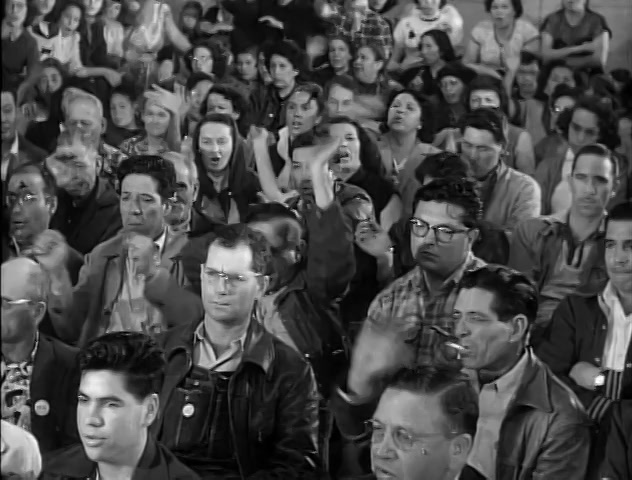
Scarcity also changes the camera's ethics. The cover frame used for this post, taken from the archival viewing copy, shows a meeting room dense with bodies, raised hands, attention, impatience, and uncertainty.[5] It is not a glamorous image. It is better than glamorous. It shows the film's core unit: a room in which political identity is formed by listening and voting as much as by marching. The film keeps returning to collective space because collective space was also its production condition. A blacklisted movie had to be made through solidarities that the ordinary industry would not supply.
Suppression Is Part Of The Story, But Not The Whole Story
The film's opponents understood its production method as a threat. AFI's historical notes describe denunciations during production, the arrest and removal of Revueltas from the United States, pressure on processing and exhibition, intimidation in New Mexico, and the difficulty of getting the movie shown.[2] The Guardian account similarly follows the hazard from vigilante pressure and Revueltas's deportation into post-production, where labs refused the film and exhibition remained vulnerable to threats and organized refusal.[3]
It would be easy to turn those facts into a martyrdom story and stop there. Salt of the Earth deserves better. Its suppression matters not only because censorship is wrong, but because the film was attacking several boundaries at once. It challenged Hollywood's blacklist. It challenged racial hierarchy in mining labor. It challenged the assumption that a union story should remain masculine. It challenged the industry habit of treating Mexican American workers as background, problem, or color rather than as historical agents.[1][2][4]
That multi-front challenge explains why the movie still feels rough and alive. It is not a clean liberal message picture in which one injustice is solved so that the audience can go home absolved. The film's most durable idea is that solidarity has to be revised by the people inside it. The miners' movement must face the women. The husbands must face their own authority. The film workers must face the blacklist by making a film outside the ordinary channels. The audience must face the fact that "labor" is too small a word unless it includes race, gender, domestic maintenance, public speech, and the risks of being seen.
Esperanza Turns Voice-Over Into Political Growth
Esperanza's narration is the film's most important formal decision. Voice-over can easily become instruction, and Salt of the Earth does use it didactically at times. But its deeper function is developmental. Esperanza does not begin as a fully formed political narrator who already knows what the story means. Her voice grows into its authority.
That growth is why the film's domestic scenes matter as much as its picket-line scenes. When Esperanza speaks from inside housework, pregnancy, anger, and fear, the film widens the definition of political experience. The strike is not only what happens when workers confront a company. It is what happens when a woman recognizes that the rules organizing her kitchen, marriage, and neighborhood are connected to the rules organizing wages and company power.[1][4]
The Library of Congress essay frames Esperanza's transformation as a move from constrained domestic position into political leadership, especially as women take over the protest when the men are jailed.[1] The point is not simply that the women become brave after the men are blocked. The sharper point is that the women had already been doing indispensable political work under another name. The strike makes that work visible, and the film makes visibility irreversible.
That is why Salt of the Earth belongs in movie history as more than a blacklist curiosity. Its form keeps moving authority away from the lone heroic male worker and toward collective speech. Even Ramon, Esperanza's husband, is interesting less as a hero than as a man forced to learn the limits of his own idea of justice. The film asks whether a movement can win outside if it reproduces domination inside. That question is still not old.
A Movement Film With A Long Afterlife
The movie's afterlife confirms the contradiction at its center. In 1954, it was hard to see in the United States; over time, it became easier to recognize as historically significant.[1][3] The Library of Congress essay notes its addition to the National Film Registry in 1992 for cultural, historical, and aesthetic significance.[1] Wikimedia Commons hosts a public media file sourced from the Internet Archive, which is the archival copy used here for image context.[5] The very availability of the film now changes its meaning. A movie once made hard to circulate has become a preservation object, teaching object, and accessible record.
That does not mean the controversy has been domesticated. The film still resists easy handling because it keeps embarrassing narrow categories. If you watch it only as labor cinema, Esperanza's home life keeps interrupting. If you watch it only as feminist awakening, the racial wage system and strike machinery keep pushing back. If you watch it only as blacklist history, the community performances keep making the film more than an episode in Hollywood victimization. If you watch it only as a historical artifact, the bluntness of its demands can still feel uncomfortably present.
That is the strongest reason to return to Salt of the Earth. It makes the blacklist visible not as an external label but as a production method: who could work, who could appear, who could speak, who could process the film, who could project it, who could stop it, and who could keep it moving anyway. In most films, the conditions of production disappear behind the finished image. Here they remain in the grain of the work. The meeting room, the picket line, the kitchen, the mine, the processing lab, and the theater all belong to one question: what does it take for suppressed people to become visible on screen and stay visible long enough to be heard?
Sources
- Stacie Seifrit-Griffin, "Salt of the Earth" (1954), Library of Congress National Film Registry essay PDF, posted August 2025, covering labor rights, racial justice, women's equality, production suppression, and registry recognition.
- AFI Catalog, "Salt of the Earth (1954)" film record, covering credits, production companies, the 1951-52 Empire Zinc strike basis, Local 890 participants, production conflict, and release history.
- Sukhdev Sandhu, "Salt of the Earth: Made of labour, by labour, for labour," The Guardian, March 10, 2014, covering blacklisted filmmakers, Chicano labor, local casting, women's picket-line role, production harassment, and exhibition obstacles.
- Encyclopedia.com, "Salt of the Earth Strike," historical encyclopedia entry on the Empire Zinc strike, Mine-Mill Local 890, and the labor conflict behind the film.
- Wikimedia Commons, "File:Salt of the Earth (1954).ogv," public media file sourced from the Internet Archive copy used for the article's frame image.