The first pursuit in The White Reindeer is not a hunt. Pirita and Aslak race reindeer across packed snow, laughing as they overtake and answer each other. Their attraction has the velocity of competition: neither waits decorously to be chosen, and neither can become interesting to the other without moving. The sequence makes courtship look like two people briefly finding the same speed.
By the end, movement has become lethal. Aslak leads a party of men after a white reindeer said to be bewitched. He catches it in a ravine and throws the cold-iron spear he has forged for the task. Only after the weapon lands does the animal become Pirita again. The young herder wins the chase and discovers that he has killed his wife.[1]
That rhyme is the severe beauty of Erik Blomberg and Mirjami Kuosmanen's 1952 film. A race helps form the couple; a hunt makes recognition impossible. Between those pursuits, marriage reorganizes who may cross the landscape freely, whose desire appears ordinary, and whose movement is renamed danger. The white reindeer is frightening not because she comes from outside the community, but because she turns its familiar grammar of courtship, labor, and hunting against itself.
Spoiler note: this close reading discusses the film's full story and final image.
Courtship begins at speed
Pirita's fate has technically been announced before the race. A sung prologue accompanies the story of her birth in the snow and foretells the witch, the white reindeer, and the fatal weapon. The movie begins as though its ending already belongs to oral tradition. Yet adult Pirita's first appearance does not feel resigned to prophecy. She is energetic, teasing, physically capable, and visibly delighted by motion.
The race matters because it establishes a form of reciprocity the marriage cannot preserve. Pirita and Aslak first understand each other through a shared activity. Reindeer are not yet an emblem of her divided nature; they are the means by which she enters social life at full speed. The camera can place competitors against the enormous white ground without reducing them to solemn figures in a legend. The scene has play, jostling, risk, and flirtation.
Pirita's authorship extends beyond the character. Kuosmanen originated the film's central idea, co-wrote the screenplay, played Pirita and her mother Maarita, and is documented as handling costume and makeup, though those two jobs were uncredited onscreen. Nordic Women in Film records Blomberg's later description of their collaboration as so close that separating individual decisions would require “tweezers”; Kuosmanen developed Pirita for months before filming.[1][2] Calling her only the director's star or muse would repeat the very narrowing that the film dramatizes. She helped conceive the woman whose creative and erotic force will exceed the role assigned to her.
The proposal and wedding that follow the race translate attraction into ceremony. Gifts are carried, families speak, and Pirita moves from competitor to bride. Nothing in the ritual is presented as a fraud. Aslak is affectionate, and Pirita wants the marriage. The trap is therefore not that love was secretly absent. It is that the lively equality of the race cannot survive the division of motion that married life imposes.
Marriage changes who gets to move
Aslak's work takes him away with the herders for weeks. Pirita remains behind, restless at night and lonely enough to seek help from Tsalkku-Nilla, the local ritual specialist. The BFI reads the transformation through the denial and policing of female sexuality: Pirita sets aside her ambition to herd reindeer for domestic expectations, then asks for a love charm because the attention promised by marriage has become intermittent.[3]
The wish is modest before it becomes monstrous. Pirita does not initially ask to devour strangers or escape her husband. She wants Aslak near her. Tsalkku-Nilla's spell converts that specific longing into an indiscriminate power: no reindeer herder will be able to resist her. The wording is cruelly exact. A relationship has failed to keep two people together, so magic addresses Pirita not as a wife but as an irresistible object for an entire category of men.
The sacrifice tightens the knot. Tsalkku-Nilla instructs Pirita to kill the first living creature she encounters. It is the white calf Aslak gave her. A marital gift becomes the price of trying to repair the marriage, and its species supplies the body of her curse.[1] The film does not separate domestic disappointment from supernatural violence; it makes one pass materially into the other.
Afterward, Pirita can cross the distance that contained her. As the white reindeer, she reaches the herders' fire, flashes across ridges, and draws men away from the group. Her freedom is real but designed by male appetite. She moves because they pursue. The spell has not released her from being wanted; it has made being wanted into her only available engine.
A cut is enough to change species
Blomberg, who also photographed and edited the film, does not build the metamorphosis around an elaborate display of a body changing shape. He trusts substitution. Reindeer-Pirita is caught; the image cuts to Kuosmanen, upright and laughing. At other moments, altered exposure, deep shadow, firelight, and the blunt adjacency of woman and animal do the work. KAVI's film-education guide notes that Blomberg considered light the essential element of his work and that he thought of the screenplay as images, effectively pre-editing scenes during preparation.[5]
The directness preserves a productive uncertainty. The white reindeer never needs to look convincingly monstrous. It can remain a recognizable animal—soft-eyed, agile, desirable to the men who see it—because terror resides in the edit. The hunter thinks he has roped prey, and a cut reveals that the category was wrong. Cinema performs in an instant the recognition that the men inside the story cannot sustain.
Kuosmanen's face is the bridge. Before the curse, her laughter belongs to racing and flirtation. After it, a similar expression becomes a threat because lighting, angle, and the hunter's fear have changed its meaning. The film does not invent an entirely separate evil face. It makes ordinary vitality unreadable once it is detached from the approved target of a husband.
This is why Pirita remains both predator and the film's emotional center. She kills, but she is also appalled by evidence of what she has done. She can stand among the villagers as a victim's body is returned, sharing their horror while concealing its cause. The human figure and the animal figure do not add up to a tidy secret identity. They create incompatible forms of knowledge: Pirita knows too much about both, while the community can protect itself only by insisting that woman and quarry are separate.
White is camouflage and exposure
Blomberg shot much of the exterior material around Inari and Utsjoki in March and April 1952. The Finnish National Filmography record identifies different real locations for the opening, the race, the proposal, the wedding, the herders' camp, the pursuits, and both Niila's and Pirita's deaths.[1] Geography gives the fable physical continuity. These are not interchangeable studio snowbanks; bodies travel over ridges, roads, and ravines whose scale determines how a chase can unfold.
Black-and-white photography turns that ground into a visual paradox. A white animal against snow ought to disappear. Instead, movement, antlers, cast shadows, and the dark line of a pursuing figure make it conspicuous. Pirita's animal form is hidden by resemblance and exposed by rarity. She belongs to the landscape too well to be an ordinary target, yet stands apart from the herd too clearly to be left alone.
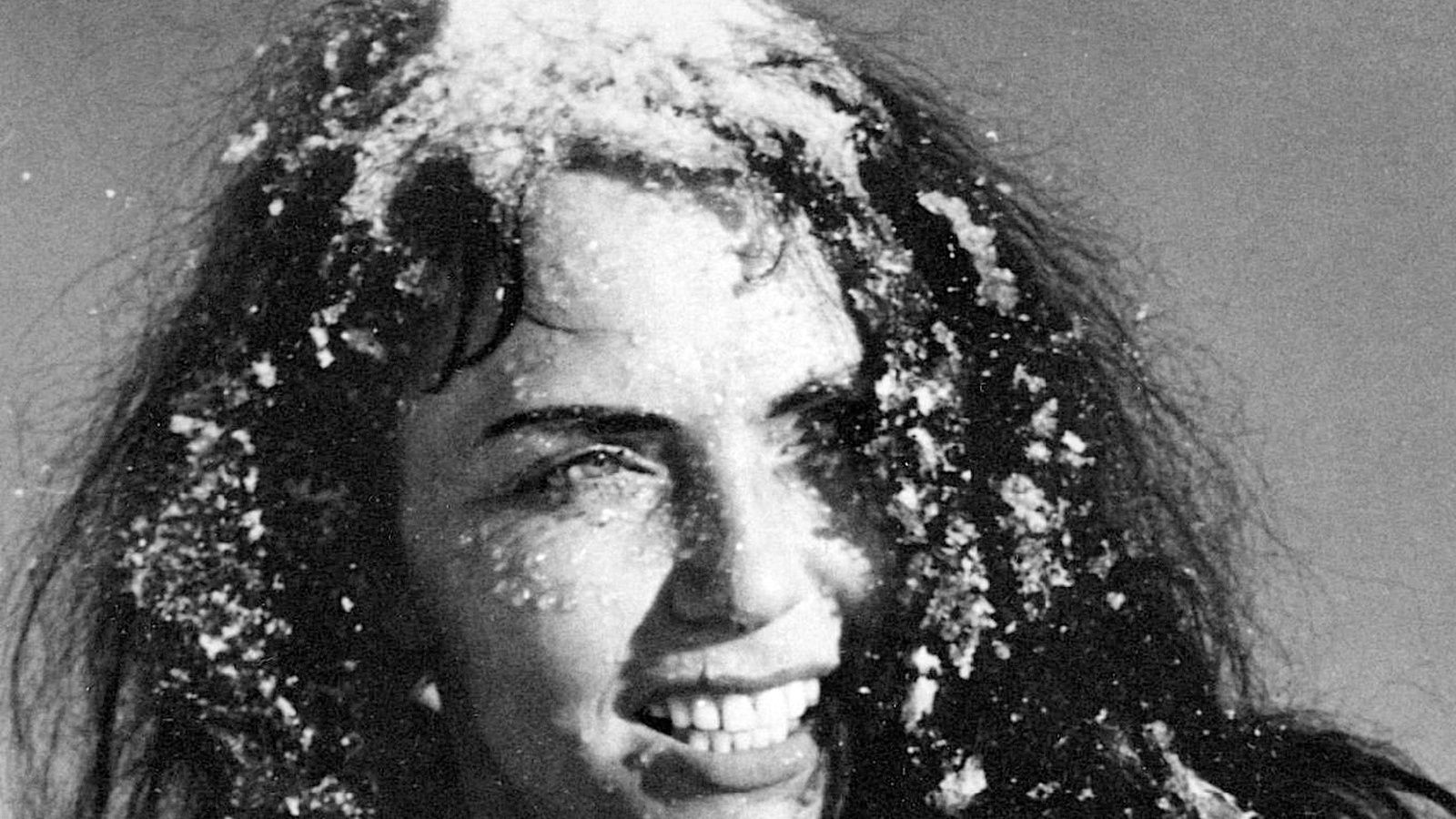
The image above brings the snowfield onto Pirita's body. Snow catches in her dark hair while her face and smile remain unmistakably human. That is crucial: the film does not erase the recognizable woman when it makes her terrifying. It changes the frame around her. White flecks, hard contrast, and recurring snow connect her to the animal landscape; the change in meaning comes from editing and from men who have learned to see quarry.
Snow is not innocence here. It receives the sacrificed calf, hoofprints, pursuit, and blood. It preserves tracks while erasing depth. Its brightness allows daylight to carry the abstraction of a nightmare: violence does not need to hide in darkness when distance itself can prevent recognition. Men see the white reindeer clearly enough to chase it and not clearly enough to understand what they are chasing.
The village forges a single answer
The curse becomes a public crisis through repetition. A herder pursues the reindeer, catches Pirita, and dies. A forester from the south dismisses witchcraft in favor of his rifle, only to return terrified after the weapon fails him. At another wedding, Pirita's power pulls the groom away from the procession. A private request for attention has become a threat to the community's marriages and to the men's confidence that pursuit will end in possession.[1]
The village responds by making its interpretation solid. Men forge spearheads because cold iron is said to kill a witch. The labor is communal, rhythmic, and rational within the story's rules. It turns rumor into a tool. Once the spear exists, ambiguity becomes harder to tolerate: the moving white figure must be quarry, and the person who throws first can become protector.
Pirita, meanwhile, has no stable group. In human form she hides among the hunters; in animal form she flees them. She goes back to Tsalkku-Nilla and finds no remedy, then returns to the sacrificial place and begs to be released. The film gives her awareness without giving her a social language in which awareness could matter. Confession would sound like proof of witchcraft. Silence keeps the hunt moving.
The last pursuit therefore completes more than the plot. Aslak again tries to match Pirita's speed, as he did when they met, but now he has been told that the figure ahead of him is not a partner. The spear lets him reach across the last distance without looking closely. When Pirita reappears in the snow, recognition arrives after action and cannot revise it.
The tragedy is not simply that Aslak was deceived by magic. It is that the community's solution required him to stop seeing relationally. He succeeds as a hunter at the exact moment he fails to recognize the person with whom the chase began.
A magnificent landscape is not an alibi
The film's visual authority needs a boundary. Blomberg's documentary background, the location work, and the attention to clothing, herding, weddings, music, and ritual can make The White Reindeer look ethnographically trustworthy. It is not a neutral record of Sámi life.
Teemu Lahtonen and Anni Teppo note that the film was made by Finnish outsiders, uses Finnish actors and language for nearly all its Sámi characters, combines practices from different Sámi groups into a generalized “Lapland,” and caricatures Tsalkku-Nilla in ways that diminish Sámi religion. They also distinguish Pirita's involuntary, werewolf-like change from traditions in which a noaidi's animal journey is intentional.[4] KAVI's contemporary educational material likewise warns that the film exoticizes, others, and reinforces stereotypes; the filmmakers themselves were not Sámi.[5]
That critique changes the close reading. The snowfield is both a brilliantly organized cinematic space and part of an image of the North prepared for outside consumption. The film is perceptive about the danger of turning Pirita into a category—wife, witch, animal—while it turns culturally distinct people and practices into a composite atmosphere. Visual precision cannot substitute for cultural accuracy.
Keeping both judgments in view is more demanding than either worship or dismissal. The White Reindeer can be a formally exact account of gendered desire and a distorted representation of the culture it uses to tell that account. In fact, its deepest contradiction lies there: a film about fatal misrecognition also participates in misrecognition.
The film reached the 1953 Cannes competition and later received a Golden Globe for foreign-language film, confirming how successfully its image of northern myth traveled abroad.[5][6] Its lasting force, however, is not just exotic snow, vampiric folklore, or an unusual monster. It is the shape made by two pursuits. In the first, Pirita and Aslak move fast enough to see each other. In the last, the whole village gives Aslak a weapon and a name for what is ahead of him. He moves faster—and sees less.
Sources
- Finnish Arts and Culture Agency / Finna, “Valkoinen peura” — official filmography record, inherited from KAVI, with credits, production dates and locations, contemporary reception, awards, and scene-by-scene synopsis.
- Anna-Sofia Lappalainen, “Mirjami Kuosmanen,” Nordic Women in Film / Swedish Film Institute (2020) — Kuosmanen's authorship, character development, screen career, and Blomberg's account of their collaboration.
- James Gracey, “BFI Recommends: The White Reindeer,” British Film Institute (May 13, 2020) — gender reading, documentary background, and folk-horror context.
- Teemu Lahtonen and Anni Teppo, “Lapin noidat ja pohjoisen taika elokuvassa Valkoinen peura,” Lähikuva 2/2020, pp. 61–69 — analysis of Sámi representation, religion, music, transformation, reception, and cultural stereotyping.
- National Audiovisual Institute of Finland, “Valkoinen peura (1952),” Elokuvapolku — production collaboration, image-led planning, gender interpretation, visual style, and a present-day warning about exoticizing Sámi representation.
- Golden Globes, “The White Reindeer” — official record of the film's foreign-language-film award.
- Harto Hänninen, “Valkoinen peura – klassikko noitanaisen kohtalosta,” Yle (December 13, 2016; updated January 19, 2017) — restored-film presentation and source page for the Pirita still credited to Yle Kuvapalvelu.