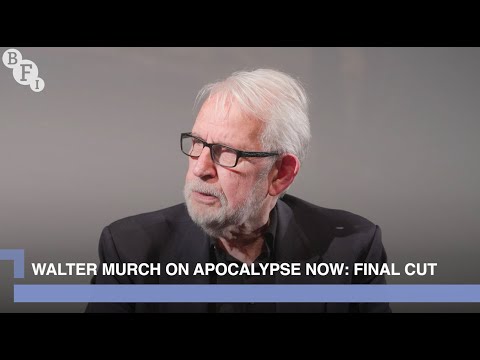
Walter Murch is often introduced through the award ledger: three Oscars, work on The Godfather films, The Conversation, Apocalypse Now, The English Patient, and a long career moving between picture editing, sound design, sound mixing, writing, and teaching.[2] That summary is accurate, but it can make his importance sound like a list of credits. The BFI Q&A on Apocalypse Now: The Final Cut is valuable because it lets the viewer hear a different center of gravity. Murch talks about filmmaking as a problem of attention: what the audience is ready to see, what it should be asked to infer, what sound can prepare before an image arrives, and why a cut is never only a splice.[1]
That makes this a useful annotated viewing rather than a general career profile. The video is tied to one monumental film, Francis Ford Coppola's Apocalypse Now, but its real subject is how editing and sound cooperate before the viewer consciously names either one.[1] Counterpoint's author page rightly identifies Murch as both editor and sound designer, while Silman-James's page for In the Blink of an Eye frames his famous editing book around a deceptively simple question: why do cuts work?[2][3] The BFI conversation gives that question a concrete body. It places Murch in front of a live audience, reflecting on a film whose helicopter sound, river movement, voice-over, music, silence, and hallucinatory cutting all depend on transitions between seeing and hearing.[1]
The viewing lens, then, is not "how did they make a war movie big?" It is "how did Murch make a vast movie legible moment by moment?" Apocalypse Now is famous for excess: jungle heat, production mythology, music, smoke, bodies, darkness, spectacle. Murch's craft is almost the opposite impulse. He keeps asking how much information can be removed, displaced, delayed, or handed to sound so that the viewer participates in constructing the moment. That is why the interview still feels current for editors, sound designers, and ordinary viewers. It turns a prestige restoration Q&A into a practical lesson in how films teach us to watch them.
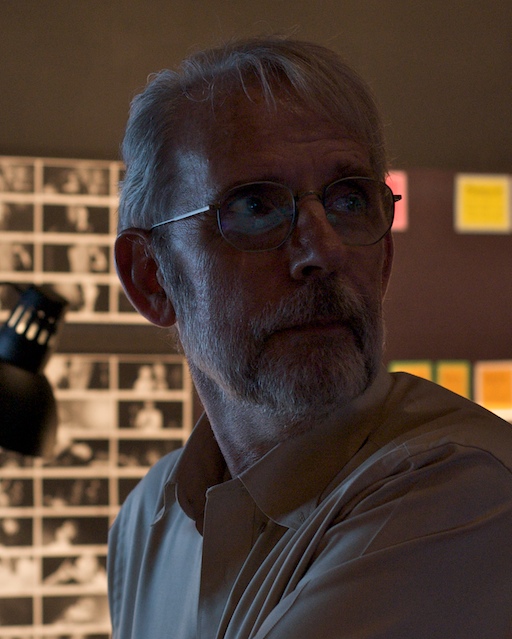
Listen for the editor who thinks in more than pictures
In the opening stretch of the Q&A, watch how the frame of the conversation resists the usual separation between editing and sound.[1] Murch's career makes that separation hard to maintain in the first place. Counterpoint describes him as an Academy Award-winning film editor and sound designer, and that paired identity matters because his films rarely treat sound as polish applied after the picture has already been solved.[2] Sound can lead the image, contradict it, haunt it, or make a cut feel emotionally inevitable before the viewer has noticed the mechanics.
That is the first major annotation for this video: Murch is not simply explaining postproduction. He is describing a way of composing perception. In a film like Apocalypse Now, helicopters are not just vehicles, jungle ambience is not just atmosphere, and silence is not just the absence of noise.[1] Each can act as structure. Sound can make space larger than the frame, make memory intrude into the present, or let a transition happen before the eye catches up. This is why Murch's book on editing remains so influential. Silman-James presents In the Blink of an Eye as a compact essay on aesthetics and practical cutting, but the underlying subject is attention: when does a viewer accept discontinuity as continuity, and when does a cut feel wrong because it violates emotional readiness?[3]
The BFI video is strongest when viewed through that question. Around the early-to-middle portion, do not listen only for anecdotes about Apocalypse Now. Listen for the grammar behind the anecdotes: preparation, delay, rhythm, and release.[1] Murch is interested in the audience's invisible work. A cut succeeds partly because the viewer supplies missing motion, completes an idea, or accepts a leap across time and space. Sound is crucial because it can soften or sharpen that leap. In that sense, editing is not only arranging images. It is designing the conditions under which the viewer's mind agrees to move.
The cut is a moral decision about emphasis
Murch's famous reputation can make his craft sound mystical, but the video keeps returning it to decisions.[1] An editor decides what a scene is really about, what the audience must know now, what can remain latent, and which sensation should dominate at the instant of transition. The phrase "the cut" can sound technical. In practice, it is often a moral decision about emphasis: whose fear matters, which gesture should be trusted, whether a silence should be held long enough to become active, whether the viewer should be oriented or unsettled.
That is especially useful for thinking about Apocalypse Now: The Final Cut. The BFI upload is presented around Coppola's war spectacle, and American Cinematheque's retrospective language likewise treats Apocalypse Now: Final Cut as a place where Murch's masterclass-level contribution to editing and sound can be understood inside a larger six-decade career.[1][4] The word "spectacle" is important, but it is not enough. Spectacle without editing discipline becomes size for its own sake. Murch's contribution is to make scale behave like psychology. The river journey can feel expansive and claustrophobic at once because the film is constantly deciding when to open space, when to crowd it, when to let sound arrive from outside the image, and when to make silence feel like a threat.
The middle of the Q&A is a good place to watch for this habit of emphasis.[1] Murch does not treat postproduction as cleanup. He treats it as the stage where the film discovers how it wants to think. That is also why his career fits awkwardly into narrow job labels. The same person who can discuss a frame boundary can also discuss sonic depth, narrative rhythm, and audience expectation. The roles are distinct in production paperwork, but in the finished experience they meet inside the viewer's nervous system.
Why the "blink" idea still matters
The title In the Blink of an Eye has become familiar enough that it can sound like a slogan, but the idea remains sharp.[3] A blink is physical, emotional, and perceptual. It is a tiny interruption that does not feel like a rupture because the mind expects it. Murch's enduring insight is not that every cut should imitate a literal blink. It is that editing works best when it respects the viewer's inner readiness to shift attention. A bad cut can be technically clean and still feel false. A daring cut can leap across time or space and still feel right if it meets the emotional logic of the moment.
The later portion of the BFI conversation is worth hearing with that in mind.[1] Murch's comments sit at the meeting point between craft history and craft practice. The restoration context matters because Final Cut is not simply a museum object. It is a reminder that films continue to be rebalanced across time: image quality changes, sound presentation changes, audience expectations change, but the fundamental question of attention remains. What should the viewer be allowed to complete? What should the film withhold? What should sound know before the image admits it?
This is where Murch's dual practice becomes a durable lesson. Many viewers notice editing only when it is fast, and notice sound only when it is loud. Murch's work asks for a better vocabulary. Editing can be quiet and still decisive. Sound can be low and still architectural. Silence can be designed. A cut can be a form of listening. The BFI Q&A matters because it gives these principles a human cadence: not a list of rules, but an experienced maker thinking aloud about how films guide attention through uncertainty.[1]
That is the best reason to watch the video even if one already knows the credits. The award record tells us Murch was important.[2] The book record tells us he changed how editors talk about their craft.[3] The BFI conversation shows why: he keeps returning the machinery of cinema to the viewer's lived act of perception. In his hands, editing feels like listening with your eyes because sight is never working alone. The cut arrives when the ear, the eye, the body, and the story are finally ready to move together.
Sources
- BFI, "Walter Murch on Apocalypse Now: The Final Cut | BFI Q&A," YouTube video.
- Counterpoint Press, "Walter Murch" - author biography and career summary.
- Silman-James Press, "In the Blink of an Eye, 2nd Edition" - publisher page for Murch's editing book.
- American Cinematheque, "Walter Murch: An American Cinematheque Retrospective" - program note on Murch's multi-role career and Apocalypse Now: Final Cut masterclass context.
- Wikimedia Commons, "File:Walter Murch 2008 (cropped).jpg" - Beatrice Murch photograph used as the article image.