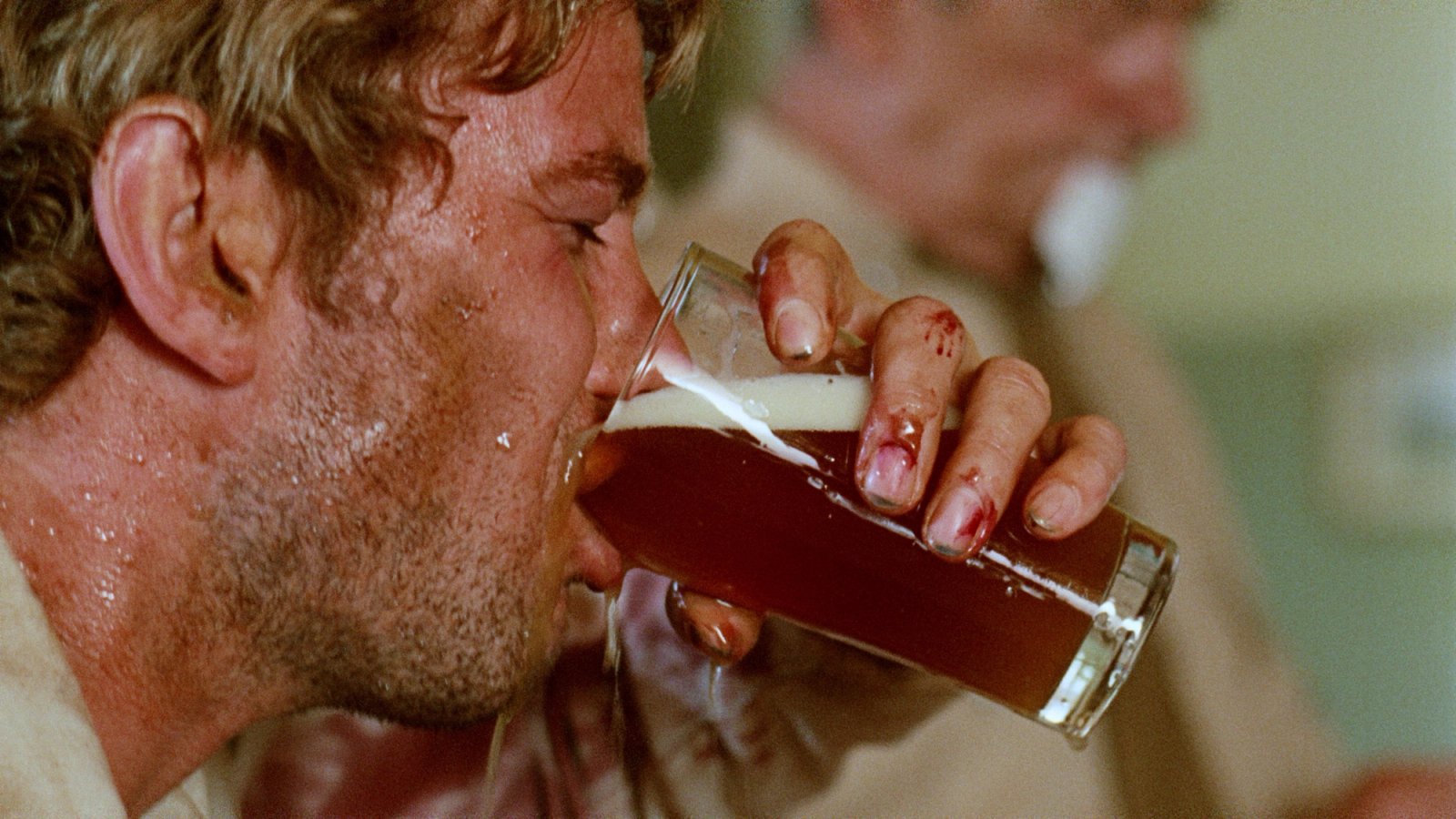
The label “4K restoration” promises an unusually clear view of a film's past. Wake in Fright makes that promise complicated. When Umbrella Entertainment announced a fresh restoration in May 2024, the Australian classic had already returned to cinemas in 2009 through work that also began with a 4K scan. The later project reopened a question that pixel dimensions could not settle: what colour should this film's heat be?[1][2]
Ted Kotcheff's 1971 film strands schoolteacher John Grant, played by Gary Bond, in the mining town of Bundayabba. Drinking and a disastrous game of two-up interrupt his journey to Sydney; the town's sociability becomes increasingly difficult to escape.[3] That premise gives the restoration's choices unusual force. The landscape and rooms have to exert pressure. A viewer's sense of that pressure depends partly on how the photographed world reaches the screen.
Getting the right material back
The recovery was less tidy than the familiar story of a lost masterpiece rescued from a bin. Peter Galvin's NFSA account records surviving television copies and worn prints. A shipment received in 2003 consisted largely of damaged television cutdowns. Editor Anthony Buckley's continued pursuit eventually brought the original picture and sound elements to the National Film and Sound Archive in September 2004.[2] Finding material with the right title had proved insufficient; the archive needed the components from which a dependable version could be made.
For the restoration released in 2009, fading and scratches defeated the initial photochemical approach. Atlab/Deluxe scanned original elements at 4K, retained the digital images as logarithmic DPX files, and performed repairs frame by frame. Soundfirm assembled the soundtrack from selected surviving components. The project also produced new prints and a safety interpositive master.[2] Its digital work therefore led back to physical film as well as to renewed exhibition. “Digital restoration” describes a set of operations, not the disappearance of celluloid from the process.
A successful return could still be revisited
Cannes presented the restored film in its Classics programme in 2009. The festival record identifies the original production year as 1971 and credits Buckley as editor and Brian West as cinematographer.[3] That separation of dates matters: the work returning to the screen carried both a production history and a new history of intervention. A restoration credit belongs beside the film's original credits because it helps identify the particular images an audience is encountering.
The NFSA's catalogue description of its restoration trailer emphasizes gains in sharpness and colour, made visible through a split-screen comparison. It also notes the use of John Scott's original score.[4] The presentation makes a persuasive case for repair: differences can be inspected within the same frame instead of recalled from an old screening. But such a comparison has a specific reach. It can demonstrate changes relative to the material selected for comparison; it cannot, by itself, certify every choice as the film's definitive appearance.
The later grade made a different case
Umbrella's 2024 announcement describes a new scan of the original camera negative, colour correction and stabilization shot by shot, and months of cleanup. Filmmaker Mark Hartley supervised the restoration, with Charlie Ellis credited as colourist.[1] These are consequential stages of work. Scanning supplies the image information on which later decisions operate. The grade determines how that information becomes a visible relationship between colours and brightness. A resolution label does not describe those decisions.
In the written description accompanying its official restoration comparison, Umbrella goes further. It says the 2009 grade had green and yellow hues that did not correspond to surviving release prints, and presents the new grade as a return to a more earthy palette. It connects that decision to Kotcheff's intention to make the heat palpable.[5] This is the later restoration team's stated rationale. It should remain attributed to that team, rather than quietly becoming an independent verdict that all questions of fidelity have been resolved.
The distinction changes what “better” can mean. More stable images and repaired damage are assessable improvements of one kind. A claim about the intended colour requires historical references as well as technical control. A release print and a filmmaker's recollection offer different kinds of evidence; neither is simply a setting on a scanner. Here, the revealing comparison is between the two teams' accounts of their work, not between the digits on their restoration labels.
Keep the versions available
Scholar Zachary Karpinellison supplies a useful way to think about this problem. His 2023 study of Wake in Fright argues for a relationship between analogue and digital versions in which both can persist, rather than a hierarchy that automatically makes the older version obsolete.[6] The paper predates Umbrella's restoration. Its value here is the framework it offers for comparing editions, not an assessment of the later grade.
Applied to this case, that framework suggests a practical editorial standard: name the restoration being discussed and preserve the evidence needed to question it. “The restored film” is too vague when an argument turns on colour. Equally, keeping an earlier edition accessible need not imply rejecting subsequent work. It makes the history of decisions legible. Viewers and researchers can ask what changed, which references supported the change, and what the new presentation makes easier or harder to see.
Wake in Fright survived well enough to be reconsidered. That is an achievement larger than the success of any single edition. The negative enabled another scan; the surviving prints supplied points of comparison; the earlier restoration became part of the record against which later choices could be explained.[1][5] The film's return to the outback sun remains an act of interpretation, carried out through materials that must stay available after the premiere applause ends.
Sources
- Umbrella Entertainment, “Umbrella Entertainment announces restoration of new wave landmark WAKE IN FRIGHT,” 17 May 2024 — new scan, restoration credits and the official still reproduced here.
- Peter Galvin, “Wake in Fright: 2009 restoration and re-release.” National Film and Sound Archive of Australia, 24 June 2021 — recovery chronology, 4K scanning, image and sound restoration, and preservation outputs.
- Festival de Cannes, “Wake in Fright.” Cannes Classics, 2009 — synopsis, production year, original credits and restored-film selection.
- Stephen Groenewegen, catalogue notes for “Wake in Fright restoration trailer.” National Film and Sound Archive of Australia, trailer dated 2008 — the comparison presentation for the restoration released in 2009.
- Umbrella Entertainment, “Wake in Fright | 2024 Restoration Comparison,” 16 May 2024 — official video's written description of scanning, grading, surviving release prints and colour intentions; cited without an embed.
- Zachary Karpinellison, “Digital restoration and the invention of analogue: The National Film and Sound Archive of Australia and Wake in Fright.” Studies in Communication Sciences 23(3), 2023, pp. 321–330 — coexistence and comparison of analogue and digital versions.