In Yaaba (1989), a boy calls an elderly outcast his grandmother. The village regards her as a witch; Bila gives her a place in his family vocabulary. She is not his relative.[1] It is a small act of naming with large consequences for how we watch. A person the community has already explained becomes someone the child still wants to know.
That gap between a public judgment and a private encounter runs through the films of Idrissa Ouédraogo. His villages contain affection, jokes, loyalties and dangerous certainties. To live among other people is to need their recognition, sometimes desperately. It is also to discover how little their verdict may resemble your life. This tension connects his stories of children, forbidden lovers and a man trying to come home with a crime behind him.
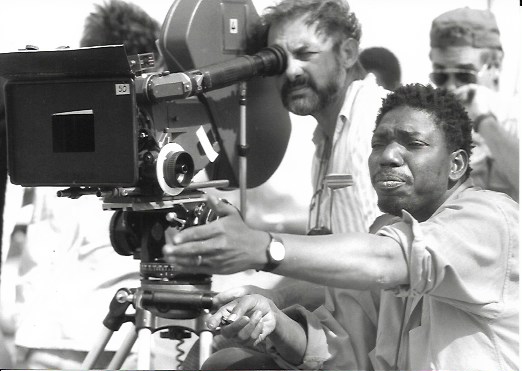
The filmmaker behind the apparent simplicity
Born in Burkina Faso in 1954, Ouédraogo trained in Ouagadougou, studied in Kyiv and graduated from Paris's IDHEC film school in 1985. His career would encompass features, shorts and the television series Kadi Jolie; he died in Ouagadougou in 2018.[3] Rural settings were one part of a practice formed across institutions, countries and formats.
He could be an energetic organizer of that practice. Producer Silvia Voser recalled meeting him at Cannes around the presentation of Yaaba. He persuaded her to produce his next film despite her lack of producing experience. She remembered his determination to reach the festival's competition the following year.[2] Tilaï did so, sharing the 1990 Grand Prix.[4] The calm surfaces of his films were being made by someone who understood the urgency of finding money, collaborators and an opening.
Critic Aboubakar Sanogo describes the early work through long takes, depth of field and carefully arranged movement, alongside medium shots and close-ups that give faces their emotional weight. He also traces a change toward tighter framing and faster rhythms in the 1990s.[5] There is no single tempo that explains the whole career. What persists is a concern with how people occupy a shared world: who can approach, who must withdraw, who is allowed to return.
A child changes the terms
Yaaba, filmed in Mooré, grew out of stories Ouédraogo remembered hearing in childhood. Its central friendship joins Bila and his cousin Nopoko with the woman their neighbours reject.[1] The premise gives the children something more interesting than innocence. They can form a relationship before accepting the explanation supplied by adults.
The word “grandmother” offers an alternative to the label “witch.” One makes a claim of closeness; the other makes distance seem necessary. Read this way, the film's tenderness has an argumentative force. Bila does not need to win a public debate before he can address the woman differently. His behaviour creates a small disagreement that the village's certainty cannot entirely absorb.
This is also a useful way into Ouédraogo's treatment of landscape. Sanogo emphasizes how long shots and duration situate people within space and time.[5] Such framing allows a social relationship to have visible distances. A community can be geographically close while keeping one person far outside its sympathies. The beautiful setting does not settle whether the life within it is generous.
Coming home can make you an outsider
Tilaï sharpens that problem through desire. Saga returns after an absence to discover that his father has married Nogma, the woman he had expected to marry. Saga and Nogma still want each other. The film's title refers to the binding code of conduct they defy.[6] Here, familiarity intensifies exclusion: the people who know Saga are the people whose rules make his love intolerable.
The dramatic trap depends on incompatible relationships occupying the same household. Nogma's new position changes what Saga is permitted to feel and do, but it has not erased their attachment. Ouédraogo gives that contradiction bodies and names. The viewer has to consider what obedience would require of these particular people. A rule that sounds settled in the abstract becomes painful when somebody must live it.
Sanogo identifies a western influence in Tilaï's opening.[5] The comparison directs attention to its dramatic construction: a return, a changed order, an intimate conflict made public. The setting gives this story its particular pressures; it cannot make one village stand for a continent.
Samba Traoré (1992) complicates our sympathy further. Following a robbery in which his accomplice dies, Samba returns to his village and builds a life with Saratou and her son. His past threatens the happiness he is trying to establish.[7] The homecoming carries a secret rather than an openly forbidden attachment.
That difference matters. If every outsider were simply right and every community wrong, Ouédraogo's recurring conflict would become a formula. Samba asks a harder question: how should we regard someone's capacity for tenderness when it coexists with wrongdoing? Domestic happiness can be real without cancelling what preceded it. The village offers him a future, but neither he nor the viewer can make the past disappear by crossing its boundary.
Who gets to see the films?
Ouédraogo's concern with audiences was practical. In a 2003 interview with Olivier Barlet, he identified distribution as a central obstacle: filmmakers could continue working while the people they hoped to reach never saw the results. Satellite television brought foreign images into homes; theatres were expensive; video and digital tools offered other possibilities. He also described the frustration of waiting years for feature funding.[8]
These remarks give his television work a place in the profile beyond an appendix to festival success. Recognition abroad did not answer the problem of access at home. A career concerned with ordinary lives also had to reckon with where ordinary viewers could encounter it. His interest in smaller tools belonged to that unfinished effort.[3][8]
In Yaaba, a child makes room for someone by changing how he addresses her. Across Ouédraogo's career, the invitation becomes more demanding. The lover may be condemned; the returning neighbour may be guilty. Each still has a life that exceeds the first explanation offered about them. His films ask us to stay long enough for that life to complicate our judgment.
Sources
- African Film Festival, Inc., “Yaaba” — film details, the children's friendship and Ouédraogo's account of its storytelling origins.
- Oyku Sofuoglu, “Swiss co-produced African masterpiece ‘Tilaï’ revived in Cannes.” SWI swissinfo.ch, 11 June 2026 — Silvia Voser's production recollections and Waka Films' photograph of Ouédraogo with Jean Monsigny.
- African Film Festival, Inc., “Idrissa Ouédraogo” — training, career, television work and biography.
- Festival de Cannes, “Idrissa OUEDRAOGO” — official competition history and the shared 1990 Grand Prix for Tilaï.
- Aboubakar Sanogo, “Idrissa Ouédraogo obituary: Burkinabe master who merged the political and the poetic.” Sight and Sound, updated 15 March 2018 — framing, duration, genre and the development of his cinematic language.
- Festival de Cannes / Cinéma de Demain, “Tilaï” — the 1990 film's synopsis, title, credits and 2026 restoration presentation.
- African Film Festival, Inc., “Samba Traoré” — the 1992 film's homecoming, robbery and family relationships.
- Olivier Barlet, “Working closer to the people.” Interview with Idrissa Ouédraogo, African Film Festival, Inc., 1 January 2003 — distribution, funding and the possibilities of video and digital cinema.