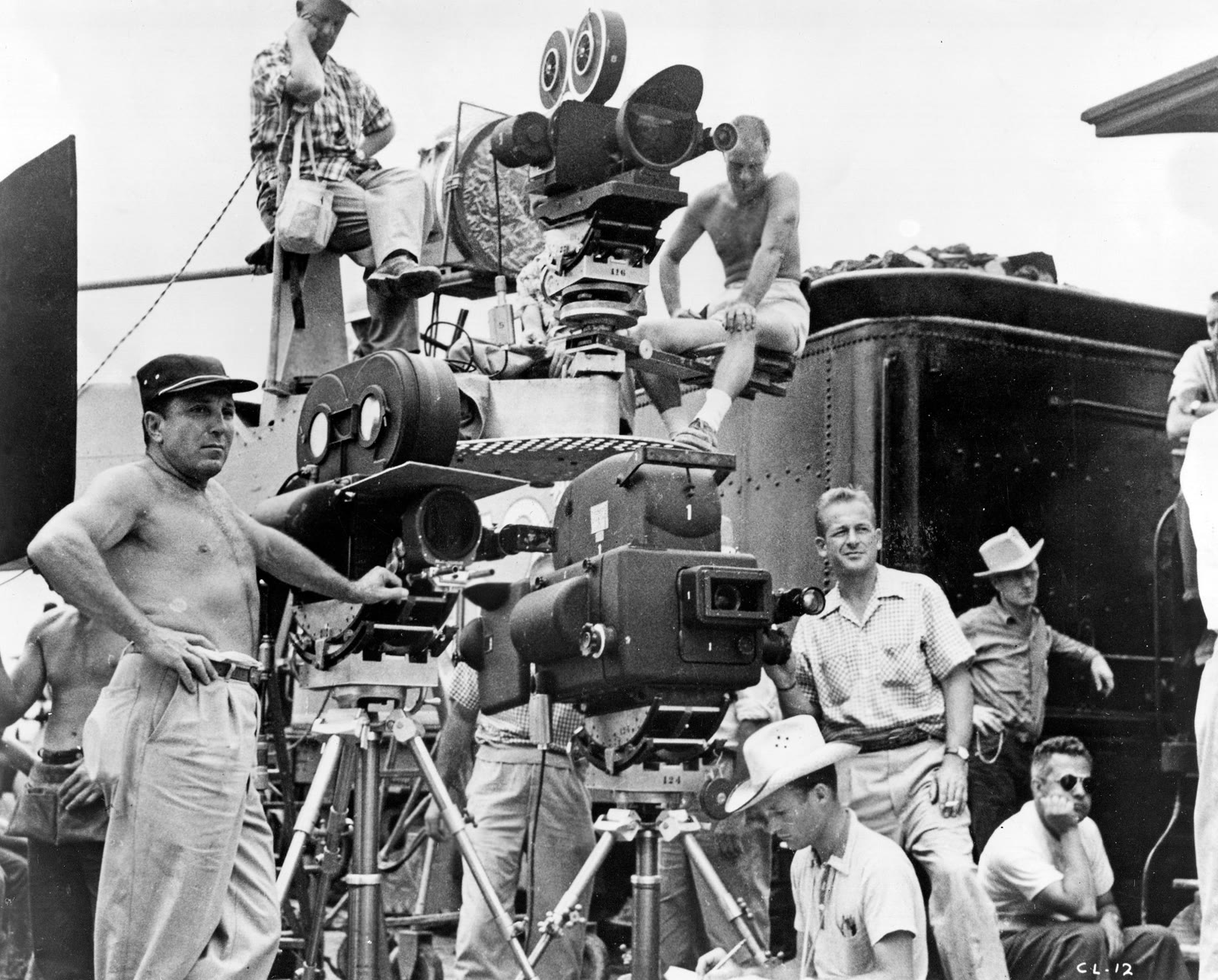
Todd-AO is best remembered as a 70mm luxury format, but that description starts in the middle of the story. Its real ambition was more specific and more revealing: it wanted to deliver the enveloping force of Cinerama without Cinerama's three-camera, three-projector operating burden. In the 1950s, when television was making the ordinary theater feel small, that was not just a technical dream. It was an industrial promise. Make the screen vast, keep the image sharp, surround the audience with magnetic sound, and do it through one strip of film and one projector.[1][2]
That promise explains why Oklahoma! became such a strange and useful test case. The 1943 stage musical was already a prestige property, and AFI's catalog records how carefully Rodgers and Hammerstein had guarded it before agreeing to the film version. The selling point was not simply that cinema could record a hit show. It was that Todd-AO might give the story the outdoor scope the producers believed it needed.[3] The format therefore had to prove two things at once: that it could make a musical feel newly cinematic, and that it could give exhibitors a roadshow event strong enough to pull audiences away from the living room.
The lead photograph matters because it makes the compromise visible. Surtees is perched high above the action with the 65mm Todd-AO camera, while the other cameras below capture the same scene in 24fps CinemaScope for the wider 35mm release path.[1] This is not a pure-format fairy tale. It is a picture of technological ambition negotiating with distribution reality.
The format was a one-projector answer to a three-projector problem
Cinerama had already proved that viewers would respond to immersion, but it was operationally awkward: multiple synchronized strips, a deeply curved screen, and a presentation system too specialized to become ordinary theater practice. Todd-AO attacked that bottleneck by widening the negative instead of multiplying the camera. SMPTE's abstract of John Belton's technical history summarizes the package: 65mm camera film, specially designed wide-angle lenses, six-track stereo magnetic sound, and 70mm projection prints, first used for Oklahoma! in 1955.[2]
The difference between 65mm capture and 70mm projection was not trivia. The extra projection width made room for magnetic sound tracks, letting the image and audio sell the same claim of theatrical abundance.[2][3] AFI notes that Todd-AO used one-strip 65mm negative film, a single wide-angle camera, and one projector, with the final 70mm print carrying six sound tracks.[3] That combination is the core of the format's intelligence. It wanted to be spectacular without being a booth nightmare.
The wide-angle optics were central to the pitch. Todd-AO's "bug-eye" lens, developed through American Optical under Brian O'Brien's leadership, was meant to push spectators into the scene rather than simply enlarge a conventional frame.[3] In practical terms, the system was using image area, lens design, frame rate, screen curvature, and sound as one experience machine. The camera did not merely record bigger pictures. It tried to change the audience's bodily relation to the screen.
Thirty frames per second was the beautiful problem
The original Todd-AO specification ran at 30 frames per second, a quarter faster than the 24fps standard that organized normal theatrical release.[1][4][5] That choice is easy to admire. A faster frame rate could make motion steadier and large-screen movement feel less juddery. On a huge curved screen, that mattered: the format was asking viewers to scan more image area, accept stronger peripheral sensation, and treat the screen less like a flat window than a surrounding field.
But the same choice also created the format's most immediate commercial headache. A 30fps negative did not fit the 24fps reduction-print economy cleanly. AFI records that Oklahoma! was ultimately released in Todd-AO, CinemaScope, and standard 35mm prints because relatively few theaters could afford the special projectors and curved-screen retrofit.[3] The ASC article's production photograph makes the workaround concrete: simultaneous camera coverage was used so the film could exist as a premium Todd-AO event and as a broader CinemaScope release.[1]
That is the key industrial lesson. A premium format can be artistically superior and still need a fallback lane. Oklahoma! did not fail the format by being shot twice. It exposed the format's dependency chain. Large-format cinema needed camera equipment, projection equipment, screen renovation, sound reproduction, lab support, distribution planning, and enough premium venues to make the roadshow economics work.
The roadshow was part of the technology
Todd-AO was not only a capture system. It was an exhibition regime. AFI's catalog notes that approximately forty American theaters were renovated for the larger curved screen needed for Todd-AO, and that New York's Rivoli Theatre became a flagship venue with a deeply curved screen whose arc was longer than its chord.[3] Tickets for the Rivoli engagements ranged from $1.75 to $3.50, high enough to mark the presentation as an event rather than routine moviegoing.[3]
That pricing and renovation context matters because it prevents a narrow camera-history reading. The format's promise lived at the end of the chain, in the room. A 65mm negative alone did not sell Todd-AO. The sellable object was a controlled encounter: huge screen, stable high-resolution image, enveloping sound, reserved-seat roadshow tempo, and the feeling that the auditorium had been rebuilt for the movie.
The restoration history of Oklahoma! confirms how much the frame rate and format remained part of the film's identity decades later. In70mm's restoration account describes the 2014 4K digital restoration being prepared at the original 30fps rate, emphasizing that Oklahoma! and Around the World in Eighty Days were the two Todd-AO titles shot at that high frame rate.[4] A normal restoration could simply chase cleanliness. This one had to preserve a historically unusual motion signature.
The system won influence without becoming the whole future
Todd-AO's cleanest achievement was that it helped establish 65/70mm as a durable prestige grammar even after the original 30fps version proved hard to generalize. SMPTE's summary says the success of Oklahoma! and a handful of later Todd-AO films helped introduce and establish 70mm as a major theatrical presentation format.[2] Belton's in70mm essay frames the heyday of Todd-AO from 1955 to 1965, while also noting the cost pressure of 70mm magnetic prints compared with cheaper 35mm prints.[5]
That mixed legacy is more interesting than a simple success-or-failure verdict. Todd-AO did not become everyday cinema. It was too expensive, too venue-dependent, and too tied to roadshow logic for that. But it clarified what premium theatrical scale could mean after Cinerama: one strip, one projector, 65mm capture, 70mm presentation, six-track sound, and a screen treated as architecture rather than neutral surface.[2][3][5]
It also left behind a useful warning. The history of movie technology is full of formats that looked better than the systems they were supposed to replace. Looking better is not enough. A format has to travel through labs, release prints, projection booths, exhibitor budgets, marketing language, and audience habits. Todd-AO's original 30fps beauty was inseparable from the fact that the industry still needed 24fps and 35mm pathways to reach most screens.[1][3][4]
That is why Todd-AO remains such a strong industry story. It tried to make Cinerama come from one projector, and in doing so it made large-format cinema more practical without making it cheap. Its influence survives not because every theater became a Todd-AO house, but because later premium formats kept returning to the same bargain: if the theater is going to matter, the whole chain has to make scale feel physical.
Sources
- American Society of Cinematographers, "Scale and Spectacle: AC In the 1950s" (2026; widescreen-industry context and source page for the Oklahoma! Todd-AO production photograph).
- John Belton, "Todd-AO: A History," SMPTE Journal 99, no. 6 (1990; abstract on 65mm camera film, wide-angle lenses, six-track magnetic sound, and corrected printing).
- AFI Catalog, "Oklahoma!" (1955; production, Todd-AO process, one-strip 65mm negative, six-track 70mm prints, dual-format release, theater retrofits, and roadshow details).
- Bryant Frazer, "Restoring 70mm Movie Musical Oklahoma! for a New DCP - at 30fps," in70mm.com reprint of StudioDaily article (2014; restoration and 30fps Todd-AO context).
- John Belton, "Todd-AO: The Show of Shows," in70mm.com (1998; Todd-AO business history, heyday, and 70mm print-cost context).