Spoiler note: this essay discusses the film's ending.
Robert Wise's The Set-Up is only seventy-two minutes long, but it feels heavier than many longer boxing pictures because it refuses the usual sports-movie luxury of time. There is no training montage, no rise through the ranks, no sentimental promise that pain is automatically character. The film begins near fight time and stays there. Stoker Thompson, played by Robert Ryan, is an aging club boxer who still believes one clean win can change his trajectory, while his manager has quietly sold the night to local criminals who expect him to lose.[1][5]
The craft miracle is that Wise turns that narrow premise into a whole social environment. AFI notes the unusual production design of the film's time scheme: narrative time and screen time are effectively the same, and the picture uses no composed musical score outside music heard inside the scenes.[1] Those two choices make the film feel almost cruelly present-tense. Nothing can be softened by later reflection or lifted by orchestral sympathy. We wait with the boxers, hear the arena's ordinary noise, and watch the clock grind toward a fight that everyone around Stoker thinks has already been decided.
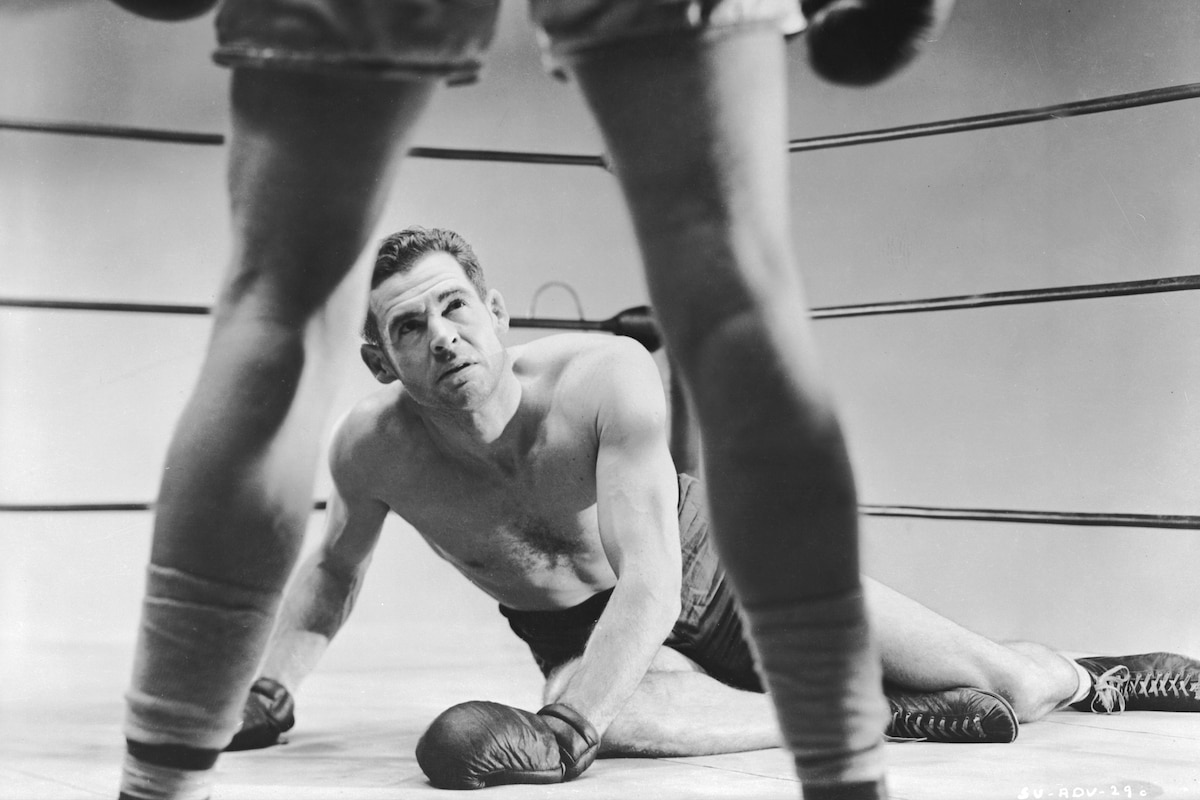
The cover still catches the method in one image. Stoker is on the canvas, framed from below through another fighter's legs, with the ropes flattening the ring into horizontal bars.[6] The shot is not just a good fight photograph. It is the film's grammar. Wise keeps converting the ring into a trap of angles: canvas, legs, ropes, corner stools, referee movement, crowd sightlines. A boxing match should be a contest between two bodies. In The Set-Up, it becomes a room where everyone has bought a different version of the outcome.
Real time removes the escape hatch
Real-time structure can be a gimmick when it exists only to show off. Here it changes the moral pressure of the film. Because the story moves almost minute by minute, Stoker's optimism cannot be dismissed as background delusion. We have to inhabit it while the people around him treat it as either bad math or bad business.[1][5] His wife Julie cannot bear to watch another beating. His handlers have decided he is not worth informing about the fix. The gamblers and spectators want impact, not dignity.
That makes the film's suspense unusually plain. The question is not whether Stoker has hidden greatness. The question is whether his belief in himself can survive a world that has already priced him as disposable. Britannica's capsule is useful because it identifies the film's central force as a gritty indictment of crime's influence in boxing, and its real-time unfolding is what keeps that indictment from becoming abstract.[5] Corruption here is not a distant underworld system. It is a message not delivered, a towel not thrown, a price agreed before the bell.
The lack of nondiegetic score sharpens the same problem.[1] Without music telling us when to feel uplifted, the arena sounds become the film's emotional weather: crowd chatter, bell strikes, footsteps, corner talk, blows, cheap entertainment bleeding through the building. Stoker's hope has to compete with actual room noise. That is a harsher test than melodrama usually permits.
The crowd is not background
Wise's arena does not work like a neutral venue. It behaves like a public appetite. Turner Classic Movies' production account says Wise researched small fight arenas in person, watching dressing rooms, handlers, managers, and local fight-night behavior before shooting.[2] That fieldwork shows in the way The Set-Up keeps cutting away from the ring without losing the fight. The crowd is full of miniatures: people who want blood, people who bet casually, people who need the action described, people who talk through pain as if it were weather.
Those cutaways matter because they prevent the fight from becoming a pure athletic duel. Every spectator supplies a different use for Stoker's body. Some need excitement. Some need a payout. Some need the comfort of judging someone else's damage from a seat. The ring is therefore public before it is heroic. Stoker is not performing in a mythic void. He is working in front of consumers.
That is one reason the film's noir quality feels so lean. It does not require Venetian blinds, nightclub glamour, or elaborate criminal plotting. The arena is enough. Money, boredom, masculinity, exhaustion, and humiliation all circulate openly. Wise's later reputation often rests on larger productions, but Senses of Cinema notes that The Set-Up was a key early work in his method, including the use of storyboards to pre-plan the film's visual construction.[4] The discipline is visible everywhere. The movie feels loose and sweaty because the world is loose and sweaty; the construction underneath is tight.
The fight is edited as labor, not spectacle
TCM's account of the fight sequence gives the most concrete craft detail: former professional fighter Johnny Indrisano choreographed the match, and Wise used three cameras during filming, including coverage for wide action, the fighters, and close details such as sweat.[2] That explains why the fight feels both readable and dangerous. The geography stays clear enough that we understand where bodies are in the ring, but the close views keep interrupting any comfortable distance.
The editing is the decisive layer. TCM reports that Wise, who had begun as an editor and worked on major Orson Welles productions, was dissatisfied with an initial cut of the fight and edited that sequence himself.[2] That background matters because The Set-Up never cuts like a director simply collecting violence. It cuts like someone who understands rhythm as consequence. A punch is not only impact. It is setup, recoil, crowd response, corner memory, fear, and renewed calculation.
The film's best fight passages are not fast in a modern action sense. They are exact. Wise lets a body take too long to rise, lets a glance across the ring last long enough to become dread, lets a cutaway to the crowd feel indecent because the spectator is enjoying what Stoker has to survive. The result is a boxing sequence that feels like work being performed under hostile management. Stoker is not merely fighting an opponent. He is fighting the clock, the fix, age, debt, and the social agreement that a man like him should know when to disappear.
The source problem cannot be ignored
One hard boundary sits underneath the film's achievement. AFI records that Joseph Moncure March's original narrative poem centered on a Black boxer, that James Edwards was reportedly first slated to star, and that Robert Ryan ultimately played Stoker while Edwards appears in the film as Luther Hawkins.[1] That history complicates the film's realism. Wise and Cohn made a tough, beautifully controlled boxing noir, but the adaptation also moved the story away from the racial premise of its source.
That does not cancel the craft. It changes what responsible admiration has to include. The film is ruthless about how the fight business uses men, but it is less able to face the full racial structure embedded in the poem's original design.[1] In the finished movie, Edwards' presence in the locker-room world becomes a reminder of an alternate center of gravity. The film's body politics are powerful; they are also historically narrowed.
This is why The Set-Up is strongest when read as both a masterclass and a compromise. The real-time structure makes exploitation immediate. The casting history shows that exploitation had already been softened at the adaptation level. A high-quality reading has to hold both facts at once.
Pride is not victory
The ending is brutal because it refuses triumph without refusing dignity. Stoker does not become a champion. He wins the wrong fight for the wrong people and is punished for violating the arrangement made over his head. The damage to his hand makes the future plain. The sport has not been redeemed by his courage. If anything, his courage has revealed how little the system values it.[1][5]
That is why the Cannes record feels fitting rather than ornamental. The festival page lists Wise's The Set-Up in competition history, and the film won recognition for Milton Krasner's cinematography and the FIPRESCI prize for Wise.[3] The praise makes sense because the movie's artistry is inseparable from its compression. Krasner's black-and-white images do not glamorize the arena. They make sweat, smoke, cheap lights, ropes, and faces into a pressure grid. Wise's direction then keeps that grid closing in until Stoker's pride is the only thing not already owned by someone else.
The last emotional turn between Stoker and Julie works because it does not pretend love has fixed the machine. It only says that someone has seen him whole after the machine tried to reduce him to a losing ticket. That is the film's severe grace. In The Set-Up, real time does not create documentary neutrality. It creates accountability. Every minute asks who is watching, who is profiting, who is pretending not to know, and who still has to climb off the canvas.
Sources
- AFI Catalog, "The Set-Up (1949)" - production history, credits, source-poem context, real-time structure, lack of composed score, and casting background.
- Paul Tatara, "The Set-Up." Turner Classic Movies, February 27, 2004 - Wise's arena research, Art Cohn's boxing background, fight choreography, three-camera shooting, and editing account.
- Festival de Cannes, "The Set Up" - Cannes record for Robert Wise's 1949 film and festival recognition.
- Senses of Cinema, "Wise, Robert" - director profile noting The Set-Up in Wise's development and storyboard-based planning.
- Encyclopaedia Britannica, "The Set-Up" - overview of the 1949 film noir, boxing-crime premise, cast, and real-time reputation.
- Turner Classic Movies, static archival still for The Set-Up used as the article image.