The easiest way to flatten Nanook of the North is to choose one verdict too quickly. Treat it only as a landmark and the film becomes innocent prehistory: a brave 1922 expedition picture that helped invent feature documentary. Treat it only as deception and it becomes a cautionary tale with no remaining formal intelligence. The harder, more useful reading is that both claims belong together. Robert Flaherty's film made documentary cinema legible to mass audiences by turning Arctic life into scenes, gestures, suspense, comedy, and family intimacy; it also fixed those scenes through choices that now sit at the center of documentary ethics: reenactment, exotic framing, omitted modernity, unequal authorship, and the camera's power to make performance look like evidence.[1][2][3]
That contradiction is why a genre-context reading still matters. Nanook was not made after documentary had settled its rulebook. It helped create the appetite that later demanded one. The Flaherty organization frames the film's centennial through that double inheritance: the movie's historical importance is inseparable from later arguments over representation and collaboration.[1] The Library of Congress preservation essay likewise treats the film as both a milestone and a problem, noting its place in film history while foregrounding the constructed nature of scenes often received as direct record.[2] In other words, the question is not whether Nanook is "real." The sharper question is how early documentary learned to make reality watchable, and what debts that lesson left behind.
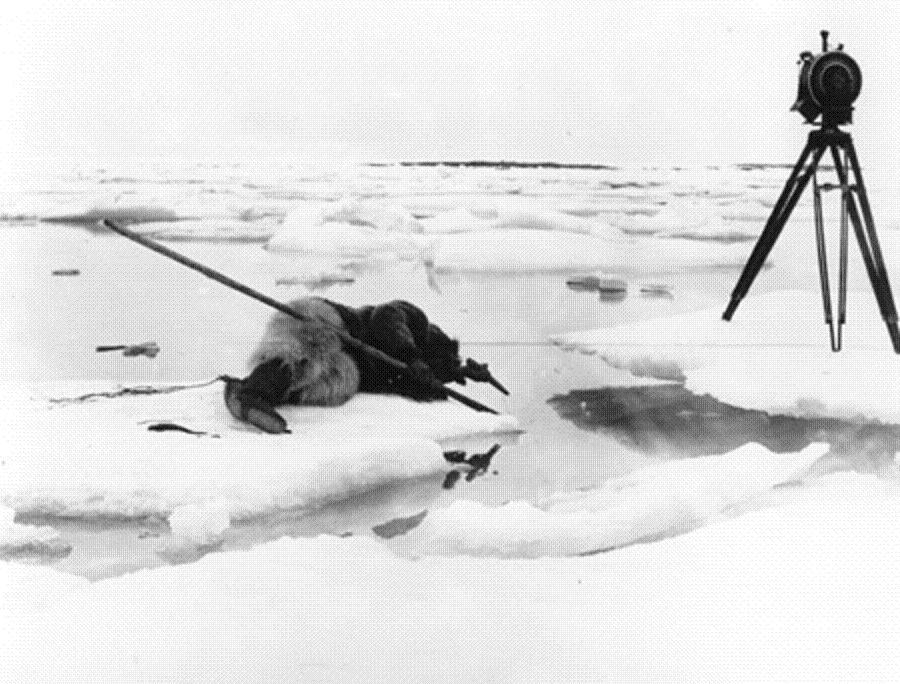
Image context: the cover is a real 1922 production photograph from Wikimedia Commons showing Flaherty's filming process, not a poster, diagram, chart, or generated visual.[6] It belongs here because this essay is about the camera's presence inside the film's claim to truth. The photograph makes the apparatus visible where the finished movie often asks viewers to feel only immediacy.
The film turns survival into sequence
Part of Nanook's durability comes from how clearly it organizes experience. The film does not ask viewers to absorb an abstract ethnographic lecture. It builds a chain of actions: travel, trade, hunting, shelter, family movement, weather, dogs, ice, hunger, and sleep.[2][4] Those actions give the audience a practical grammar. A kayak opens; bodies emerge; a seal hunt becomes suspense; an igloo is built before our eyes; a family group turns the harshness of environment into a set of routines. The film's power lies in this conversion of daily skill into narrative rhythm.
That conversion is not neutral. Flaherty repeatedly favors legibility over social complexity. The camera likes tasks that can be understood without much language: pulling, cutting, laughing, chewing, building, running, waiting. TCM's historical note emphasizes the film's popular impact and Flaherty's role in shaping nonfiction feature filmmaking, but that popularity came from a very specific formal choice.[4] The Arctic becomes readable because the film selects actions that play well as silent-cinema spectacle. Survival is made cinematic by becoming episodic.
The result is neither simple fraud nor transparent document. It is staged clarity. The film shows real skills, real bodies, real weather pressure, and real knowledge of environment. It also arranges those things for an outside viewer's expectation of drama and primitiveness.[1][2] That is the bargain at the center of the film: life appears more truthful because it has been made formally clean.
Staging is the method and the wound
The film's most famous ethical problem is not a hidden footnote; it is close to the core of how the movie works. The Library of Congress essay discusses reenactment and construction, including scenes shaped for camera access and dramatic effect.[2] Flaherty's own account of the production is similarly revealing because it presents filmmaking as expedition, selection, persistence, and story-building rather than passive recording.[3] The staging is not an accidental blemish on a purely observational project. It is the project's operating system.
That matters because Nanook teaches the viewer to trust visible effort. If a man hauls against an animal, if snow cuts across the frame, if children crowd into shelter, the evidence feels bodily and therefore immediate. Yet bodily immediacy can coexist with authorial construction. A scene can record real exertion and still misstate social reality. A gesture can belong to an Inuit participant and still be framed inside an outsider's fantasy of timelessness.
This is where the film becomes more than a museum object. Modern documentary still wrestles with the same fault line. Reconstructed scenes, guided interviews, participant performance, selective chronology, music, editing compression, and access negotiated through unequal institutions all shape nonfiction images. Nanook feels archaic because its paternalism is so visible, but it feels contemporary because its central tension never disappeared. Documentary gains force by arranging reality; it loses trust when arrangement hides the terms of its own making.
The missing modernity is part of the story
One of Flaherty's most consequential choices was to frame Inuit life as if it belonged outside modern time. The film's characters are made to feel elemental, almost preindustrial, even though the people filmed were not sealed off from trade, tools, colonial contact, or economic exchange.[1][2] The trading-post material gestures toward contact, but the film's stronger emotional current runs toward a fantasy of untouched survival. Its audience is invited to admire resilience while quietly placing that resilience at a distance.
That distance is not only historical. It is aesthetic. The film repeatedly gives viewers the pleasure of discovery without the burden of reciprocity. We watch Nanook and his family perform legible intimacy, but the film does not give them equal authorial control over how their world is explained. Britannica's concise framing is useful here because it calls the movie both a "dramatic interpretation" and a prototype for later documentary filmmaking.[5] Once preserved, canonized, and taught, the film becomes a document not only of Arctic representation but of what early cinema institutions chose to value.
The name "Nanook" itself has become shorthand for documentary origin, but that shorthand can obscure the people behind the figure. The film asks one Inuk man to become a representative type, a heroic interface through which an outside audience can imagine an entire way of life.[2][3] That is why the movie's charm is ethically complicated. Its humor and tenderness are not fake; its frame is narrow.
A genre begins by confusing evidence with performance
The useful lesson of Nanook is not that documentaries should never stage anything. That rule would be historically naive and formally thin. The lesson is that staging changes the kind of truth a film can claim. If a filmmaker reconstructs an event, the reconstruction may clarify a practice, restore an inaccessible memory, or protect a participant. It may also replace a complex present with a cleaner myth. The difference depends on disclosure, collaboration, context, and power.
Flaherty's film arrived before those expectations were stable, which is why it can look both foundational and evasive.[1][3][4][5] It gave later filmmakers a vocabulary: location work, extended nonfiction narrative, charismatic subjects, environmental drama, and the transformation of daily process into cinematic suspense. It also gave later critics a warning: the more beautiful the nonfiction image, the more carefully we should ask who shaped it, who benefits from its legibility, and what kinds of life it leaves outside the frame.
That is why Nanook of the North still deserves attention. Not because it offers a pure beginning, and not because condemning it settles the matter. It matters because it preserves documentary at the moment of becoming persuasive before becoming fully accountable. The film's achievement and its flaw are fused. It made reality move like cinema, then forced the genre to spend the next century arguing about what that movement had cost.[1][2][5]
Sources
- The Flaherty, "Nanook Centennial" - centennial context for the film's legacy, representation debates, and continuing institutional reckoning.
- Library of Congress National Film Preservation Board, Nanook of the North essay PDF - historical overview, preservation framing, and discussion of constructed scenes.
- Robert Flaherty, "How I Filmed 'Nanook of the North'," International Documentary Association - Flaherty's production account and statement of filmmaking method.
- Turner Classic Movies, "Nanook of the North (1922)" - silent-film article on the film's production history and popular/documentary significance.
- Encyclopaedia Britannica, "Nanook of the North" - reference entry on the film's 1922 release, dramatic interpretation, and documentary-film significance.
- Wikimedia Commons, "File:Tournage de Nanook of the North 1922.jpg" - archival production photograph used as the article image.