Burt Lancaster slides down a ladder, runs beside the tracks, catches a moving train, and comes back past the camera aboard it. John Frankenheimer keeps the action in one shot. There is no convenient cut between the man who starts the journey and the man who completes it. The distance has to be crossed; the train will not wait. Guillermo del Toro singles out this passage in his discussion of The Train for the Directors Guild of America.[1]
That small journey contains the film's larger method. A task becomes suspenseful when we understand what finishing it demands. Lancaster's railway inspector, Paul Labiche, has strength and nerve, but the movie makes his expertise just as exciting. He belongs to a world of working machinery, and he can interfere with that machinery because he understands it.
The Train was released in France and Britain in 1964, before its American opening in March 1965. Its story pits Labiche and the French Resistance against Colonel von Waldheim, played by Paul Scofield, who wants to carry looted paintings into Germany as the occupation collapses. Jean Tournier and Walter Wottitz photographed the film in black and white.[2] Its craft poses a wonderfully concrete problem: how do you make the audience feel both a locomotive's mass and the fragile human effort required to stop it?
Spoilers follow for the film's sabotage sequences and ending.
Give the yard a working life
The early passage following Labiche through the railway yard does more than introduce a location. People and machinery remain active around him and deep inside the frame. Jeremy Arnold's TCM essay draws attention to this crowded staging and to Frankenheimer's habit of placing objects or people very close to the lens.[3] Labiche is immediately legible as someone who knows his way through a complicated workplace.
The composition gives the viewer several distances to read at once. The foreground has pressure; the background has business of its own. A yard that continued only when the hero looked at it would feel like scenery. Here, his movements must fit an existing rhythm. My reading is that this is where the film earns its later sabotage: before the railway becomes an obstacle, it becomes a system we believe can function.
Yale Film Archive's Michael Kerbel connects Frankenheimer's wide-angle staging to his earlier work in live television, where deep compositions and elaborate camera movements let action unfold across substantial spaces.[4] In this film, that inheritance has a practical dramatic use. A close face need not cancel the world behind it. Authority, danger, and ordinary work can occupy the same image.
The soundtrack reinforces that density. Arnold notes how much information travels through the trains' hissing and metallic movement during stretches with little dialogue.[3] Machinery supplies its own punctuation. The railway keeps announcing that it has forces and rhythms beyond any character's speech.
Full scale still requires design
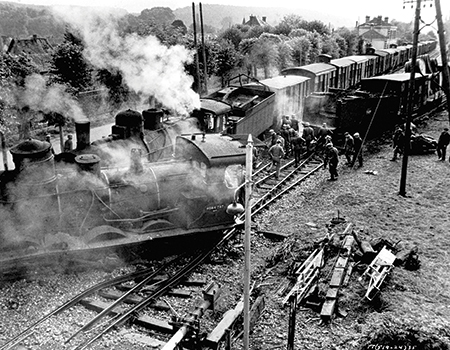
The production used real trains for its collisions and wrecks, rather than miniature substitutes.[4] But the phrase “it was real” can obscure the work that made those events readable. Something can happen in front of a camera and still produce an incoherent image. Weight needs direction, placement, and an intelligible point of impact.
Bret Wood's production account for TCM describes the preparation for a collision between two steam locomotives: the approaching track was lowered so the impact would drive the engines into a more destructive encounter instead of sending them bouncing apart.[5] The event was physical, and its screen appearance was engineered. The crew shaped what the mass would do.
This makes “practical effects” the useful description. An actual collision remains an effect when it is arranged for a film. Its credibility comes from the contact among wheels, track, earth, and metal; its dramatic clarity comes from decisions made before that contact occurs. The attraction is not simply expensive destruction. We can perceive resistance, and then see it overcome.
The AFI catalog supplies another corrective to a purely heroic account of the shoot. It records French railway employees participating as background actors and government cooperation in supplying railway cars and personnel. It also documents a weather-related interruption when exterior scenes required foliage that the production could not convincingly replace.[2] The tangible world gave the filmmakers resources, but also imposed a calendar. Working at full scale meant negotiating with a place.
Let a job take time
Late in the film, Labiche attacks the railway at its smallest useful scale: he works on the track's fastenings while the threat approaches. Del Toro describes Frankenheimer alternating close views of the work with wider views of the pursuing forces.[1] A hand tool and a locomotive belong to the same suspense sequence because the editing makes their different speeds collide.
The crucial unit is the unfinished task. We do not need to become railway engineers to understand the danger of being interrupted before the work is complete. Each return to Labiche asks how much remains. Each return to the approaching enemy reduces the time available. The cutting can accelerate our anxiety while the stubborn job continues to demand effort.
This is the film's most useful lesson in action construction. Show enough of a task for the audience to recognize progress, then put that progress under pressure. Lancaster's physical presence gives the sequence conviction, but the situation gives it shape. Muscles alone would make a demonstration. An approaching deadline makes a scene.
What stopping the train cannot settle
The machinery has a clear objective; the people do not have such a clean moral finish. Djoymi Baker's essay in Senses of Cinema emphasizes the growing obsessiveness of both Labiche and von Waldheim, and the way their struggle makes the relation between human lives and artistic value increasingly uneasy.[6]
There is also a limit to the film's apparent documentary authority. Kerbel's Yale notes distinguish its expansive adventure from the historical episode behind Rose Valland's account, in which administrative obstruction helped keep the art train near Paris.[4] Convincing railway operations do not make the screenplay a literal reconstruction.
For me, that distinction sharpens the craft rather than diminishing it. Frankenheimer has built a world in which effort produces visible results. A train can be delayed, damaged, stopped. Yet no successful operation can establish how much suffering the objective was worth. The film teaches us to admire a job completed, then leaves us with a question that competence cannot answer.
Sources
- Robert Abele, “The Cost of War,” Directors Guild of America Quarterly, Winter 2018 — Guillermo del Toro's discussion of staging, the sustained train-boarding shot, track sabotage, and Photofest image credits.
- American Film Institute, “The Train,” AFI Catalog — credits, production chronology, railway cooperation, weather delays, and the 1964 European and 1965 American releases.
- Jeremy Arnold, “The Train on Blu-ray,” Turner Classic Movies, August 15, 2014 — deep-focus compositions, the railway-yard tracking shot, and sound.
- Michael Kerbel, “Film Notes: The Train,” Yale Film Archive, November 8, 2015 — full-scale filming, wide-angle staging, live-television background, and the distinction between the story and historical events.
- Bret Wood, “The Train,” Turner Classic Movies, July 28, 2004 — practical effects and the preparation of the locomotive collision.
- Djoymi Baker, “‘In his element’: Burt Lancaster and The Train (John Frankenheimer, 1964),” Senses of Cinema, April 2023 — performance, obsession, and the conflict between preserving art and preserving lives.