Many courtroom films depend on orientation. You learn where the bench is, where the witness stands, who occupies the center, and how authority is arranged in the room. Carl Th. Dreyer takes almost all of that security away in The Passion of Joan of Arc and leaves the viewer with something harsher: a procession of faces under pressure, cut against blank walls, fragments of stone, and angles that never quite settle.[1][3][4] The result is one of cinema's strangest paradoxes. A film built from a medieval heresy trial feels less like a pageant of the past than like an immediate physical ordeal.
That intensity begins with Dreyer's choice of material. The film draws on the historical record of Joan's trial, yet it condenses the proceedings into a single day, stripping away the usual comforts of historical distance and procedural sprawl.[4][5] Janus's program note stresses expressionistic lighting, interconnected sets, and painfully intimate close-ups.[1] Those are not three separate embellishments. They form one system. Dreyer makes judgment feel architectural, but he refuses to let the architecture become stable enough to reassure us.
The effect is so strong that the movie can seem to float free of ordinary continuity rules. Alex Barrett's BFI essay is useful here because it names some of the rules the film breaks: inconsistent eyelines, uncertain screen direction, close-ups that do not calmly re-establish the room, and a camera style that keeps denying the usual map of where bodies sit in relation to one another.[3] In another film that might read as confusion. Here it becomes pressure.
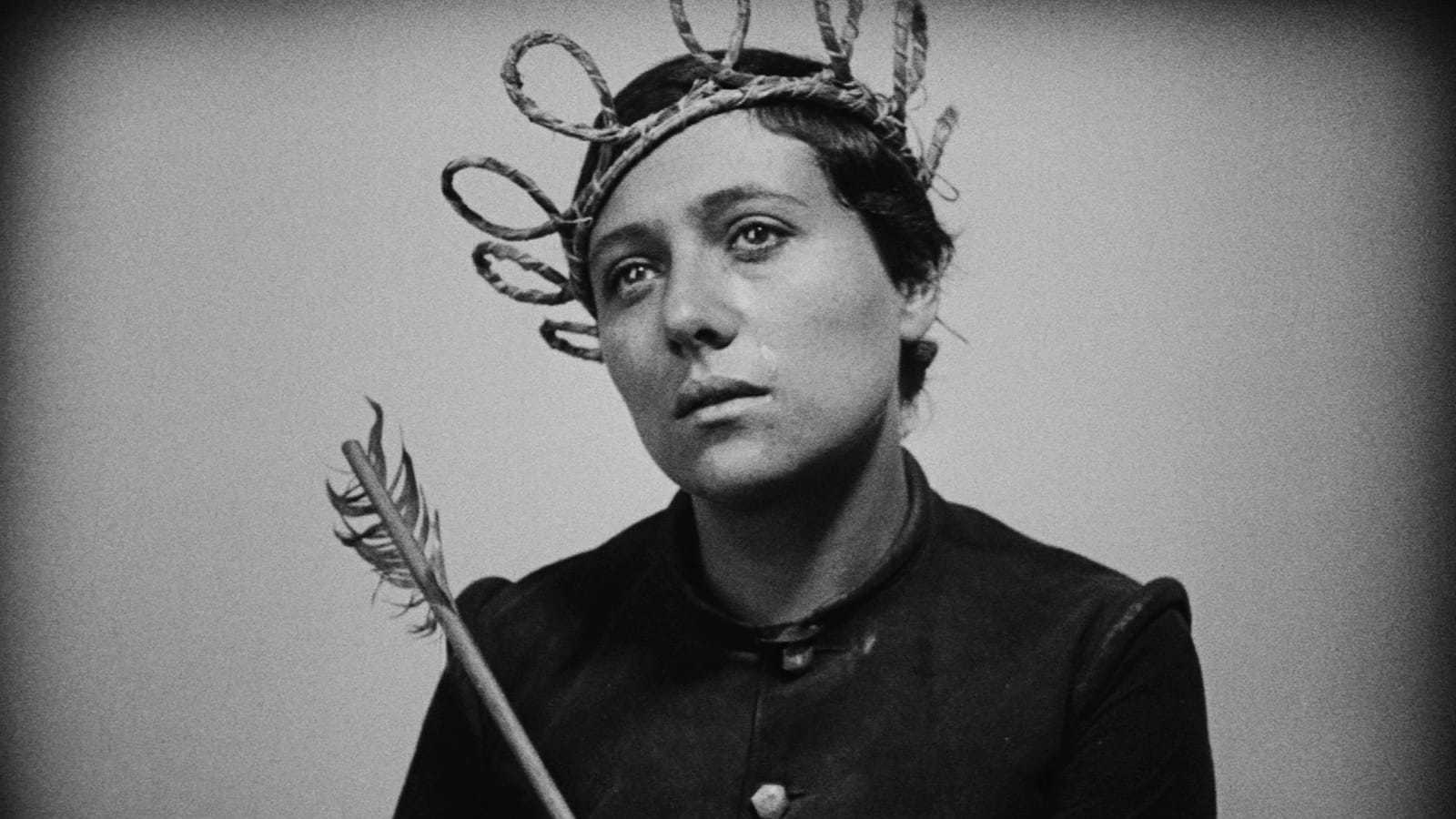
Image context: the cover uses an official Janus still from The Passion of Joan of Arc. A real film still is essential here because this article is about Dreyer's close-up logic itself: the way Falconetti's face, photographed at severe proximity, carries the film's emotional scale more than any single set piece or courtroom wide shot.[1]
Faces come before procedure
The first radical move in The Passion of Joan of Arc is that the trial does not unfold as a contest of arguments. It unfolds as a contest over what a face can endure. Dreyer gives the judges, clerics, guards, and onlookers distinctive surfaces: pocked skin, shaved crowns, heavy brows, thin lips, eyes that seem to inspect and accuse at once.[3][4] Yet the film does not use those faces simply to sort saints from villains. What matters is the cumulative rhythm of looking. Joan is inspected, crowded, cornered, and interpreted by men whose authority rests on reading her correctly, while the camera keeps insisting that the most important thing in the room is the excess of feeling that escapes their categories.
Renée Falconetti's performance remains the hinge. Janus describes it as a legendary embodiment of agony and ecstasy, and that is fair, but the performance is more exact than those abstract words suggest.[1] Falconetti does not merely look holy or frightened. She seems to register each question as a fresh assault on breathing, posture, and concentration. The close-ups are famous, yet what lingers is their variation. Sometimes Joan's face appears calm enough to hold itself together; sometimes it looks as if thought itself has become physically costly. Because Dreyer stays so close, the shifts do not read as theatrical signals. They feel granular, almost involuntary.
That is why the film's spiritual force does not require devotional belief from the viewer. BAMPFA's note on the film emphasizes Dreyer's search for lived immediacy rather than museum reverence, and you can feel that ambition in every close view of Falconetti.[5] Joan matters here less as an abstract symbol than as a body being forced to answer under hostile conditions. The martyrdom begins long before the fire. It begins in the labor of remaining legible to oneself while hostile institutions keep renaming you.
White walls make the room feel infinite and airless
Another reason the film feels so modern is that Dreyer does not photograph the courtroom as a full social chamber. He breaks it into surfaces. A curved wall. A rough block of stone. A window edge. A floor that seems too bare. A ceiling line that arrives only when he wants the room to feel crushing.[2][3][4] BFI Southbank's note on the film captures this well: the sets are both specific and abstract, historical and stripped, dense with texture yet oddly emptied of ordinary coordinates.[4]
That design changes how power works in the frame. In a conventional trial movie, authority is distributed through positions. In Dreyer, authority arrives as encirclement. The judges do not always dominate because they sit higher. They dominate because the cutting lets them accumulate around Joan from too many directions. One face intrudes, then another, then a diagonal glance, then an overhead angle, then a severe close-up that seems to have no breathable space around it.[3] The room feels at once crowded and spatially broken, which is exactly why the film can seem both theatrical and violently immediate.
Barrett argues that Dreyer breaks the rule that a viewer should always know where everyone is.[3] That is true, but the film gives something back in exchange. It offers emotional orientation instead of geometric orientation. We may lose track of the courtroom's exact layout, yet we never lose track of Joan's exposure inside it. The white walls intensify that bargain. They strip away decorative information and leave the eye with naked contours: skin, cloth, stone, tears, steel. Judgment ceases to be an abstract legal process and becomes a surrounding environment.
The film's cruelty lies in how carefully it observes everybody else
It would be easy to write about The Passion of Joan of Arc as if the close-ups served Joan alone. They do not. The judges are also rendered with extraordinary specificity, and that matters because Dreyer never lets authority remain faceless.[1][3][4] He studies the bureaucracy of belief. Some men look merely tired, some look vain, some look morally insulated by office, and some appear almost fascinated by the spectacle they are helping to produce. The film refuses to blur them into one generic persecuting block.
That attention deepens the movie's cruelty. These are not demonic phantoms descending from nowhere. They are functionaries, scholars, clerics, technicians of doctrine. Their confidence depends on converting Joan's interior certainty into a series of manageable procedural categories.[4][5] Dreyer films them so closely that their certainty begins to look unstable too. A smirk lasts too long. A glance flinches. A face leans toward caricature, then returns to banal professionalism. The trial becomes terrifying because it is administered by recognizable people who believe form itself will deliver truth.
Seen this way, the film's famous close-ups are not expressions of pure interiority. They are collisions between institutions and skin. Falconetti's face is the center of the film, but every other face is part of the machine pressing on it. That is why the movie still feels contemporary. It understands that power often appears not through grand spectacle but through repeated acts of examination, classification, and compelled self-explanation.
Restoration does not soften the film. It sharpens the wager
The restoration history adds one more layer to the viewing experience. Janus notes that the original version, long thought lost, was discovered in 1981 in a Norwegian mental institution, and later restoration work returned the film to circulation in a form much closer to Dreyer's design.[1][2] That story matters because The Passion of Joan of Arc is a film where every tonal value counts. The whites cannot turn muddy, the blacks cannot collapse, and Falconetti's face cannot be reduced to a generic silent-era icon if the movie's full severity is going to register.
The press notes also point to Richard Einhorn's Voices of Light, the score that now often accompanies the restoration theatrically.[2] Even when one watches the film in another setting, that restoration-era framing clarifies something important: Dreyer's work survives not as a relic preserved behind glass, but as a demanding present-tense experience that each restoration either clarifies or dulls. In this case clarity matters enormously, because the film's drama lives in gradations of gaze, texture, and light pressure.
That is why the movie feels carved in stone without ever becoming static. Stone is everywhere in the imagery, yet the film's real material is vulnerability under scrutiny. Dreyer turns a record of interrogation into an assault of faces, walls, and glances so concentrated that ordinary historical distance collapses. The miracle of The Passion of Joan of Arc is not simply that it is severe. It is that the severity remains alive. Nearly a century later, the film still knows how to make judgment feel spatial, public, and frighteningly intimate at once.[1][3][4]
Sources
- Janus Films, "The Passion of Joan of Arc" film page and official stills.
- Janus Films, Press Notes: The Passion of Joan of Arc (restoration and score notes PDF).
- Alex Barrett, "4 hard-and-fast rules of filmmaking... and how The Passion of Joan of Arc breaks them." BFI.
- BFI Southbank Programme Notes, "The Passion of Joan of Arc".
- BAMPFA, "The Passion of Joan of Arc" screening page.