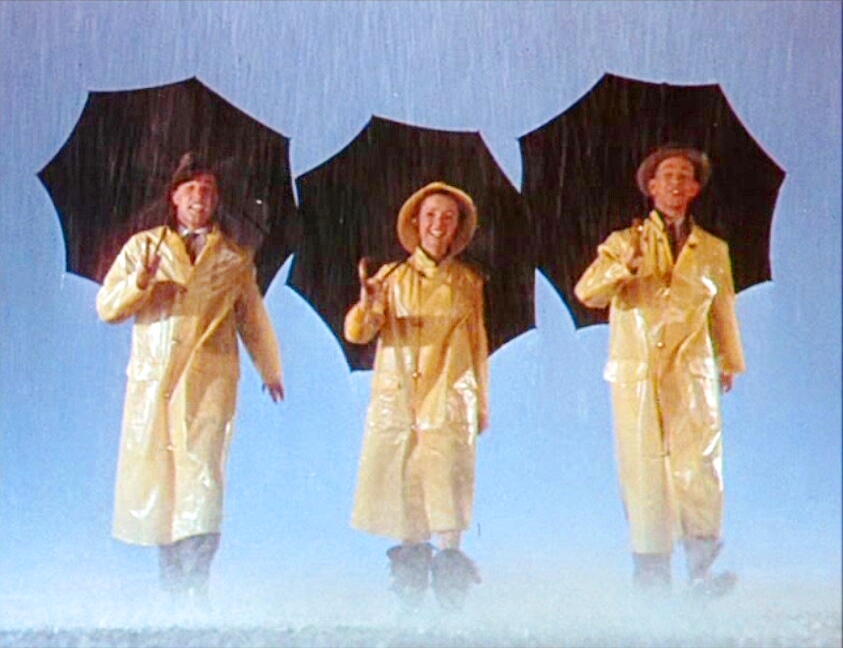


Singin' in the Rain is one of those films that can suffer from its own ease. The title song, the puddles, the yellow raincoats, the way Gene Kelly, Debbie Reynolds, and Donald O'Connor seem to move as if gravity had signed a union contract with MGM: all of it can make the movie feel like pure release.[1][3][6] Yet the musical remains powerful for the opposite reason. Its joy is engineered. It takes the ugly, transitional mess of late-silent and early-sound Hollywood and turns it into a surface so fluid that viewers almost stop noticing the amount of labor required to keep it flowing.[3][5][6]
That is why these two videos belong together. Warner Bros.' 4K trailer presents the film the way popular memory usually carries it: buoyant, weatherproof, almost frictionless.[1] Debbie Reynolds's Turner Classic Movies interview restores the harder story beneath the shine: bruising rehearsal schedules, exacting choreography, a teenager pushed through studio-level precision, and a musical built around voices that are constantly being reassigned, corrected, or hidden.[2][3][5] One video gives you the dream of effortless entertainment. The other gives you the body that had to absorb the cost.
The pairing also clarifies something central about the film's historical joke. Singin' in the Rain is set during Hollywood's conversion to sound, which means its comedy depends on panic, embarrassment, and technological mismatch: microphones in the wrong place, stars whose voices refuse the image, scenes that have to be redone so the illusion will hold.[3][5][6] Even the title song carries studio archaeology with it. Turner Classic Movies notes that "Singin' in the Rain" first appeared in The Hollywood Revue of 1929, decades before this film repurposed it into MGM's most radiant piece of self-mythology.[4] The musical's triumph lies in its ability to turn industrial repair work into weather, rhythm, and charm.
Image context: the cover uses an archival trailer still rather than a poster. That choice suits the piece because this article is less interested in a branded emblem than in the film's manufactured weather system itself: synchronized bodies, controlled rain, and a studio image so smooth that the machinery behind it almost disappears.[1]
Video 1: Warner's 4K trailer sells the finished miracle
Seen on its own, the Warner trailer is a compact lesson in how the film wants to live in collective memory.[1] It does not begin with friction. It begins with momentum. Faces are bright, feet are quick, umbrellas turn into graphic patterns, and the whole object presents itself as a nearly seamless burst of studio delight. The trailer is selling a world in which sound, movement, romance, and comedy all cooperate. That is exactly the image of the movie that survived, and for good reason. The picture really does feel that open when it is running well.
What the trailer usefully hides, though, is the amount of technical anxiety buried inside that smoothness. TCM's overview of the film stresses that the story is built around Hollywood's chaotic adjustment to sound recording, with performers and producers scrambling to remake themselves for a new medium.[3] The trailer hardly lingers on that stress as stress. Instead, it converts the crisis into a style. Awkward microphones and voice problems become comic timing. Studio panic becomes romantic velocity. The rain itself becomes proof that the whole machine is under control.
That transformation is the first reason the trailer matters critically instead of merely promotionally.[1][3] It demonstrates the exact bargain the musical keeps making. The film takes transition-era instability and reissues it as grace. The title number is the clearest example. Because the song already belonged to MGM's earlier sound-era history, its reuse in 1952 carries a quiet act of studio self-rewriting with it.[4] Something once tied to an earlier revue now becomes the emotional crest of a movie that pretends the industry's most humiliating growing pains can be danced through and absorbed into legend.
The trailer also highlights how much of the film's pleasure depends on group coordination rather than isolated star charisma.[1] Even when Kelly dominates the frame, the movie's enduring glow comes from arrangements: rain, costume, pavement, orchestra, camera movement, backing performers, and the crisp spacing among bodies. The trailer turns that coordination into ease so successfully that it almost erases the industrial discipline beneath it. That erasure is not a flaw. It is the film's defining power. Singin' in the Rain survives because it makes control look like spontaneous weather.
Video 2: Debbie Reynolds puts the labor and substitution back into view
Reynolds's TCM interview is valuable because it pulls the film away from the myth of natural cheer and returns it to human exertion.[2] She does not describe the production as if it simply floated into being on charm. She remembers inexperience, pressure, and the punishing standard demanded by Kelly and the MGM system. That perspective matters because Reynolds, in the finished film, is one of the key carriers of ease. Kathy Selden moves lightly, jokes quickly, and seems to inhabit the musical's changing technical world with almost impossible flexibility. Hearing Reynolds describe the strain required to produce that flexibility changes the whole texture of the movie.
The interview becomes even more revealing when you place it next to the film's theme of dubbing.[2][3][5] The plot famously turns on a voice crisis: Lina Lamont's image can survive the silent era, but her speaking voice cannot survive synchronized sound. Kathy becomes the hidden repair, supplying voice where the star image fails. AFI's note on the film points out the deeper irony: the movie's own polished illusion also relies on concealed substitution, including Jean Hagen's vocal work in the famous dubbing scene and Betty Noyes's uncredited singing contribution for Debbie Reynolds in "Would You?"[5] In other words, the musical about hiding the labor behind a usable voice is itself built from distributed voices.
That nested structure is one reason the film still feels modern.[3][5][6] It understands entertainment as a chain of corrections. Images are adjusted. Voices are reassigned. Bodies are trained until they look effortless. TCM's film essay emphasizes how expertly the musical satirizes the industry's conversion pains while simultaneously luxuriating in what the mature studio machine can do once it masters those pains.[3] Reynolds's testimony keeps the satire from becoming too clean. The machine did not solve the problem by magic. It solved it by driving performers, technicians, arrangers, dancers, and dubbing talent through an exacting process whose seams the audience was never meant to dwell on.
That is why the interview belongs inside the interpretation rather than as a trivia supplement.[2] It returns mass to the film. The rain had to be lit. The smiling had to continue through fatigue. The "natural" chemistry had to be rehearsed into precision. Once Reynolds tells the story from inside the production, Singin' in the Rain stops looking like a spontaneous celebration of show business and starts looking like a musical that knows charm is a manufactured compound. The elegance remains real. So does the cost.
What the two videos reveal together
Watched in sequence, the two embeds tell a sharper story than either can alone. The trailer gives you the perfected object: MGM weather converted into joy, sound-era panic rewritten as flowing movement, and a studio style so confident that it looks immune to difficulty.[1][3] Reynolds gives you the corrective pressure from underneath: the laboring body, the hidden voice, the endless repetition, the industrial demand that delight arrive on schedule.[2][5] Together they reveal that Singin' in the Rain is not simply a happy musical. It is a musical about how happiness gets fabricated, polished, and made legible at scale.
That is the film's lasting intelligence. It does not merely laugh at early sound cinema for being clumsy.[3][6] It understands that modern entertainment is built from acts of synchronization whose success depends on concealment. The joke lands, the umbrella opens, the song carries, the camera glides, and the viewer receives a world in which nothing seems misaligned. Yet tucked inside that smoothness are substitutions, technical fixes, and bodies doing far more work than the finished image admits.[2][5]
The movie endures because it does not resolve that contradiction; it dances it. Warner's trailer keeps the shine intact.[1] Reynolds's interview lets the strain show through.[2] Put together, they make Singin' in the Rain look even more impressive, because the film's real achievement is not sunshine by itself. It is the studio art of turning repair into pleasure and letting pleasure fall like weather.
Sources
- Warner Bros. Entertainment, "Singin' in the Rain | 4K Trailer | Warner Bros. Entertainment," YouTube video.
- Turner Classic Movies, "Debbie Reynolds Talks About Singin' in the Rain," YouTube video.
- Turner Classic Movies, "Singin' in the Rain."
- Turner Classic Movies, "The Hollywood Revue of 1929" — background on the earlier MGM appearance of "Singin' in the Rain."
- AFI, "AFI Movie Club: SINGIN' IN THE RAIN."
- Library of Congress, "Singin' in the Rain" item page.