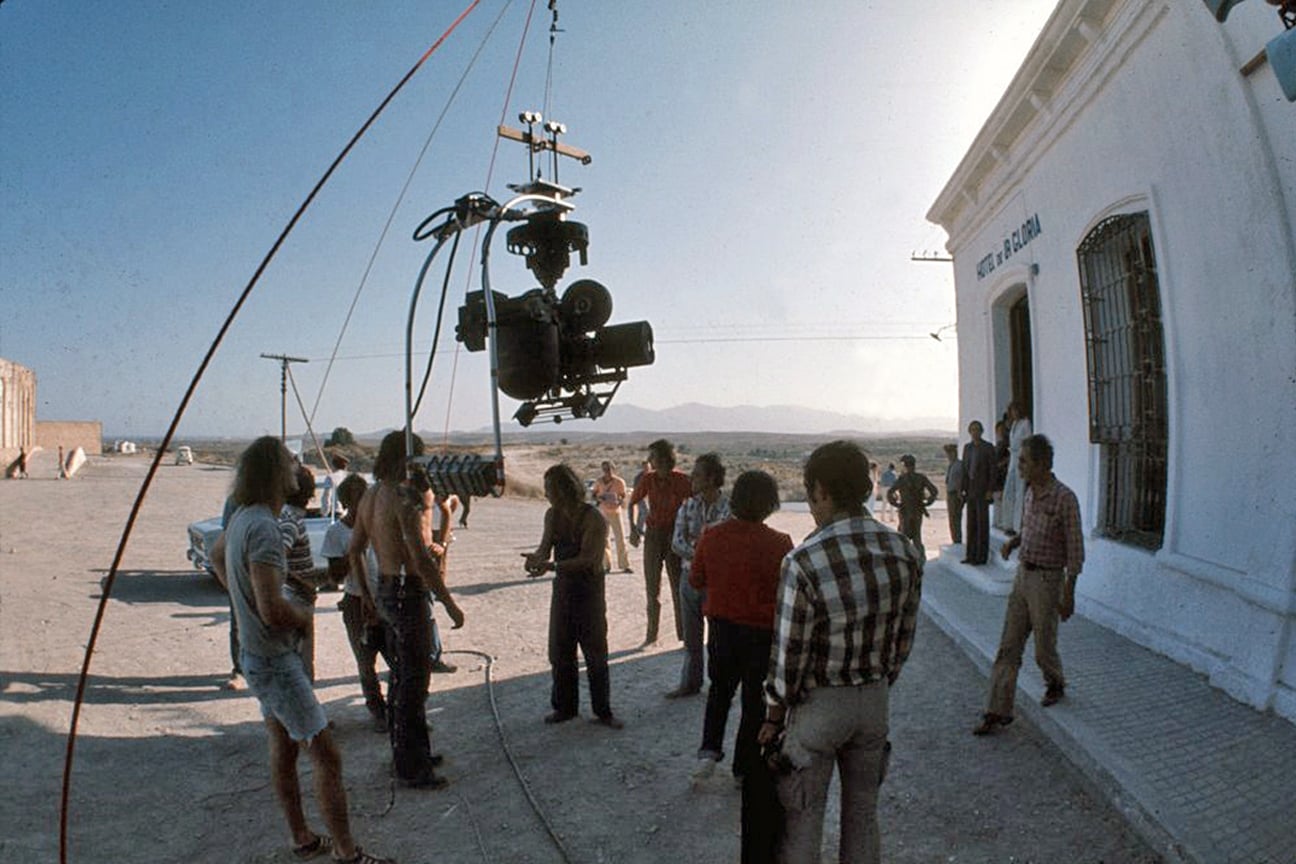
David Locke steals a dead man's identity because he wants a life that will move without him having to decide where it goes. Near the end of Michelangelo Antonioni's The Passenger (1975), the camera performs a more successful escape. It begins in Locke's hotel room, glides toward a barred window, passes impossibly into a dusty square, and stays outside while the thriller reaches him. By the time it circles back, Locke is no longer the center of the shot. He is something the world can look in on.
The celebrated take lasts about seven minutes and is technically the film's penultimate shot, not its last.[1][6] Its virtuosity is obvious. Its deeper achievement is quieter: Antonioni and cinematographer Luciano Tovoli use an unbroken movement to transfer ownership of the image. A story organized around one man's borrowed identity ends by discovering that the camera does not need him.
Spoiler note: this essay discusses the film's ending and David Locke's death. It refers to Sony Pictures Classics' preferred director's cut, corresponding to the version originally released in Europe as Professione: reporter.[2]
A thriller that keeps losing its assignment
Locke, played by Jack Nicholson, is a television reporter working in the Sahara when a fellow hotel guest named Robertson dies. The two men resemble each other closely enough for Locke to exchange passport photographs, clothes, and rooms. He reports his own death, assumes Robertson's appointments, and learns too late that the dead man was an arms dealer connected to an African rebellion. The route carries him through London, Munich, Barcelona, and southern Spain, accompanied for part of the journey by an unnamed young woman played by Maria Schneider.[2][3]
That outline promises pursuit, revelation, and a restored identity. Antonioni keeps allowing other realities to press against the mechanism. In a 1975 interview, the director described Locke as unable to become more politically committed and unable to explain why.[4] A Queen's University Belfast introduction sharpens the contradiction: the reporter pretends to be an arms dealer, the voyeur to be an activist, and the pursuer becomes the pursued.[5] He wants Robertson's itinerary more than Robertson's commitments. The borrowed calendar supplies motion, but it cannot manufacture belief.
The movie's spaces notice this vacancy. Desert tracks, London interiors, Gaudí's Barcelona, highways, and plazas do not simply receive Locke's drama; they repeatedly become more compelling than his attempt to control it. A Queen's University Belfast introduction describes Antonioni's modernist camera as free to wander or glance aside once conventional narrative scaffolding has been loosened.[5] The ending turns that tendency into a decisive piece of craft. The camera does not glance away from the climax. Its glance elsewhere is the climax.
From a man's room to nobody's view
Antonioni explained the design to Tovoli as a passage from subjectivity to objectivity without a cut. The shot would begin with the protagonist in his room, leave through the window, and observe from outside.[1] At first the distinction seems clean. Inside belongs to Locke: bed, fatigue, barred opening, appointments nearly exhausted. Outside belongs to the square: a driving-school car, people crossing, vehicles arriving, ordinary activity whose meanings are not announced for us.
Yet the camera never becomes an all-knowing witness. It gains space and loses certainty. Once outside, it can register several actions at once, but the fatal event in the room is withheld. People and cars converge; the girl moves through the square; danger enters the hotel beyond our view. Continuity guarantees that time has not been cheated, while framing refuses the proof a thriller normally supplies. The Film Comment interviewer Renee Epstein described the movie's camera as no longer subordinate to character or plot; Antonioni answered that he had needed to be free with it and not maintain one style.[4] The ending realizes that freedom without pretending it has become neutral.
That makes Antonioni's word “objectivity” productive rather than final. The move leaves Locke's perspective, but it does not arrive at a neutral God's-eye account. The Queen's program note argues that objectivity in Antonioni is itself unstable—a device that makes a heterogeneous world look coherent.[5] The penultimate shot lets us feel both claims. The square is larger than Locke's consciousness, but the camera still selects, drifts, delays, and returns. Freedom from a character is not freedom from a point of view.
The seamless image is built from a handoff
The apparent ease required an extraordinary apparatus. A ceiling-mounted rail carried the camera across the hotel room and about a meter beyond the window. A slight zoom kept the metal grille outside the frame long enough for crew members to swing it open. The camera, stripped of its usual protective housing, was then transferred from the rigid track to a cable suspended from a crane. A gyro-stabilized Wescam system absorbed the shocks of that handoff; an operator steadied the rig as it traveled around the square. Before the camera looked back, the grille was closed again.[1]
Light and weather became part of the machine. The crew shot near dusk to reduce the exposure difference between the room and the exterior, while still adding enough interior illumination to avoid an iris change during the passage. Wind disturbed the cable, forcing the production to wait for still intervals. Antonioni monitored the image from a van and relayed instructions to performers and operators. He said the sequence took eleven days to complete.[1][2]
These facts are fascinating because the finished shot suppresses almost every one of them. The viewer sees no transfer, no opening grille, no crew, no change of support. What feels like one camera discovering that walls no longer apply is actually a relay: rail to hook, fixed structure to suspended cable, interior exposure to exterior light, one operator's control to a larger choreography.
The hidden relay echoes Locke's identity exchange without reducing the shot to a diagram. Locke also tries to cross a boundary by swapping supports: one photograph for another, one passport for another, one itinerary for another. But his transfer remains unstable because he mistakes documentation for a self. The camera's transfer works because dozens of people acknowledge the mechanism and coordinate it. Its apparent autonomy is a collective achievement; his apparent autonomy is a refusal of connection.
The bars close behind the camera
The grille is the sequence's most elegant practical effect because it disappears exactly when it matters. We first accept it as a hard limit between the room and the square. The camera approaches, the bars slip beyond the edge of the image, the apparatus passes through the gap, and the grille closes before the returning lens reveals it again.[1] The barrier seems to have permitted one impossible crossing and then denied that a crossing occurred.
That is the film's identity problem in miniature. Locke's new passport also hides a hinge. To strangers, “Robertson” appears continuous; outside the frame are scissors, substituted photographs, a corpse, and Locke's desire not to be accountable to his own history. Both transformations depend on concealed labor. Only the camera can complete its circuit. When it returns to the barred window from the other side, it does not recover the original view. The room that once contained the world has become one enclosure within it.
This reversal changes the emotional use of the long take. Continuous shots are often praised for immersion: no cut releases the spectator, so presence seems to intensify. The Passenger uses continuity to stage absence. We remain present for the elapsed time of Locke's death but are not granted its decisive image. The longer the shot continues, the less its duration belongs to him.
Sound completes the displacement. Jack Nicholson's commentary, quoted by the BFI, keeps returning to the phrase “still one shot” as the girl leaves, a boy throws stones, a possible gunshot is heard, and an ambulance and police arrive.[6] The square does not fall silent in deference to a protagonist's end. Engines, footsteps, doors, voices, and ambient movement continue to compete for attention. Because Antonioni refuses the isolating cut that would announce cause and reaction, death enters an already occupied sound field. It is consequential without becoming the only event the world is allowed to contain.
The return is more radical than the escape
If the shot ended after passing through the window, it would be a magnificent image of liberation. The return refuses that comfort. The camera rotates through the square and faces the hotel from outside, restoring the bars and showing the room as a place that other people can enter, inspect, and misrecognize. Locke's wife and the unnamed girl offer incompatible forms of recognition: the legal identity has run out, while a brief human connection remains.[4] Neither answer can return the dead man to the stable self he tried to discard.
The brief exterior coda that follows keeps the hotel in the landscape rather than turning Locke's body into a final icon. This is why calling the sequence a stunt misses its craft logic. The machinery does not exist merely to extend duration or advertise difficulty. It changes the hierarchy of the film. Room becomes façade; protagonist becomes one element of a room; private escape becomes an event absorbed by public space.
The BFI places The Passenger among essential thrillers while noting how its antihero slips through the cracks of his own story.[3] Antonioni makes that slippage literal, but he does not let the movie disappear with the man. A ceiling track, a hinged grille, a stabilized camera, a cable, a crane, patient light, and coordinated bodies carry the image across the limit Locke cannot cross. The camera outlives him because cinema, unlike his borrowed identity, knows that movement depends on other people.
Sources
- David E. Williams, “The Passenger: One Epic Shot,” American Cinematographer, August 24, 2020 — Antonioni and Tovoli's stated design, Wescam rig, ceiling track, hinged grille, cable transfer, dusk exposure, production choreography, duration, and source of the behind-the-scenes photograph.
- Sony Pictures Classics, “The Passenger” — official synopsis, cast and screenwriting context, location production, eleven-day final-sequence account, and identification of the preferred director's cut.
- British Film Institute, “100 essential thrillers” — film identification, director, identity-swap premise, geographic route, and the Andalusian endgame.
- Renee Epstein, “Antonioni Speaks—And Listens,” Film Comment, July–August 1975 — contemporary interview on Locke's political detachment, the camera's freedom from subordination to plot and character, exchanged identity, and the ending's recognition dialogue.
- Des O'Rawe, “The Passenger/Profession: Reporter (1975),” Queen's Film Theatre / Queen's University Belfast, May 2025 — modernist context, unstable objectivity, environmental attention, location history, and the camera's resistance to conventional continuity.
- Matthew Thrift, “16 incredible long takes,” British Film Institute, July 13, 2015 — identification of the take as the penultimate shot and Jack Nicholson's commentary on the square's simultaneous actions, ambiguous gunshot, arrivals, and final look back at the hotel.