Sergio's family leaves Cuba, but almost everything else stays behind. The protagonist of Tomás Gutiérrez Alea's Memories of Underdevelopment remains in a high-rise apartment with space, rent income, his estranged wife's clothes and recorded voice, a telescope trained on Havana, and enough inherited comfort to call his inertia freedom. The revolution moves outside; inside, he takes inventory.
Possession is the film's quiet grammar. Sergio treats objects as proof of cultivation, access as proof of understanding, and memory as something that belongs to the person who can replay it. He extends the same habit to people and places: Elena enters his wife's wardrobe; Hemingway's house becomes a test of taste; hotel terraces become views through his lens. Newsreels, street music, testimony, state officials, and the approaching Cuban Missile Crisis keep changing what those possessions mean.[1][3]
The result, released in 1968, is neither a clean denunciation nor a secret endorsement of its bourgeois intellectual. It is an inventory of a class position after its confidence has outlived its guarantees. Sergio can keep the keys, the tape, and the view for a while. The film asks whether any of them amount to a life he has actually made.
Spoiler note: this essay discusses the film's major relationships and final movement.
History is still warm
The story occupies 1961 and 1962, between the Bay of Pigs invasion and the October missile crisis, while the film looks back from only a few years later.[1] That short interval matters. Gutiérrez Alea was not reconstructing an era whose meaning had settled. He was filming a revolution old enough to have institutions and contradictions, yet young enough that its defining images still circulated as immediate memory.
Cinema was one of those new institutions. The Instituto Cubano del Arte e Industria Cinematográficos, or ICAIC, was established on March 24, 1959, less than three months after Fulgencio Batista fled Havana. Its mandate held a productive tension: film would be an art and also a popular instrument for education and ideas.[1] Gutiérrez Alea helped found ICAIC and supported the revolution, but he also defended cinema's capacity to criticize the reality it belonged to. Memories of Underdevelopment comes from inside that tension, not from a neutral platform above it.
This makes Sergio an unusually dangerous guide. He too speaks from inside Cuba while imagining himself elsewhere. His wife, parents, and friends leave for Miami; he remains in the family's large Vedado apartment, living on property income and attempting to write. Staying might resemble commitment, but the film presents it as drift made comfortable by assets. He has rejected his class's exit without surrendering its material insulation.[1][5]
The title word becomes unstable immediately. “Underdevelopment” is Sergio's preferred entry in the ledger for the nation, its culture, its women, and his inability to create. He can connect poverty to colonial history and recognize dependency as a structure. Yet the term also protects him. If everything around him is deficient, his own inactivity can remain the one asset whose value he never has to question.
The apartment keeps score
Sergio's voice-over supplies continuity, but his apartment supplies the conditions for that voice. The rooms are large, the city is below, and his family's departure has left him with privacy other people cannot assume. When officials ask how many people occupy the building, housing stops being scenery and becomes political arithmetic. The home from which Sergio judges Cuba is itself part of the redistribution he prefers to contemplate abstractly.[1]
The crucial move is not to reveal that Sergio lies about everything. He often notices real contradictions. His error is to treat the ability to describe a structure as freedom from the benefits it gave him. The apartment makes that mistake visible: detachment requires square footage, income, and a door that closes.
The rooms also become a storehouse for absent people. Sergio listens to a taped conversation with his estranged wife and replays fragments of their marriage; memories of a German lover return in soft, selected images; erotic scraps and fantasies enter his mental montage. He handles the past like the clothing left in a wardrobe—available for inspection, arrangement, and reuse after its original owner has gone.[2]
But the soundtrack resists ownership. A recorded voice preserves tone and friction that his commentary cannot fully absorb. Memory arrives with seams. Instead of illustrating a stable self, the flashbacks show Sergio revising his identity through the women he has diminished, desired, or abandoned. His cultivated melancholy begins to look less like sensitivity than a method of keeping every relationship one edit away.
Public images do not fit the collection
Against Sergio's curated memories, the film places public images with a different weight. Documentary footage of invasion, political trials, protest, and mobilization enters the fiction; still photography and news material interrupt rather than decorate the narrative.[1][3] These passages do not merely tell us what year it is. They challenge the scale of Sergio's private drama.
The film's opening is already a warning. Before Sergio's airport farewell gives the story an identifiable center, an outdoor Afro-Cuban dance sequence fills the screen with percussion, bodies, and collective motion. Darlene J. Sadlier reads this beginning as a preface to the film's treatment of class and race, and emphasizes the larger pattern formed by voice-over, music, documentary footage, isolation, and remembering.[4] Sergio will try to make Cuba legible from above; the movie first presents it at ground level, crowded and rhythmically alive.
That does not make the archival material a voice of pure truth. Newsreels frame; revolutionary institutions edit; public images can become official memory. Their different texture matters because they cannot be stored as merely one more Sergio souvenir. They introduce crowds, conflict, and historical consequence at a scale his apartment cannot contain.
This is also why Gutiérrez Alea appears as himself when Sergio takes Elena to ICAIC, and why Edmundo Desnoes—the author of the 1965 novel adapted by the film—appears at a public discussion about the intellectual and revolution.[1] The movie shows some of the people and machinery producing the images Sergio consumes. Even his interior life depends on collective work and public institutions.
Culture is property he cannot share
Sergio's relationship with Elena concentrates the cruelty of possession. He draws the younger, working-class aspiring actor into his apartment and his wife's abandoned wardrobe, then measures her against a Europeanized ideal of cultivation. At a bookshop, museum, and Ernest Hemingway's former home, he reads her boredom as proof of national deficiency. Culture becomes a collection he can display but not a relationship he knows how to share.[1]
The film does not need Elena to become a hidden intellectual in order to expose him. Her vulnerability is material: class, age, family expectations, and Sergio's power shape what their affair can mean. When her family accuses him of rape and the relationship enters a courtroom, his private account meets another institution of narration. Testimony, social convention, and law now frame events he had treated as an episode in his own education.
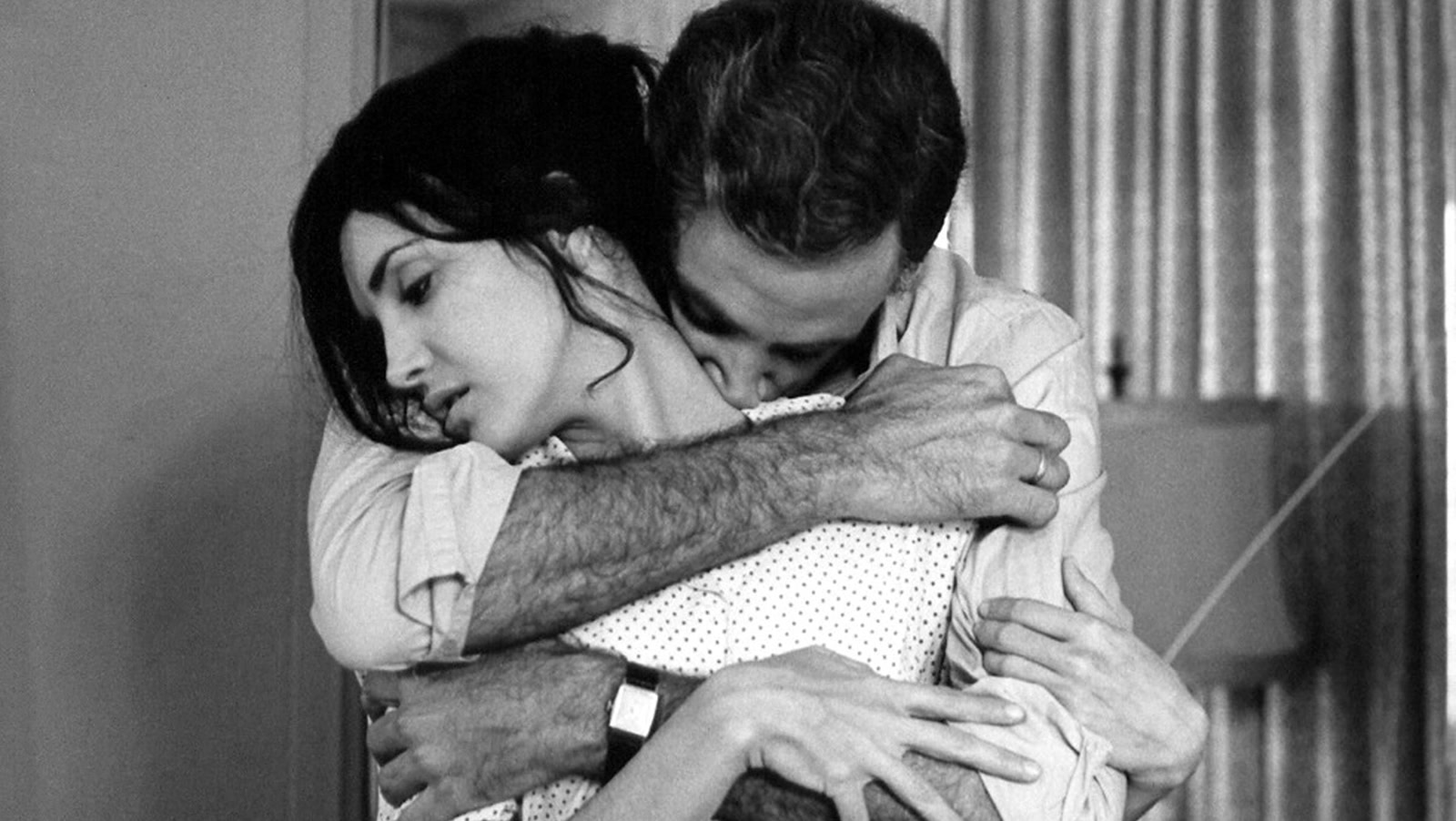
Gutiérrez Alea's camera does not absolve the film from Sergio's gaze; it makes our proximity uncomfortable. We have been invited to enjoy his sharp observations and the elegance of his isolation. The Elena story asks what that pleasure has omitted. A spectator can reject Sergio morally while continuing to consume the city and its people through his eyes. The embrace in the article image is tender and enclosing at once: his arms occupy the frame while her face turns away.
The same pattern governs his encounter with public debate. At a forum on literature and revolutionary society, Sergio is alert to stale rhetoric and self-importance. His skepticism is not entirely misplaced. Yet he uses the panel's limitations to excuse his own silence. The scene holds open two thoughts at once: official discourse can become schematic, and the intellectual who recognizes the scheme can still be politically useless.
This doubleness helps explain the film's divergent reception. It could be read as an indictment of the passive bourgeois intellectual, while some Cuban exiles found in it a compelling account of why people left.[1] The interpretations disagree, but both recognize that Sergio's apartment is not a neutral box. It is the material residue of a social order whose future is being contested.
Even the view changes hands
Early in the film, Sergio's telescope turns looking into leisure. From the balcony, he watches bodies around a hotel pool. The apparatus extends his habits: women, streets, and the city become available while he remains protected from contact.
Near the end, the same field of view changes. Soldiers occupy the hotel terrace and install weapons as the missile crisis approaches.[1] The telescope has not become more truthful; the object of Sergio's visual possession has been requisitioned by history. An instrument built for private inspection now frames preparations for a confrontation that could annihilate both observer and observed.
The reversal is devastating because Sergio's method stays constant. He remains at the eyepiece. What changes is the cost of believing that access amounts to mastery. His apartment, property, language, and cultivated identity are not shelters beyond history; they are goods whose meanings and guarantees were made by the world below.
The 2016 restoration shown in Cannes Classics returned the film's black-and-white surfaces to international screens, while the BFI's 2022 poll placed it among the films selected by critics as cinema's greatest.[3][6] Those honors can make a radical work feel safely canonical—another masterpiece acquired by the international collection. Yet the film remains abrasive because it asks what collection hides: who furnished the room, who left, who can enter, and which histories make possession possible.
Memories of Underdevelopment separates instruments of possession—the telescope, tape recorder, wardrobe, museum, and apartment—from counterforces such as the newsreel, street, and trial. The first group lets Sergio turn access into a claim; the second returns those claims to people, institutions, and historical consequences he cannot own. The revolution can change the legal status of buildings and income. The film pursues a harder dispossession: separating Sergio from the belief that what he can survey, replay, classify, or desire therefore belongs to him.
Sources
- Joshua Jelly-Schapiro, “Memories of Underdevelopment: Imaging History,” The Criterion Collection, August 26, 2018 — ICAIC history, production context, setting, form, characters, reception, and source of the film still.
- The Criterion Collection, “The Revolutionary Subjectivity of Memories of Underdevelopment,” April 29, 2019 — analysis of voice-over, point of view, flashbacks, and the film's critical use of Sergio's subjectivity.
- British Film Institute, “Memories of Underdevelopment (1968)” — film record, credits, mixed fictional and documentary form, and 2022 Sight and Sound poll placement.
- Darlene J. Sadlier, Memories of Underdevelopment: Memorias del Subdesarrollo. BFI Film Classics/Bloomsbury, 2023 — adaptation, political context, archival footage, opening dance, voice-over, music, gender, and reception.
- Michael Chanan, Memories of Underdevelopment. Rutgers University Press, 1990 — continuity script, source novel, Gutiérrez Alea interview, Cuban historical context, reception, and U.S. controversy.
- Festival de Cannes, “Memorias del Subdesarrollo” — 2016 Cannes Classics restored-print presentation, synopsis, production year, credits, and ICAIC production record.