Contains spoilers, including the ending of The More the Merrier (1943).
Connie Milligan has worked out how two people can occupy her apartment without getting in each other's way. There is a timetable, and even a map. Then her new lodger, Benjamin Dingle, tries to follow the instructions. Coffee-making collides with shower time; he takes the pot into the bathroom and spills its contents while removing his robe. The plan has accounted for the rooms. It has been less successful with the person moving between them.[1]
George Stevens's The More the Merrier turns a wartime Washington housing shortage into a comedy of involuntary proximity. Jean Arthur plays Connie, Charles Coburn plays Dingle, and Joel McCrea plays the young serviceman who becomes the apartment's third occupant.[2] Its pleasure lies in watching shared space change meaning. First it needs managing. Then it permits attraction. Finally, the arrangements that protected privacy begin to look like obstacles to being together.
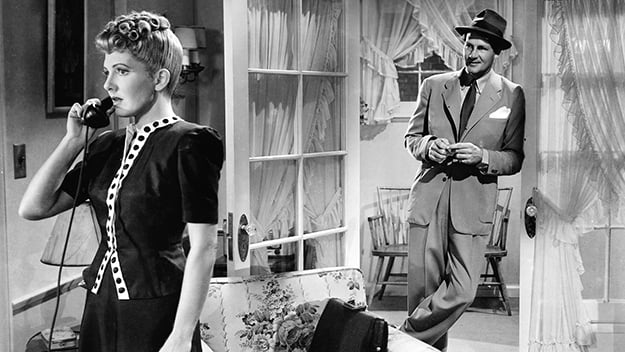
Connie's orderliness deserves some sympathy. As Claire E. Graman observes in her study of screwball comedy, her efforts at control grow out of practicality, decorum and patriotism.[1] Sharing an apartment creates work: someone has to coordinate the bathroom and get breakfast made. The timetable gives that work a visible shape. When Dingle fails to obey it, the comedy belongs partly to his confidence that he can improvise his way through a system someone else must keep running.
His improvisation becomes more consequential when he rents half of his room to Sergeant Joe Carter without Connie's permission. Later, after meeting her fiancé, the bureaucrat Pendergast, Dingle decides Joe would suit her better.[3] The distinction matters. The apartment has already been reorganized before its leaseholder is consulted about the romance. Dingle treats an inconvenient housing arrangement as an opportunity to arrange another person's future.
The film's title makes his intrusions sound wonderfully generous. More company will bring more happiness. Yet Graman identifies a conservative force inside this apparent anarchy: the older man's disruption helps establish the couple he considers appropriate.[1] That reading gives the bustle a useful friction. Connie's rules may be funny, but abandoning them does not automatically leave her in charge. Someone else is very ready to take over.
Stevens also gives Arthur and McCrea time in which their attraction can become persuasive on its own. Sheila O'Malley describes their walk home as a gliding take, with other courting couples along the sidewalk and Joe finding opportunities to touch Connie's bare shoulder and neck.[4] The movement has a different rhythm from the morning rush. Nobody needs to arrive at the next station in the household routine. A journey between places becomes an occasion to linger together.
On the front steps, that lingering grows more intimate. MoMA's account emphasizes the extended takes and the small gestures through which the courtship develops.[5] This is a demanding way to stage attraction: the performers must keep changing the relationship within a shared stretch of time. The camera allows hesitation to register. A touch can be followed by a retreat, a new approach, a different response. The scene's suspense concerns what the two will permit themselves to acknowledge.
Connie keeps talking about Pendergast while Joe caresses her; eventually she takes Joe's face and kisses him.[3][4] Her initiative is essential to the scene's appeal. Joe's persistence alone would make the courtship a demonstration of his certainty. Arthur supplies a decision. The woman who has been explaining the life she intends to lead suddenly acts on the feeling interrupting her explanation. Words and movement have been proceeding at different speeds; for a moment, movement wins.
Back indoors, they speak from separate beds through the wall between their rooms. O'Malley notes how the staging creates the impression of a couple already in bed together.[4] The partition preserves a literal separation while their voices make it emotionally porous. Here, proximity no longer causes a scheduling problem. It lets them speak privately without having to cross the room and face each other. The architecture offers both protection and contact.
I read the sequence as a gentler revision of Connie's first plan. At breakfast, separate tasks had to fit together without collision. Now two people can remain in their own places and still share something. Intimacy has acquired a form that need not immediately consume every boundary. That makes the later destruction of the partition feel like a larger step than a convenient bit of carpentry.
The finale turns urgency back into administration. To head off a threatened scandal, Dingle proposes a quick marriage followed by an annulment. Joe and Connie marry in South Carolina, return to the apartment, and discover that Dingle has had their dividing wall removed.[3] His matchmaking now extends to the building itself. The ending delivers the satisfaction of a barrier disappearing, along with the familiar unease of a helpful man deciding that other people's arrangements require improvement.
What makes the romance convincing is the time Arthur and McCrea have already spent negotiating closeness: the walk, the steps, the quiet voices across the wall. Dingle can arrange a wedding and remove a partition. The actors must make us believe there is someone on the other side worth reaching for. Their pauses do that work. In a comedy so full of schedules, the most persuasive moments are the ones nobody seems eager to finish.
Sources
- Claire E. Graman, “A Room and the Right Kind of People:” The Ideology of Romantic Comedy in Classical Hollywood Cinema. University of Oregon doctoral dissertation, 2020, pp. 165–167 — the timetable, coffee-pot gag and Dingle's paternal authority.
- Sony Pictures Entertainment, “The More the Merrier” — the 1943 film's cast, director and wartime housing premise.
- American Film Institute, “The More the Merrier” (1943), AFI Catalog — tenancy, Pendergast, courtship, South Carolina wedding and the final removal of the wall.
- Sheila O'Malley, “TCM Diary: The Chemistry Set.” Film Comment, July–August 2019 — the walk home, Connie's kiss, the bedroom composition and the reproduced film still.
- Museum of Modern Art, “The More the Merrier. 1943. Directed by George Stevens.” Screening notes, 2025 — extended takes and performance in the front-stoop sequence.