Contains spoilers for Hardly a Criminal, Apache Drums, Black Tuesday and Saddle Tramp.
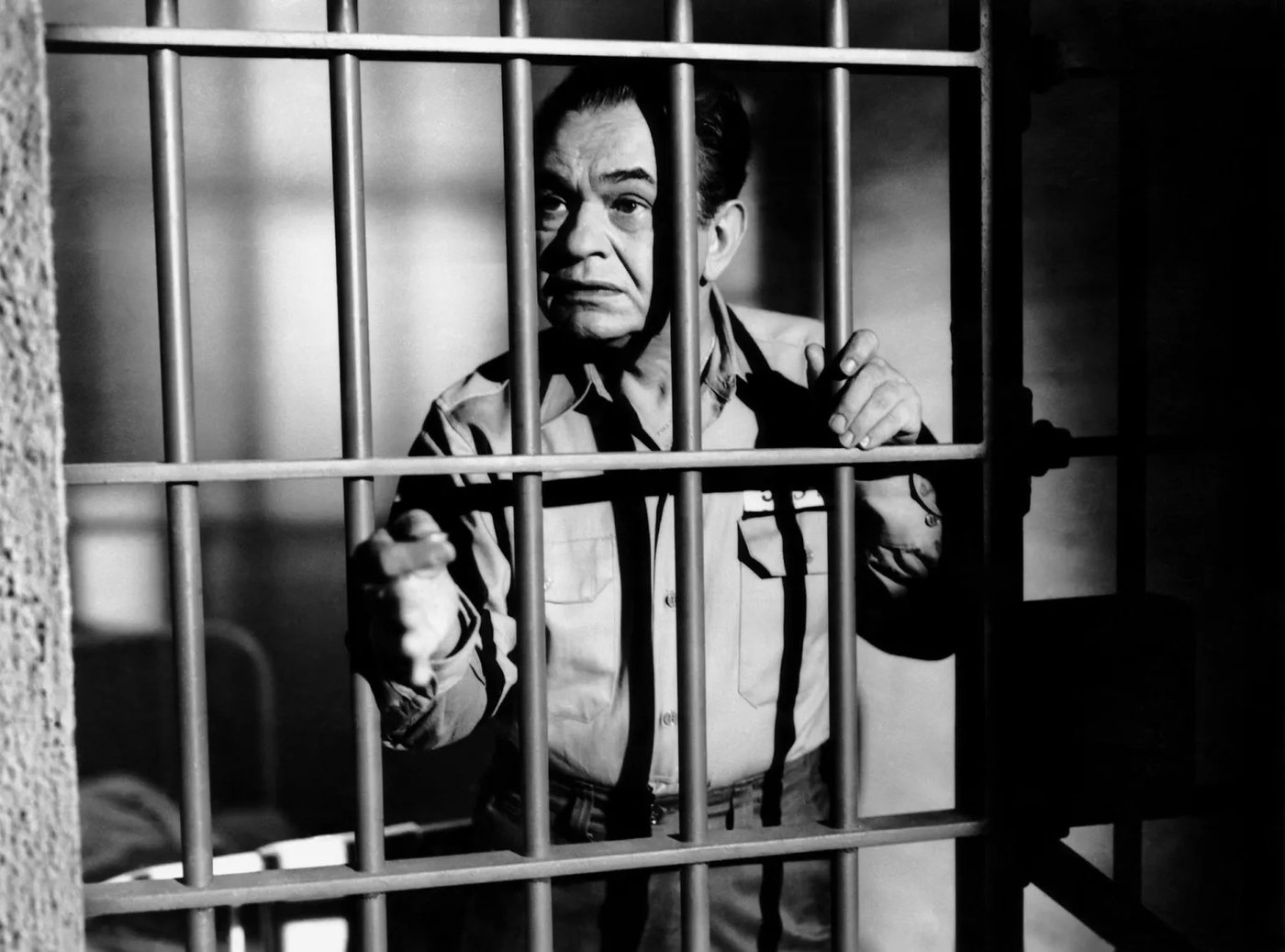
In Black Tuesday (1954), a condemned gangster gets out of prison and ends up cornered in a warehouse. Edward G. Robinson's Vincent Canelli wins the immediate struggle: he escapes execution, takes hostages and keeps moving. Yet the route leads through enclosed spaces toward another siege.[1] Hugo Fregonese can make a breakout feel exhilarating without allowing the architecture to promise freedom.
The Argentine director had considerable experience of leaving. Born in Mendoza in 1908, he worked in his home country's film industry before making Hollywood features, then pursued projects across Europe and eventually returned to Argentina. His travels included a deliberate attempt to loosen his obligations: according to a 1960 interview cited by historians Santiago and Andrés Rubín de Celis, he bought himself out of his Universal contract to seek more ambitious work.[2] Independence was something to negotiate, pay for and try to sustain.
A sentence mistaken for a savings plan
Before Hollywood, Hardly a Criminal (Apenas un delincuente, 1949) gave escape an unusually perverse starting point. Jorge Salcedo plays a clerk who steals money, hides it and accepts imprisonment as the price of eventually enjoying the proceeds. He has treated punishment as a predictable expense. A fellow prisoner's interest in the money exposes what the calculation leaves out.[3]
The premise makes the prison more than an obstacle placed between a man and his wishes. He has chosen to enter it. His plan assumes that he can surrender control of his days while retaining control of his future, as though confinement were simply a period crossed off a calendar. Once other people acquire power over him, that neat separation collapses.
Fregonese gives this bad bargain a bustling setting. As Imogen Sara Smith describes, the film's opening chase and its montage of Buenos Aires street life establish speed and impatience before the story settles around its dissatisfied clerk.[4] The city helps us feel the attraction of a shortcut. It also makes his decision to buy future ease with present confinement seem stranger: he wants to escape an ordinary working life by submitting to an institution that will govern him more completely.
Shelter has conditions
The problem changes shape in Apache Drums (1951), produced by Val Lewton. Stephen McNally's gambler Sam Leeds is expelled from Spanish Boot, then returns with news of an impending attack. The town that has rejected him must reckon with needing him. Eventually its inhabitants take refuge in the church.[5]
Here Fregonese makes the protective building difficult to trust. Darkness, high openings and the sound of the attackers keep attention fixed on what may enter. Smith singles out the violent change from blackness to firelight and painted bodies appearing through the windows.[4] A wall can block a view without blocking a threat. The church concentrates the inhabitants' fear by forcing them to share the same limited information.
There is a serious limit to the film's sympathy. Its opening gives the Apache hunger and dispossession as reasons for resistance, as the AFI catalog records.[5] But the siege largely makes the viewer experience them as a danger arriving from outside. The introductory explanation does not give the attackers the sustained individuality granted to the people sheltering within. Fregonese's command of suspense and the imbalance in that suspense can be recognized together. The walls organize our sympathies as effectively as they organize the action.
Getting out, staying alive
In Black Tuesday, the building belongs to a harsher moral world. Canelli's flight carries hostages into the warehouse with him. His continued survival depends on depriving other people of choices; escape for one man becomes confinement for the people he takes along. Sydney Boehm's screenplay and Stanley Cortez's photography help give that situation its force.[1]
This distinction keeps Fregonese's fascination with fugitives from becoming a simple endorsement of them. We can want to know whether Canelli will get away while seeing exactly whose lives he spends in the attempt. The forward movement of a thriller recruits our attention before our judgment has caught up.
Robinson's tenderness toward Hattie, played by Jean Parker, makes the judgment harder. Dave Kehr notes the contrast between Canelli's brutality and his affection for the woman who has waited for him. Her death during the siege breaks through his composure; even then, he refuses the priest's appeal to surrender.[6] Love reveals a capacity for grief without making him safe for anyone else. The film leaves that contradiction painfully intact.
The freedom to stay
Fregonese's own departures did not guarantee the opportunities he sought. His European years included unrealized projects, among them a long pursuit of a Don Quixote adaptation. He returned to Argentina in 1971 and made his last two features there.[2] The biography supplies a practical caution against turning an itinerant career into a romance of limitless choice. A filmmaker could change countries and still need someone to finance the next picture.
Nor did his films invariably condemn settling down. In Saddle Tramp (1950), Joel McCrea's drifter acquires domestic responsibilities. Kehr draws attention to the ending: standing beside his new wife, he watches migrating geese and tries to persuade himself that their wandering no longer describes his own life.[6] The upward look preserves an appetite that the happy ending cannot quite put away. Staying can be a choice and still involve a loss.
The 2022 retrospective organized by Dave Kehr and Ehsan Khoshbakht, presented at MoMA after its Bologna origins, brought a new restoration of Apache Drums and a new 35mm print of Black Tuesday into this conversation.[7] Seeing these films together makes their differences matter. The clerk tries to purchase freedom, the townspeople pool their vulnerability, the gangster extends his life at others' expense, and the drifter accepts attachments. Fregonese keeps asking what a person will be able to do after the door opens. The answer is seldom contained in the escape itself.
Sources
- The Museum of Modern Art, “Black Tuesday. 1954. Directed by Hugo Fregonese” — credits, prison breakout, hostages and warehouse setting.
- Santiago and Andrés Rubín de Celis, “The Way of a Gaucho: The Career of Hugo Fregonese.” Film International — biography, the Universal contract, unrealized European projects and return to Argentina.
- The Museum of Modern Art, “Apenas un delincuente (Hardly a Criminal). 1949. Directed by Hugo Fregonese” — the clerk's theft, planned imprisonment and encounter with a predatory fellow prisoner.
- Imogen Sara Smith, “Hugo Fregonese: Escape Artist.” MUBI Notebook, 1 September 2022 — Buenos Aires street montage, Apache Drums' siege and the reproduced Black Tuesday still.
- American Film Institute, “Apache Drums (1951).” AFI Catalog — production credits, synopsis and the film's introductory account of Apache hunger and dispossession.
- Dave Kehr, “Hugo Fregonese.” MoMA Magazine, 31 August 2022, reprinted from Film Comment's November–December 2012 issue — Canelli and Hattie, and the closing image of Saddle Tramp.
- The Museum of Modern Art, “Hugo Fregonese: Man on the Run,” 1–14 September 2022 — retrospective organizers, institutional context and exhibition copies.