Spoilers follow, including the ending of Kon Ichikawa's 1983 film.
Cherry blossoms fill the opening of The Makioka Sisters, but the conversation soon reaches money. Four sisters have gathered for their customary Kyoto outing, dressed for an occasion that promises continuity. Audie Bock notes how quickly the opening brings financial concerns into this celebration of spring.[2] The flowers offer a reassuring appointment with beauty. The family's unfinished business comes along.
Ichikawa's adaptation of Junichiro Tanizaki's novel follows an Osaka family whose two eldest daughters are married. Yukiko, the third, must find a husband before the youngest, Taeko, can marry. Sayuri Yoshinaga plays the reserved Yukiko; Yuko Kotegawa plays the more rebellious Taeko.[1] Their futures are joined by a rule that makes age into an order of departure. One sister's hesitation becomes another sister's delay.
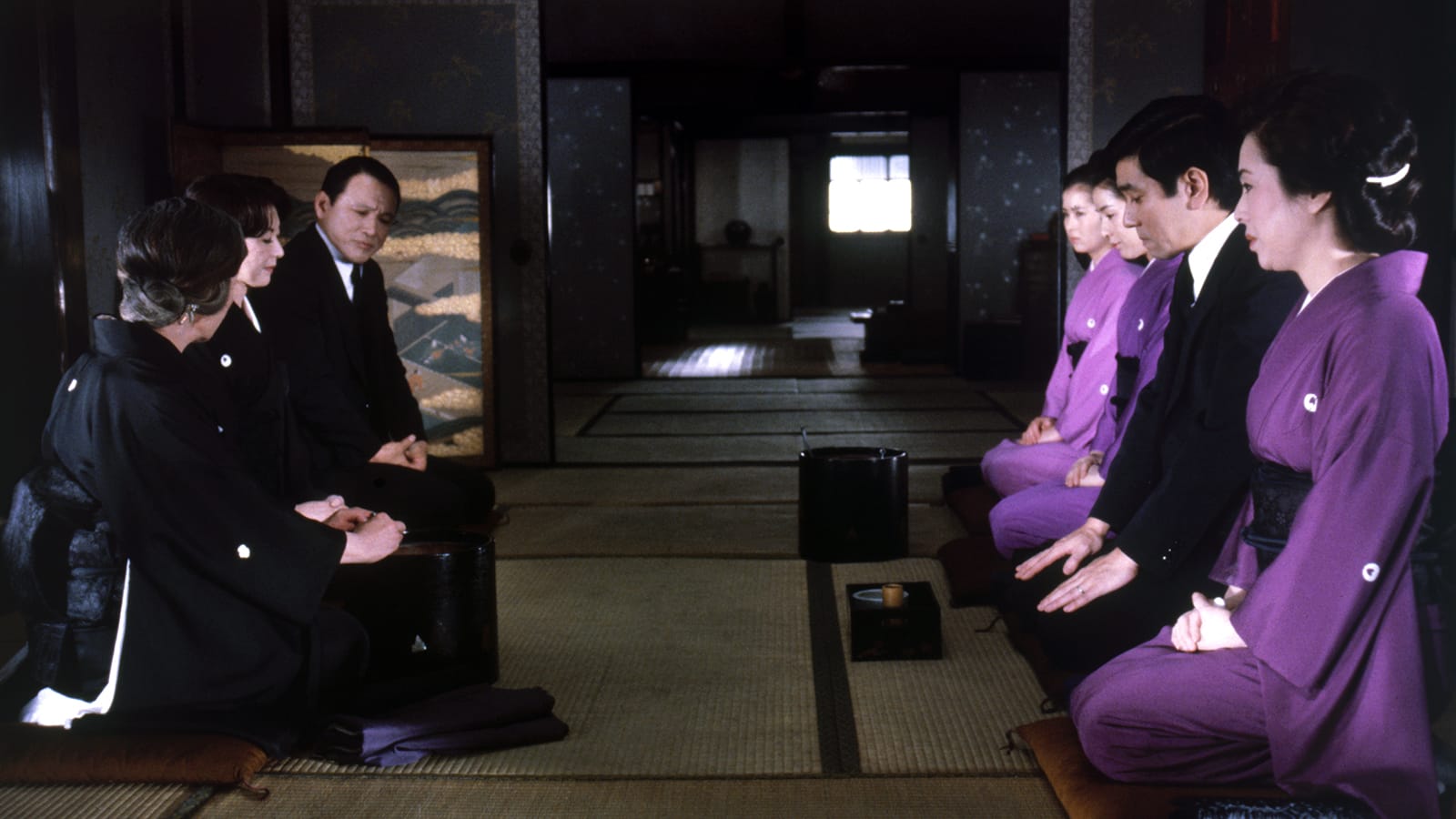
The changing seasons give that arrangement a quietly uncomfortable frame. Spring can return without settling anything. A family outing can be repeated, complete with the pleasure of recognizing familiar faces, while the people taking part grow less able to remain as they are. I read the film's seasonal rhythm as a measure of how much effort goes into making continuity look effortless.
Taeko's problem is especially concrete. She wants access to her dowry to develop her dollmaking, but the eldest sister, Tsuruko, and her husband, Tatsuo, retain control of it until she marries. Marriage, meanwhile, must wait for Yukiko.[3] The arrangement keeps turning Taeko back toward the same closed door. Money intended to support her future cannot finance the future she wants to begin.
This makes the family's solicitude difficult to separate from its authority. The money is being preserved for Taeko, yet she cannot determine its use. A different sequence—work first, marriage later—would require her relatives to accept her judgment about the shape of her own life. Their timetable answers that question before she can make her case.
Such restrictions inhabit a household that also knows how to enjoy itself. Bock describes Tsuruko and Sachiko, the second sister, trying on new obi sashes whose stiff brocade squeaks as they breathe.[2] The detail gives luxury a small, comic voice. Dressing requires assistance; elegance has a texture, a weight and an awkwardness. The women share pleasure in handling the garments, and that intimacy matters. The family whose rules can frustrate them also supplies companionship, practical help and occasions for delight.
Yukiko's waiting is harder to interpret. Her reserve does not make her an empty space into which a suitable husband can simply be placed. Nick Pinkerton observes that the attraction between her and Sachiko's husband, Teinosuke, is communicated largely through their eyelines.[4] Attention travels across the household without becoming a proposal anyone could openly discuss. The official search for a match proceeds alongside a relationship that has no acceptable place in its arrangements.
The distinction between a glance and a declaration gives the film much of its delicacy. A declaration would force a response; a look can leave everyone outwardly where they were. This is also a form of delay. The household can continue functioning while its members experience it differently. Staying together does not require them to agree on what their togetherness means.
The film's beauty therefore deserves scrutiny as well as surrender. In the published summary of her study of the adaptation, Kathe Geist points out that Ichikawa omits the novel's catastrophic Kobe flood. She argues that his changes turn the earlier work toward an affirmation of Japanese cultural identity during the country's renewed commercial strength.[5] That reading locates the film's selectiveness in its own production period. This is a 1983 act of remembering, with choices about what a comfortable past should look like.
The omission also changes the pressure we feel. Without that large rupture, small arrangements can occupy more of our attention: who controls money, who waits, who looks at whom. Their apparent modesty should not make them negligible. For someone trying to leave a household, an ordinary condition attached to a dowry may have more immediate force than the grandeur of the surrounding scenery.
At the end, Yukiko's departure to marry leaves Teinosuke longing for her; his memory returns to the sisters among the blossoms.[3] The family has achieved the outcome it spent so much time arranging, yet the remembered group has become something it cannot simply reassemble. Success has altered the picture.
That is the ache inside the annual outing. A ritual makes another meeting imaginable, and its recurrence can feel like a promise. Ichikawa lets us enjoy that promise while showing how much it asks of the people who sustain it. The blossom season will come back. Each sister still has to decide how much of her life she can spend waiting.
Sources
- The Criterion Collection, “The Makioka Sisters” — official film listing, cast, credits, seasonal structure and marriage premise; source of the photographic film still.
- Audie Bock, “The Makioka Sisters: Of Love and Money.” The Criterion Collection, 10 June 2011 — the opening conversation, annual outing and squeaking obi scene.
- Michael Sragow, “The Makioka Sisters.” The Criterion Collection, 26 September 1993 — Taeko's dowry and dollmaking plans, family marriage order and Teinosuke's closing recollection.
- Nick Pinkerton, “Portrait of a Time Already Gone in Japanese Family Drama The Makioka Sisters.” The Village Voice, 4 May 2011 — household relationships and the attraction conveyed through eyelines.
- Kathe Geist, “Adapting The Makioka Sisters,” in Word and Image in Japanese Cinema. Cambridge University Press, 2000, pp. 108–125 — publicly available chapter summary on the omitted flood and the adaptation's cultural framing.