Contains spoilers for Anthony Asquith’s 1951 film.
Taplow has brought his classics master a secondhand book. Since the master could once have written the book himself, it seems a perilous choice. The volume is Robert Browning’s translation of Aeschylus’s Agamemnon. Andrew Crocker-Harris, now leaving his teaching post through ill health, once worked on a translation of his own. Yet the words that bring him to tears are a schoolboy’s choice of inscription on the flyleaf.[1][2]
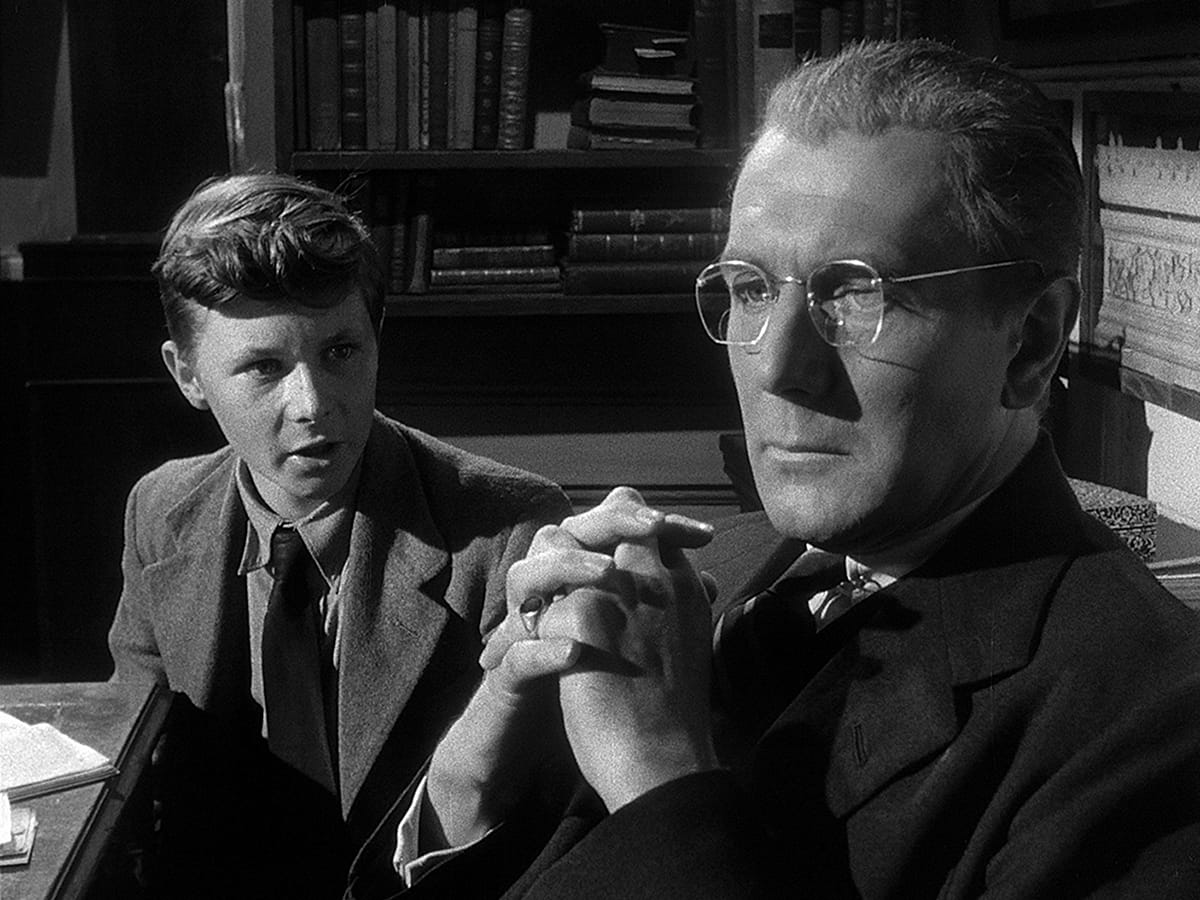
Michael Redgrave plays Andrew and Brian Smith plays Taplow in Anthony Asquith’s The Browning Version.[1] Watch what happens to their usual division of labour when Andrew opens the gift. Ordinarily the teacher sets a passage, the pupil construes it, and the teacher pronounces on the result. This time Taplow has picked the Greek. Andrew has to work out what it means that somebody should have picked it for him.
The difficult word is “gentle”
Taplow’s inscription calls down divine favour on a gentle master.[2] The Greek poses little difficulty for Andrew. The adjective is another matter. Asquith has let us hear about this man before we meet him, and his pupils have found considerably harsher names for him. Then Redgrave supplies the voice that makes a schoolboy’s imitation possible, thin, pitched a little high, so exact in its cadences that a boy can borrow it and be instantly understood. It is quite an achievement to have taught a class how you sound while leaving it so little idea of what you love.[3]
Taplow can do the voice and still want to give the present. That mixture is one of the kindest things the film allows a boy to be capable of. Andrew’s wife Millie, who has heard the imitation, offers her husband a devastatingly economical explanation. The boy fears she will tell on him. A gift might buy him some insurance.[2][4] Millie scarcely needs to dispute a single detail of what happened. She only has to put the mimicry and the book in that order and let Andrew supply the motive.
Think back, though, to the extra trouble Taplow has taken. A boy intent on currying favour could have stopped at Browning. The inscription gives Andrew something to do that he is good at, and it gives him a surprise when he does it. For an instant he gets to discover something by reading Greek. One can imagine how long it has been since he went into a lesson without already knowing the answer. When he cries and then begs pardon for the display, the old professional reflex is almost more painful than the tears. Even now he feels obliged to tell the boy how to judge what he has just seen.[2][4]
Three words at assembly
Terence Rattigan’s stage play leaves Andrew having claimed his turn to speak at the end-of-term ceremony. The screenplay Rattigan wrote for Asquith takes him into the hall and makes us sit through the beginning of his prepared remarks. It matters that he has brought a speech. He could get all the way to the end of it and go home with his dignity intact. Instead he breaks off and says, “I am sorry.” He tells the boys that he has failed them as a teacher.[2][4]
Redgrave gives the two scenes quite different kinds of exposure. In front of Taplow, feeling overtakes Andrew before he can decide what the boy ought to see. At assembly he has time to choose. There are rows of pupils in front of him who would be able to imitate the old voice, and here he is giving them something quite new to repeat. The boys applaud.[2] For once Andrew must stand there and hear a response for which he has drawn up no marking scheme.
It would be easy to take the applause home as a certificate of good teaching. The inscription makes that ending harder and more interesting. Taplow found a use for Greek that his master had never set him. Whatever Andrew taught him contributed to that gift, including the pleasure of getting the words exactly right. What Andrew can give the rest of the school, on the last day he will have them together, is the same courtesy Taplow showed him. He can choose a few words himself, address them to the people who ought to hear them, and leave the answer in their hands.
Sources
- The Criterion Collection, The Browning Version (1951), film credits and still gallery.
- Frank Miller, The Browning Version, Turner Classic Movies, on the inscription, Redgrave’s performance and the adaptation.
- Geoffrey Macnab, The Browning Version, Criterion, on the introduction of Crocker-Harris and Redgrave’s voice.
- Tim Dirks, The Browning Version (1951), Filmsite, scene descriptions and frames from the gift and farewell sequences.