Spoilers for the early stages of the voyage.
At Kingston Dock in Glasgow, a man goes to inspect the vessel that will carry his employer’s belongings. He walks straight past it. The boat alongside looks perfectly satisfactory, and Mr Pusey can go back to work with a clear conscience. Watch the distance he covers on foot. Alexander Mackendrick needs just one extra berth to turn a conscientious employee into an accomplice. [1]
The cargo in The Maggie, Mackendrick’s 1954 Ealing comedy, belongs to Calvin B. Marshall, an American airline magnate fitting out a Scottish island house as a surprise for his wife. The boat Pusey walked past is a Clyde puffer, a small steam cargo vessel whose skipper urgently needs the fee. Alex Mackenzie plays Mactaggart, who has secured the job under a misapprehension he can ill afford to clear up. Paul Douglas plays Marshall. By the time the two men have business face to face, someone else has already vouched for the boat. [2][3]
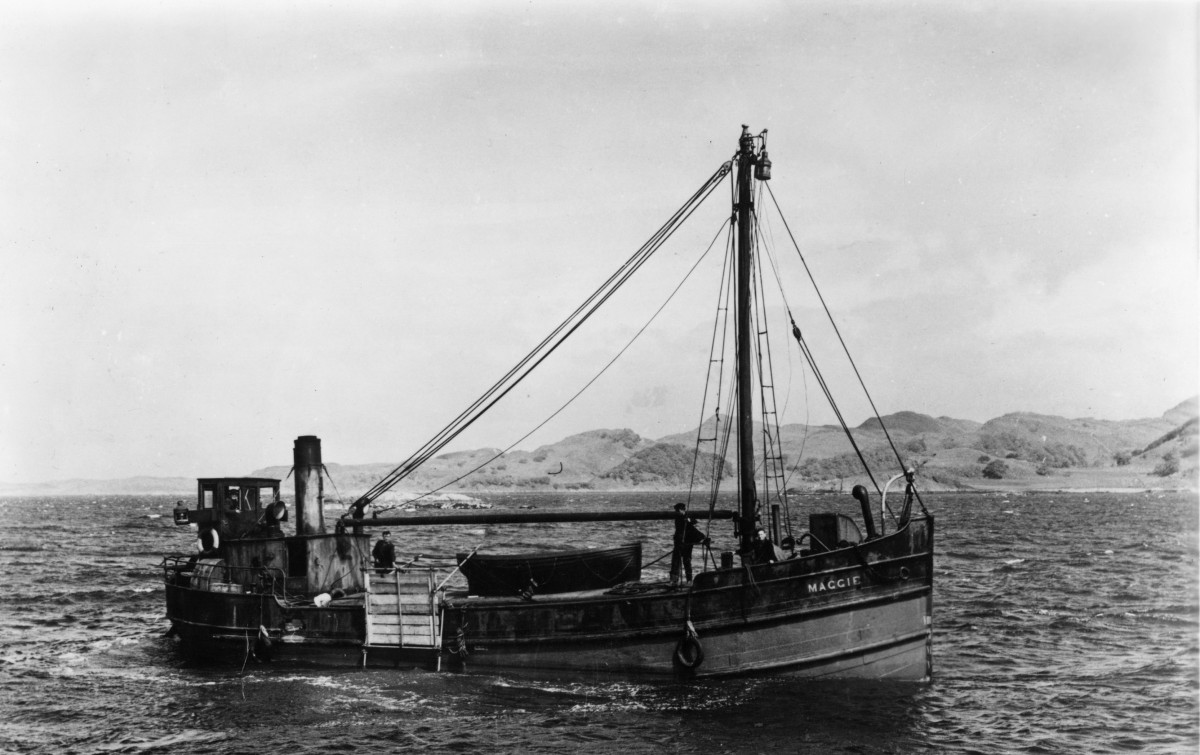
Pusey’s mistake is a generous joke. Give the man a clipboard and a list of things to check and he could make it again. The one thing he needs to establish comes before any question about seaworthiness. Which boat are we talking about? The spectator has an advantage here that money will keep failing to buy Marshall. We have seen the skipper and crew come ashore. We know where they belong when they get back.
Soon all Glasgow seems able to identify the Maggie. Having set out at low tide, she spends the night stuck on the roof of the subway tunnel under the Clyde. A newspaper reporter comes down to ask the skipper for a statement. People gather on the suspension bridge and cheer when the rising water floats her free. Mackendrick has picked a lovely spot for a maritime embarrassment. Even before the audience on the bridge arrives, the boat has been held up by public transport. [1]
Those cheers complicate the easy pleasure of seeing Mactaggart caught out. From the bridge, the sight everyone has waited for is a boat beginning to move. From Marshall’s end, the same movement carries a stove, plumbing and heating equipment farther away in a vessel he has every reason to distrust. Imagine the sequence ending with a cut to an empty room in the island house. It would be quite easy to get a laugh at the skipper’s expense. On the riverbank we share his relief. [1][2]
Marshall has the means to change our vantage point. He takes a light aircraft and a hired car, catching up with the puffer at a swing bridge on the Crinan Canal. There is Pusey again, pointing his umbrella down at Mactaggart. In Glasgow he could have reached the right boat by taking a few steps back. Now it has taken two men and two vehicles to get that pointing gesture right. The umbrella is marvellously precise and wholly inadequate. Everybody can see which boat has the goods. Somebody still has to get them off it. [1]
In an essay on the film, Colin McArthur places its Scottish victory fantasy against the growth of American investment in postwar Scotland. The encounter at the bridge gives that reading a peculiar tenderness. An airline man has flown after a little steamboat, and his grievance is as homely as the skipper’s. One man would like his wife to walk into a furnished house. The other would like to wake up tomorrow with a boat to run. At the dock it seemed obvious which of them could afford to lose. By the time Pusey raises his umbrella, I find myself mentally unloading a stove, wondering who on either side of this argument has come prepared to lift the other end. [1][2][4]
Sources
- Phil Wilkinson, Reelstreets, film frames and location identifications for The Maggie, especially captures 2–12 and 19–20.
- StudioCanal Vintage Classics, The Maggie, synopsis, cast, restoration notes and official stills gallery.
- British Film Institute, “10 great films set in Glasgow,” on the Clyde puffer and Marshall’s business.
- Colin McArthur, “The Maggie,” in Cinema, Culture, Scotland, Edinburgh University Press.