A man unfolds a map on a moving train. Give him a seat in a passenger coach and the most he can do is annoy the person beside him. In Gerald Potterton’s 1965 short The Railrodder, Buster Keaton has the vehicle to himself. It is a railway maintenance cart with an open top, scarcely wider than the track, and he has chosen to consult his map on a trestle. Each fold he opens makes the sheet more useful as a map and more troublesome as a piece of paper. Meanwhile the wheels are taking care of the one question a map could answer. The man can only go where the rails go. [1][2]
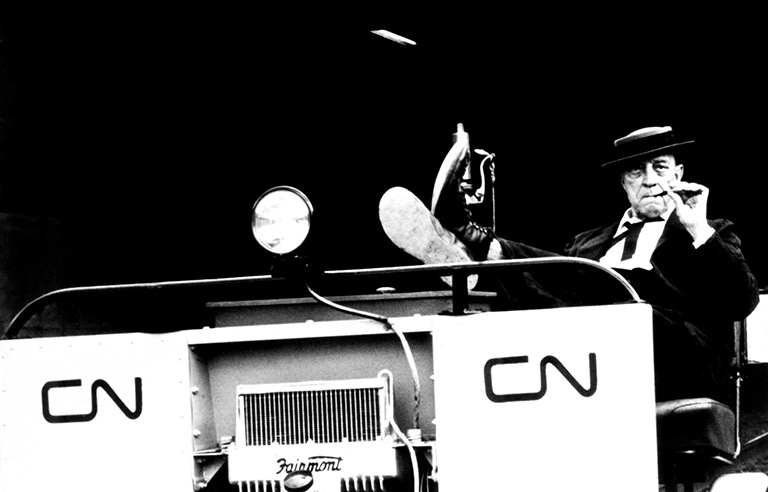
Potterton came upon the vehicle before he came up with the passenger. Driving to work in Montreal, he saw a railway worker crossing a bridge on a speeder. He had been thinking about a film that would take a camera across Canada. What caught his eye that morning was how a person looked going by. There is a whole change of camera position in that thought. Put us at the front of a train and we can watch the country approaching. Let us see the person riding through it and we can also watch what escapes his notice. Potterton took about half a page of script to his meeting with Keaton. [3][4]
The trip begins with another sheet of paper. In London, Keaton finds an advertisement in his newspaper inviting him to see Canada. There follows a rush of things worth seeing, including a herd of buffalo and Mounties riding in formation. Then he jumps into the Thames. By the time he wades ashore in Nova Scotia, the film has spent fewer moments getting him across the Atlantic than an ordinary traveller might spend looking up a fare. The ad said “See Canada Now.” The joke depends on his attention to that last word. [1][3]
Once he has the cart, Potterton can let the traveller keep his own hours. Out on the prairie, Keaton takes tea with bison for company. The animals that went by in such a hurry in the advertisement now have leisure to look at him. It is a lovely reversal for a travel film. We have come all this way to see the wildlife, and the wildlife has turned out for a look at an Englishman taking tea. His absorption in the business at hand gives the animals time to become funny. A big reaction from him would use up that time. [1][2]
On the trestle, the same habit divides the audience’s attention more painfully. There is a small domestic difficulty we know in our fingers, the effort of getting a great sheet of folded paper under control. Beyond its edges we can see the drop. Keaton can give the paper his full attention because we are doing the worrying for him. The director had to carry both thoughts at once. According to National Film Board curator Albert Ohayon, the men often worked out gags the night before shooting. This one worried Potterton and the crew, and Keaton insisted on performing it himself. He turned sixty-nine during production. [1][2]
Knowing that can change where you look. On a first viewing it is easy to search the edges of the cart for danger. On a second, watch how much work the map has been given. It provides a reason for Keaton to be busy, grows big enough to interfere with him and keeps his predicament legible from a distance. A close-up of a worried face would cost us the sight of the trestle. A close-up of the map would cost us Keaton. A traveller trying to find his place on a piece of paper gives Potterton a way to keep a man, a vehicle and a considerable piece of Canada in the same joke. [1]
Sources
- Gerald Potterton, The Railrodder (1965), National Film Board of Canada.
- Albert Ohayon, “Buster Keaton rides the rails in Canada,” National Film Board of Canada.
- Gare Joyce, “The Railrodder,” Canada’s History. Interview with Potterton and photograph of Keaton on the speeder.
- National Film Board of Canada, Gerald Potterton recalls pitching the film to Keaton.