Contains spoilers for The Gunfighter (1950).
Given a few minutes alone with his father, a boy asks who was the toughest man he ever saw. It sounds like a waste of precious time. There is quite a lot Jimmy Ringo might like to tell his son, starting with the fact that he is his father. But the boy believes he has been granted an audience with a celebrity, and on those terms it is an excellent question. For once Jimmy gets to choose whose name a child will carry out of the room. [1][2]
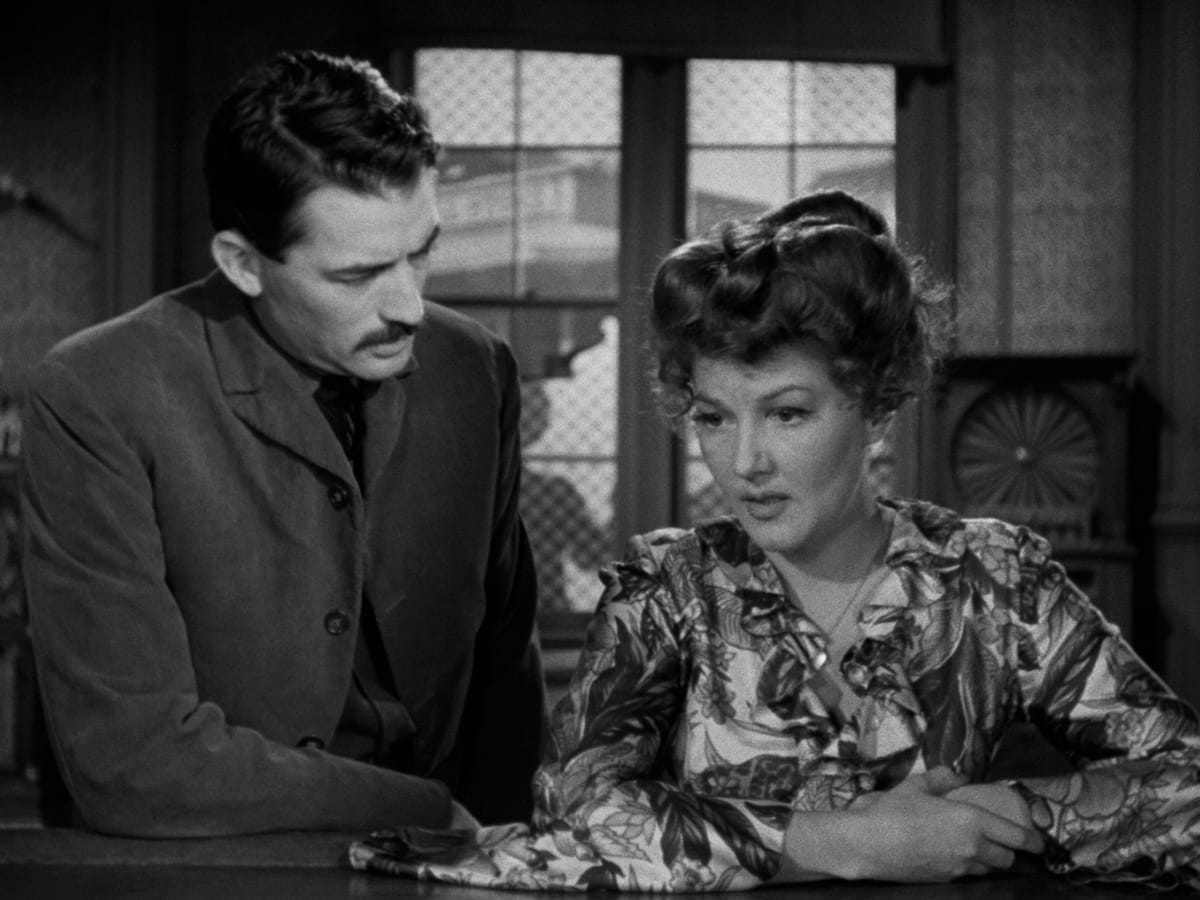
By the time Henry King brings the two together, we have had most of a picture to consider what a schoolboy in Cayenne can learn in one morning. The boys abandon their lessons to hang around the Palace Bar, where the famous gunman is waiting. Their teacher, Peggy Walsh, happens to be Jimmy’s estranged wife. As K. Austin Collins points out, even the girls get a holiday out of this mass desertion. A man sits down for a meal and changes the timetable at a school he has never entered. Somewhere among these children is the one he came to town to see. [2][3]
The joke grows sharper as word gets around. A deputation of respectable women goes to the marshal’s office to complain about the visitor. They deliver their complaint to Jimmy himself. For all the trouble his name has caused, his face needs an introduction. Gregory Peck lets the women finish. There is a little pocket of freedom in listening to people describe you when they have no idea who you are. His boy will give him a more painful version of the same privilege. [2][3]
Peggy has good reason to preserve that gap between the name and the face. She has a job here. Her son can run with the other boys. Jimmy’s suggestion that they start over somewhere out west makes distance sound wonderfully cheap, especially coming from a man with a horse waiting. Peggy has just seen how little time it takes a stranger to disrupt her classroom. The year they agree to let pass before they reconsider would be evidence she could use. A promise made during a hurried visit costs him very little. A year of ordinary mornings would cost him some ingenuity. [2]
Then the boy comes in with his question, and Jimmy names Mark Strett, the town marshal. Mark goes about his business without a gun. He also used to ride with Jimmy. The boy already knows the lawman and has had ample opportunity to observe him. What he lacks is any reason to study him as closely as he studies this visitor. For an instant Jimmy can put the considerable advertising power of his own name behind a man who managed to leave their old life. He can even do it without breaking Peggy’s confidence. Any stranger might give a boy that answer. Only his father has quite so much riding on it. [2]
King saves a harsh rhyme for the space behind the saloon. As Graham Fuller observes in Sight and Sound, the spectators who have gathered for a fair fight never get one. Hunt Bromley shoots Jimmy in the back. Dying, Jimmy asks Mark to say that Jimmy drew first. The lie sounds generous until you remember those boys outside the Palace. By morning there can be a new answer to the question of who the toughest man is. Bromley will spend the rest of his life meeting people eager to test it. [2][4]
At the funeral Peggy finally claims her place in public as Jimmy’s wife. Her son can own the relationship now, when no introduction is possible. What the boy still has, and what nobody else at the funeral can have in quite the same way, is a piece of advice he received before he knew enough to ask his father for it. The next time he passes the marshal on the street, he has a reason to look twice. [2]
Sources
- The Criterion Collection, The Gunfighter (1950), film credits and still gallery.
- American Film Institute, The Gunfighter, AFI Catalog synopsis and production record.
- K. Austin Collins, “The Gunfighter: You Can’t Go Home Again,” The Criterion Collection.
- Graham Fuller, “The psychological western,” Sight and Sound.