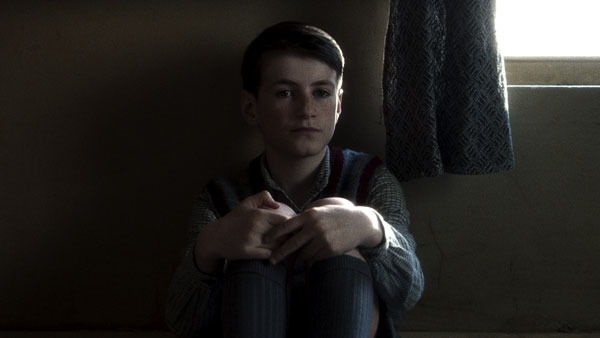
Discusses several sequences, without recounting the ending.
A patch of sunlight travels across a carpet. The camera waits. In The Long Day Closes, this modest domestic event receives the time and musical attention another film might reserve for an arrival or a revelation.[4] It asks us to become interested in a room before anyone does anything in it.
Terence Davies's 1992 film follows Bud, played by Leigh McCormack, through a remembered Liverpool childhood. Marjorie Yates plays his mother; Michael Coulter photographed the film, Christopher Hobbs designed its spaces, and William Diver edited it.[1] Their work gives recollection a physical form. We feel the distance between a boy and the world through a window, a pool of light, or the movement that carries us from one room into another.
The result can seem to drift, yet its transitions are exceptionally deliberate. A useful way into the film is to watch what remains continuous when the place or time changes.
A house returns before its story does
Early in the film, the camera advances along a ruined, rain-soaked street and enters an abandoned house. A dissolve restores the interior to inhabited life, with Bud on the stairs. Michael Koresky's Criterion essay describes this movement from dereliction into the remembered home.[2]
The camera has established a route before the edit changes the building's condition. That shared route lets the audience recognize the house across time. We need no explanatory conversation about who used to live there: the transformation is legible in the surfaces around us.
It also makes the return precarious. The empty building is already in our memory when the household appears. We can enjoy the room's recovered warmth while retaining an image of its disappearance. The dissolve allows those two states to touch; a clean break would give us less time to feel their overlap.
Give light somewhere to stop
The film's appearance involved decisions made across several crafts. In a contemporary account reprinted by BFI Southbank, Pat Kirkham and Mike O'Shaughnessy report that Davies showed Coulter paintings by Vermeer and Rembrandt, alongside 1950s Kodachrome photographs of Lancashire. Strongly illuminated areas falling away into shadow were among his references.[3]
The same account describes tests involving stocks, lenses, filters, and bleach bypass, as well as a restricted palette for sets and costumes. Older Cooke lenses helped soften the image's definition. The desired effect depended on how photographed objects, optics, and printing worked together.[3]
That coordination matters dramatically. A bright window does not have to make the whole room equally available. Light can gather around Bud while leaving the space beyond him obscure. Such an image offers shelter with a visible edge: warmth occupies a particular portion of the frame. The eye discovers both the invitation to come closer and the darkness surrounding it.
Let a room hold the attention
The carpet sequence gives this control of attention an unusually long test. As Koresky details in his published study of Davies, a nighttime view of one rug dissolves into another carpet under changing daylight. Eventually the camera tilts up to reveal Bud looking through the window, with a curtain over him. Butterworth's A Shropshire Lad accompanies the passage.[4]
The delayed reveal changes our relationship to the room. At first, we have no face telling us how to respond. Brightness and shadow provide the activity. Once Bud appears, we discover that he has been looking elsewhere; our prolonged attention to the floor cannot simply be assigned to his literal point of view.[4]
This is an intimate film with room for an independent viewer. It can bring us close to childhood without making every image an illustration of what the child sees. The pause gives us our own small experience of waiting, noticing, and wanting something to happen.
Carry the movement across the cut
Another sequence begins with Bud swinging on a railing while Debbie Reynolds sings “Tammy.” Overhead camera movements and dissolves carry us through a cinema, a church, and a classroom, before returning to the boy. MUBI's account traces the route and its repeated vantage point.[5]
From above, rows of seated people become a recurring arrangement. The continuity of motion helps us recognize the resemblance before considering what each room demands of its occupants. Sitting together can mean pleasure, worship, or instruction. Similar geometry accommodates very different kinds of attention.
The sequence's unity therefore leaves room for disagreement between the spaces. The cinema offers Bud a pleasure that cannot be assumed of school or church. Movement joins these experiences without making them emotionally interchangeable. Returning to the railing brings the excursion back to a small, repetitive bodily action: the world has opened out while the boy remains where we left him.
The soundtrack can choose the next room
In a 2012 interview with Michael Guillen, Davies explained his broader approach to transitions. An ordinary cut, he suggested, tends to be understood as the next thing happening. Dissolves can unsettle that assumption, letting a sequence follow emotional association. He compared the audience's ability to follow such relationships to listening to a symphony.[6]
That distinction helps explain why the film remains navigable even when a calendar would be difficult to reconstruct. A melody, a continuing movement, or a familiar shape supplies something to follow. The viewer can recognize a relationship without deciding precisely how much time has elapsed.
There is a practical generosity in this. Davies gives us perceptible connections while leaving their emotional weight open. The same transition can feel comforting because it holds things together, and melancholy because it makes their separation apparent. We are allowed to arrive at either feeling before finding words for it.
The changing carpet light and the journey across public rooms work at different scales. One holds our attention inside a small patch of domestic space; the other carries it across the institutions of a childhood. Both give memory a duration we can inhabit. The house feels remembered because the film has taught us how to spend time there.
Sources
- The Criterion Collection, The Long Day Closes — film year, cast, crew, and supervised restoration details.
- Michael Koresky, “The Long Day Closes: In His Own Good Time,” The Criterion Collection, January 28, 2014 — opening movement into the house, autobiographical context, and the film still reproduced above.
- BFI Southbank, The Long Day Closes programme notes, 2025, reprinting Pat Kirkham and Mike O'Shaughnessy, Sight and Sound, May 1992 — contemporary reporting on lighting references, lenses, colour, design, and printing.
- Michael Koresky, “The Rug Shot,” excerpt from Terence Davies, University of Illinois Press, 2014, reproduced with permission in the Badlands Collective's September 10, 2014 screening programme, page 3 — the two carpets, camera movement, Bud's position, and Butterworth's music.
- MUBI Notebook, “The Camera Moves #8,” December 12, 2017 — written analysis of the “Tammy” sequence and its cinema, church, classroom, and railing transitions.
- Michael Guillen, “Memory as Mise-en-scène: A Conversation with Terence Davies,” MUBI Notebook, March 21, 2012 — the director on editing, emotional association, and musical structure.