Spoilers follow, including the death and the ending.
The frightening thing about a secret is that someone can entrust it to you without explaining what it means. In The Fallen Idol (1948), a boy acquires responsibility much faster than he acquires understanding. Adults want him to notice nothing, remember selectively, and speak at precisely the right moment. Their expectations would defeat a considerably older accomplice.
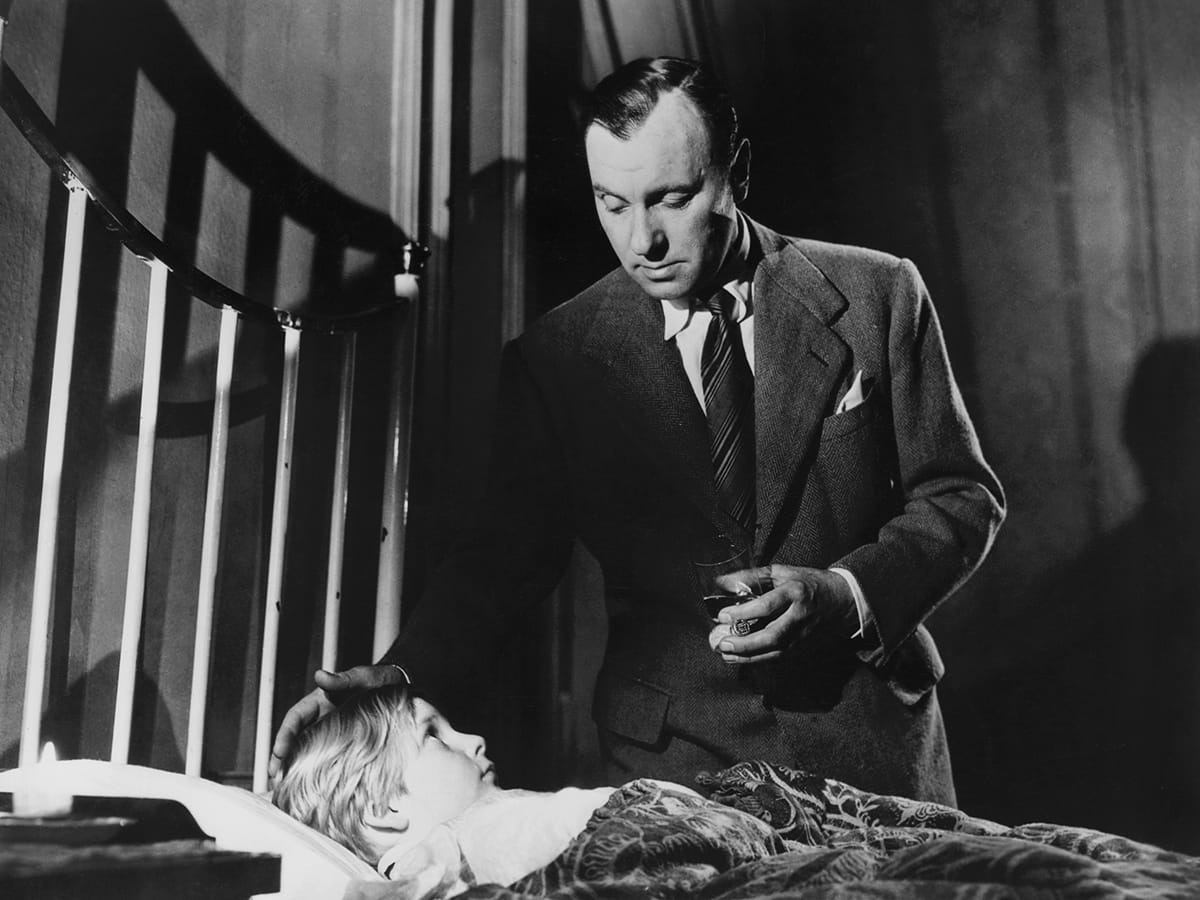
Carol Reed directed the film from Graham Greene's screenplay, with Ralph Richardson as the embassy butler Baines and Bobby Henrey as the ambassador's son, Philippe.[1] Its suspense grows from a painful imbalance: the boy loves Baines enough to protect him, but knows too little to judge what protection requires.
An invitation with hidden conditions
The tea-shop encounter gives that imbalance an ordinary setting. Philippe discovers Baines with Julie, played by Michèle Morgan. Baines introduces her as his niece. To an adult spectator, the strained conversation belongs to a couple whose relationship is in trouble; to Philippe, the explanation offers a perfectly serviceable family connection. He is subsequently asked to keep the outing secret.[2]
Calling Julie a niece does more than conceal an affair. It gives Philippe a role in a scene whose real participants understand it differently. He can join them, enjoy their company, and feel included, while remaining excluded from the knowledge that governs their behaviour.
That is the trap in Baines's warmth. An adult who makes time for a lonely child can also recruit that child into arrangements serving the adult's needs. The affection need not be false for the demand to be unfair.
The boy who will not take a hint
Henrey's performance keeps Philippe from becoming a miniature detective. Geoffrey O'Brien points to his awkward timing: he speaks too loudly, intrudes, and fails to read signals that seem obvious to the adults. His apparent lack of polish gives the surrounding performances something resistant to work against.[3]
Watch the difference between attending to a conversation and knowing how to behave within it. Philippe can listen closely without recognising that he is meant to withdraw. A pause that adults understand as embarrassment may seem to him like an opening for another question.
The resulting comedy is uncomfortable because the audience possesses the missing social knowledge. We may wish the boy would stop interrupting. Then the film makes us register the selfishness inside that wish: why should he be responsible for making their deception run smoothly?
The interval he cannot see
The fatal sequence turns this difference in knowledge into an editing problem. After Baines and his wife confront each other, Philippe retreats down the outside fire escape. Windows give him intermittent views. He sees conflict and, later, its apparent consequence; the movement between floors hides the decisive interval.[4]
Reed lets the audience see what the boy misses. Baines has disengaged from the struggle before Mrs. Baines falls while attempting to spy from a ledge. Her death is accidental. Philippe nevertheless believes that Baines killed her. Chris Machell's account of the adaptation emphasises this change from Greene's story, in which Baines causes the fatal fall.[4]
The distinction changes what we fear. We know an innocent man may be accused, while Philippe believes a guilty friend must be saved. Every protective lie therefore has two meanings. For the boy it demonstrates loyalty; for us it threatens to manufacture the case against Baines. Seeing more gives the audience anxiety rather than control.
A hero under questioning
Richardson makes the child's mistaken confidence credible. Baines can entertain Philippe with invented adventures, yet become halting and confused when questioned by the police. Brian Eggert describes the butler's pacing, sweating, and corrections as his authority collapses under scrutiny.[5]
Those changes expose how local his command has always been. With Philippe, he chooses the story and knows more than his listener. With detectives, he must answer questions whose implications he cannot control. His affectionate storytelling has given the boy a confident hero to imitate, but offers neither of them a dependable method for dealing with suspicion.
There is a sting in the resemblance between them. Both try to protect someone by managing what an investigator hears; both make matters worse. Baines has helped teach Philippe that love and concealment belong together. Now he must endure the consequences of being loved on those terms.
A correct conclusion can rest on a mistake
The ending refuses a simple lesson about truth winning out. A footprint on the ledge helps clear Baines. Yet, as Norman N. Holland explains, the mark was left before the fatal incident. Philippe tries to correct the police's understanding and is dismissed after his earlier lies. The investigators reach the right conclusion about Baines's innocence without correctly reconstructing the clue's history.[6]
This is also the ending's vulnerable point. In his Sight and Sound essay, reprinted in BFI programme notes, Philip Kemp argues that the police abandon their suspicions too readily and that the resolution weakens the film.[7] The objection deserves weight: a convenient escape can release suspense without satisfying the reasoning that produced it.
But the convenience leaves a troubling residue. Philippe has finally attempted the behaviour adults prescribe, and the adults have stopped listening. The return of his parents closes the household emergency without demonstrating that anyone has understood his ordeal.[3]
Baines is safe. The boy's education is harder to assess. He has discovered that being trusted with a secret and being trusted when he speaks are separate privileges. The people who gave him the first have proved much less willing to grant him the second.
Sources
- The Criterion Collection, The Fallen Idol — film year, director, screenwriter, and cast credits.
- Howard A. Rodman, “The Fallen Idol,” Criterion, December 22, 1992 — tea-shop encounter, secrecy, and accompanying film still.
- Geoffrey O'Brien, “The Fallen Idol: Through a Child's Eye, Darkly,” Criterion, November 6, 2006 — Henrey's performance, adult expectations, and the parents' return.
- Chris Machell, “A Shocking Thing for a Child: Subjective Truth in Fallen Idol,” THRESHOLDS, February 2018 — the fire-escape sequence and changes to Greene's story.
- Brian Eggert, “The Fallen Idol (1948),” Deep Focus Review, May 10, 2018 — Richardson's changing performance and the interrogation.
- Norman N. Holland, “Carol Reed, The Fallen Idol (1948)” — the misleading footprint and Philippe's rejected correction.
- Philip Kemp, “The Fallen Idol,” Sight and Sound, August 2006, reprinted in BFI Southbank programme notes, September 13, 2021 — criticism of the ending.