Alfred Hitchcock's The Lodger: A Story of the London Fog is easy to shrink into a career-origin anecdote. It is the early silent film he later called his "first true Hitchcock movie." It has a threatened blonde, a wrongly suspected man, an anxious crowd, a director cameo, and a boarding-house interior that already seems to know the grammar of later suspense.[1][2][5] Those facts are true, but they can make the film sound like a sketchbook for masterpieces still to come.
The stronger reason The Lodger matters is that it makes suspense spatial before it makes suspense branded. In 1927, Hitchcock was not yet the Master of Suspense as a public identity. BFI frames the film more concretely: a strange lodger may be a serial killer in Hitchcock's first suspense thriller, with a fog-shrouded London, matinee idol Ivor Novello, and the famous glass-floor image that lets the people downstairs "hear" footsteps by seeing the man above them.[1] Henry K. Miller's Guardian account likewise anchors the film in Hitchcock's third-feature moment, when the director later described it as the true beginning of his career.[2]
That movement is the real genre story. The Lodger does not invent the thriller from nothing. It draws on Jack-the-Ripper memory, Marie Belloc Lowndes's story world, theatrical melodrama, German Expressionist lighting, British popular crime fiction, and silent-era visual ingenuity.[2][3][5] But it fuses those materials into a practical suspense machine. Fear enters a house, climbs the stairs, circulates through newspapers, gets misread by lovers and parents, then returns as mob pressure. The film teaches the thriller to ask not only who did it, but how suspicion travels before anyone knows.
Before The Hitchcock Brand
Hindsight makes The Lodger look inevitable. The blonde victim. The innocent man under pressure. The possessive policeman. The public appetite for murder. The cameo. The staircase. The dangerous ambiguity of looking. Miller's account is useful because it places the famous "first true Hitchcock movie" phrase back inside a messy production year rather than treating it as a simple destiny label.[2] The Lodger therefore looks less like a first step on a prewritten road than like a discovery: here was a form elastic enough to hold his instincts together.
The film's movement-and-genre importance sits in that discovery. British cinema in the mid-1920s did not have to make this kind of thriller look so unstable. The story could have become a tidy mystery with clear clues, a villain unmasked, and a romance repaired. Hitchcock instead leans into atmosphere, point of view, mistaken inference, and visual pressure. BFI's film record calls attention to the expressionist mood in an English context, while the San Francisco Silent Film Festival's BFI National Archive essay ties the film to Hitchcock's return from Germany and the influence of films such as The Cabinet of Dr. Caligari and Nosferatu.[1][5]
That influence matters because Hitchcock does not merely import shadows. He domesticates them. The angled unease of German Expressionism is moved into a rented London room, a landlady's worry, a daughter's desire, and a newspaper city hungry for another Tuesday murder. The style does not float above the plot. It changes how ordinary English interiors behave.
The Boarding House Becomes A Sensor
The most famous device in The Lodger is the transparent ceiling. The Buntings sit below while the lodger paces above; Hitchcock makes the ceiling disappear so that the audience sees the feet and body that the family can only hear.[1][5] The trick is technically showy, but the scene endures because it solves a silent-film problem with genre intelligence. Without synchronized sound, the movie still has to make footsteps oppressive. It does so by turning hearing into architecture.
The room upstairs is not simply where a suspect sleeps. It is a pressure chamber. Every movement from above alters the meaning of the downstairs space. A ceiling should be a boundary between domestic layers; Hitchcock turns it into a membrane. The people below are not witnesses in any legal sense, yet they begin to feel surrounded by evidence. The house becomes a sensor that misreads its own signals.
That is the seed of a recurring suspense method. Later thrillers would use microphones, telephones, surveillance windows, flashbulbs, motel peepholes, rear windows, and shower curtains. The Lodger gets there with a ceiling, a staircase, a room search, and the rhythm of a man leaving at night. The question is not merely whether the lodger is guilty. The question is whether a domestic space can stay ordinary once suspicion has trained everyone to interpret it.
The San Francisco Silent Film Festival's BFI Archive essay notes that Ivor Montagu later reduced the number of title cards sharply, which helps underline the film's commitment to visual rather than explanatory cadence.[5] That matters because the suspense is not locked inside one clue. It is made by timing: who is out, who is awake, who is looking, who has a key, who is late, who knows too little, and who knows too much too early.
The City Feeds On Murder
The film begins by making murder into circulation. A scream, a body, a public report, a sign, gossip, paper, performance, and street talk all move faster than moral understanding. BFI's 2012 review essay describes the story as a capital in panic, with a killer known as the Avenger haunting darkened streets and preying on blonde-haired women.[4] Public Domain Review's collection note similarly places the film around the hunt for a serial killer in London, while emphasizing its roots in Lowndes's story and stage adaptation.[3]
This is why The Lodger belongs to thriller history rather than only Hitchcock history. It understands that crime in a city is mediated. The Avenger is not just a person in the plot. He is also a name, a weekly expectation, a press rhythm, a sign that flashes "Golden Curls," a commodity for news sellers, and a fear that tells women how to arrange their hair before going outside.[3][4] Suspense grows because information keeps moving while certainty does not.
The wrong-man structure depends on that gap. Suspicion is socially useful before it is true. It lets the policeman Joe turn jealousy into investigative posture. It lets the parents organize their unease around a visible tenant. It lets the crowd become righteous before evidence has caught up. The film's genre logic is sharp: a city frightened by an unknown murderer may prefer the wrong suspect to no suspect at all.
Star Image Makes The Suspect Unstable
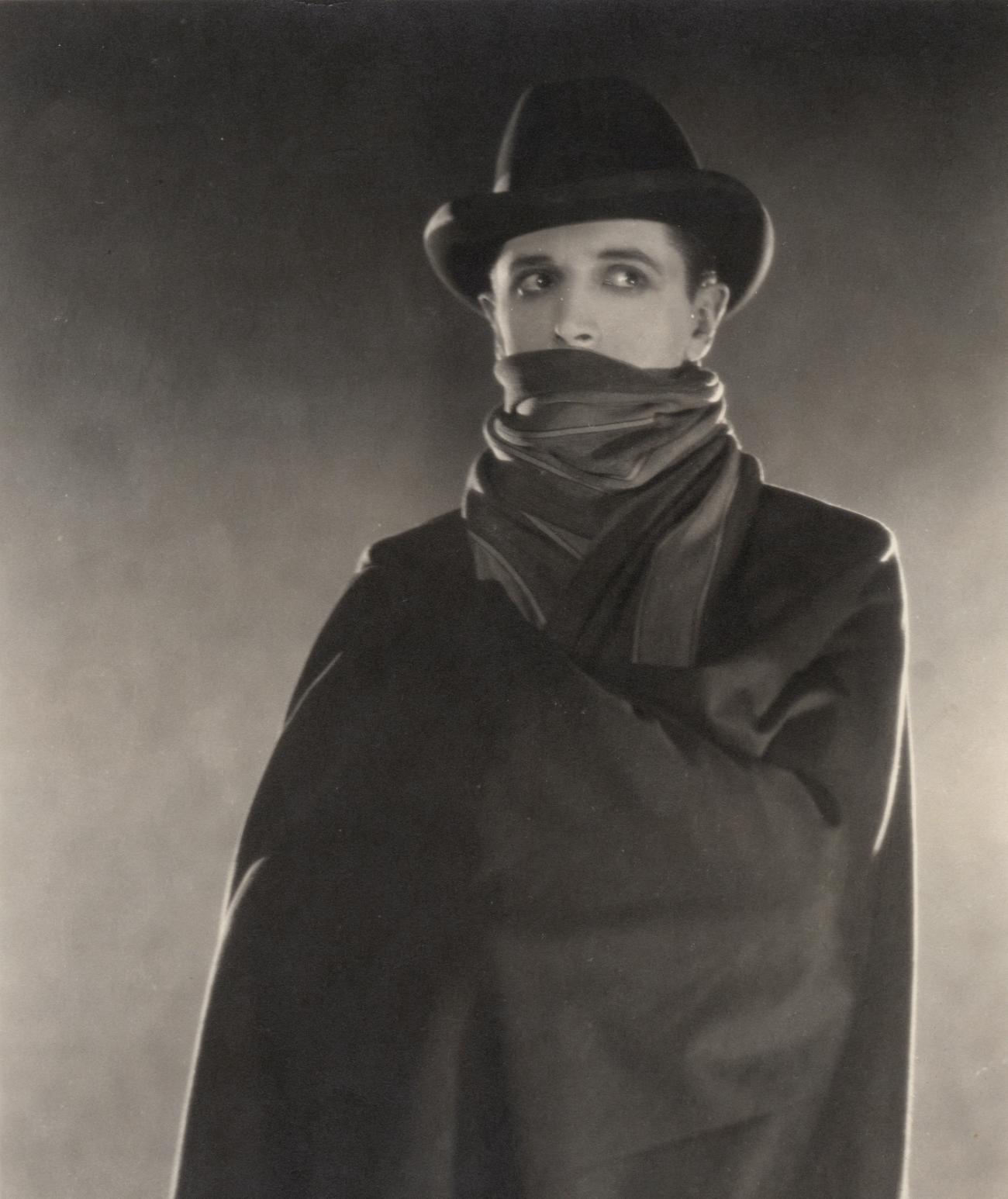
Ivor Novello is crucial because his casting makes the film argue with itself. BFI notes that Hitchcock asked the audience to think the worst of a matinee idol in the title role, while Miller describes Novello as Britain's preeminent male star at the time.[1][2]
That star image becomes part of the suspense. The viewer is asked to read Novello's beauty both ways. His wrapped face, pale gaze, and careful movement make him look dangerous, wounded, theatrical, and possibly innocent all at once. If he were played only as a monster, the film would become a hunt. If he were played only as a romantic victim, the film would lose its dread. Instead, his star image keeps bending the accusation. The house suspects him even while the image invites fascination.
This ambiguity is one of the film's most durable genre lessons. Suspense does not require the viewer to believe every possibility equally. It requires the viewer to feel how each possibility changes the space. If the lodger is guilty, the upstairs room is a hidden murder chamber. If he is innocent, the same room is where a wounded man is being slowly misread. The images work in both directions.
Expressionism, But With English Weather
The San Francisco Silent Film Festival essay describes The Lodger as a film made shortly after Hitchcock's return from Germany, marked by stylized light, shadow, and disturbed psychological space.[5] BFI's film page compresses the same point in a useful formulation: the trick is a moody expressionist film in a specifically English setting.[1] The phrase matters because the movie's fog is not only atmosphere. It is a translation device.
Fog makes London visually uncertain without turning it into a fantasy city. It softens edges, hides routes, and gives every doorway a little delay. The lodger's arrival through that weather is therefore more than a dramatic entrance. He seems delivered by the same city condition that has already made the murders hard to solve. The room he rents becomes a concentrated version of the streets outside: partial, gray, charged with incomplete knowledge.
That is why the film can feel both old and modern. Its title cards, tinted restorations, and silent-performance gestures belong unmistakably to the 1920s.[4][5] Yet the mechanism remains contemporary. A community receives fragments, arranges them into a story, projects guilt onto a body, and feels temporarily safer because the story has a shape. Hitchcock would refine that mechanism for decades, but The Lodger already understands its social danger.
The Thriller Learns To Distrust Its Own Evidence
The film's first release was not a quiet historical footnote. BFI's review retrospective quotes early trade excitement, including the bold claim that it might be the "finest British production ever made."[4] The San Francisco Silent Film Festival's essay adds the behind-the-scenes friction: distributor C. M. Woolf initially thought the picture should be shelved, while Michael Balcon and Ivor Montagu helped bring it into releasable form; Montagu cut title cards heavily and Edward McKnight Kauffer's title designs helped announce a more modern graphic identity.[5] Miller also cautions that the later rescue myth can be exaggerated, which makes the production history more interesting rather than less: the film's reputation was built through conflict, revision, and later storytelling as much as through a single triumphal screening.[2]
The restoration history sharpens that point. The SFSFF essay explains that the negative no longer exists and that restoration depended on nitrate prints, later restoration materials, and attention to the original tinting and toning.[5] What survives now is not a transparent original but a carefully rebuilt object. That is fitting for a film about partial evidence. The Lodger reaches us through traces, just as its characters live through traces.
Its genre legacy is not simply that Hitchcock found suspense. It is that suspense found a structure in which rooms, papers, faces, weather, crowds, and star images all become uncertain evidence. The film does not ask the viewer to solve a puzzle cleanly. It asks the viewer to feel how quickly a puzzle can become a social force.
That is why The Lodger still feels more than formative. It is not only the first true Hitchcock movie; it is an early thriller about the cost of wanting a true story too soon. Suspicion enters the room before proof does, and once it enters, even the ceiling starts to look guilty.
Sources
- BFI, "The Lodger A Story of the London Fog (1926)" - film record with synopsis, credits, glass-floor note, motif context, and the BFI still used for the cover image.
- Henry K. Miller, "'I felt a sickening pain': how the 'first true Hitchcock movie' almost killed its star," The Guardian, 2022 - production-history essay on June Tripp, Ivor Novello, Gainsborough, Hitchcock's "first true" phrase, and the release myth.
- The Public Domain Review, "The Lodger: A Story of the London Fog (1927)" - collection note on the film's Lowndes source material, London serial-killer plot, cameo, and silent-thriller framing.
- Sam Wigley, "Then and now: The Lodger reviewed," BFI, 2012 - restoration-era review roundup and original critical reception.
- San Francisco Silent Film Festival / BFI National Archive, "The Lodger" - program essay on German Expressionist influence, title-card revision, release history, restoration materials, tinting, and BFI print source.