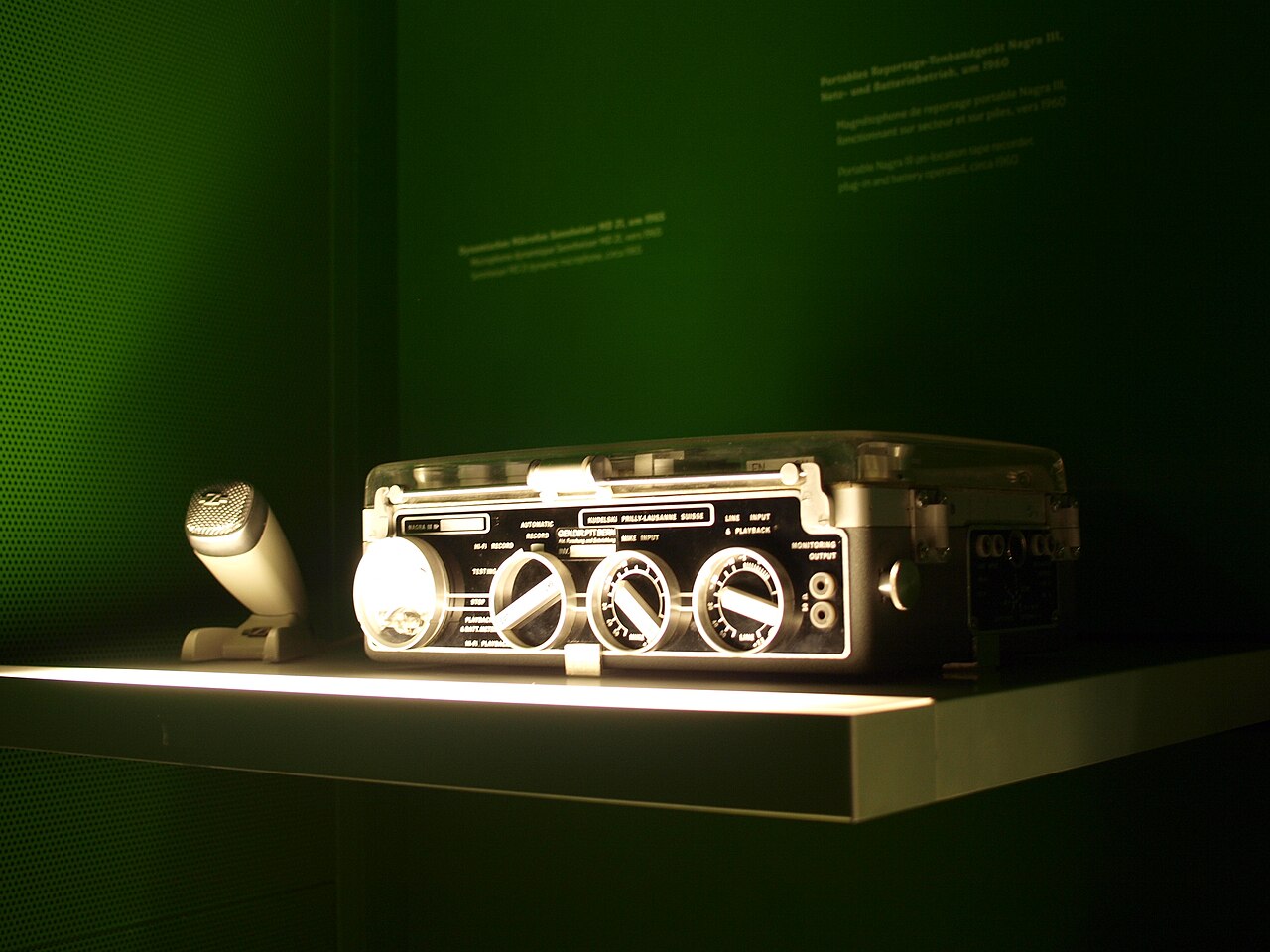
Movie history often tells the story of mobility through cameras: lighter bodies, faster lenses, shoulder rigs, zooms, dollies, Steadicam, handheld digital. Sound had its own weight problem. A camera could chase a person down a street only if the soundtrack could arrive with it, stay in sync, and bring back voices that did not sound like field notes pasted over images later.
That is why the Nagra III deserves to be treated as a movie machine, not just an audio collector's object. It did not make film sound portable by being cute or small in the consumer sense. It made professional location sound portable enough to trust. Nagra's own product history says the III was released in 1957, used extensively in broadcast and film, and built in more than 10,000 units, while emphasizing the new freedom it gave sound engineers to move with a scene.[1] Local 695's production-sound history dates the model's practical debut to 1958 and describes the same breakthrough from the working side: a recorder rugged enough, stable enough, and self-contained enough to become normal equipment rather than a special expedition.[2]
The lead photograph helps because the machine looks like what it was: not a black box, but a compact control surface for a recordist who had to make decisions while the world kept moving. Reels, selector, switches, level control, and the large modulometer turn listening into a field operation.[6]
The Recorder Was A Logistics Argument
The Nagra III's importance begins with a simple production claim: if sound can be carried, powered, monitored, and trusted away from the studio, then the set can change shape. Local 695's account stresses how different the III was from earlier Nagra machines. The spring-wound drive was replaced by a servo-drive DC motor, tube electronics gave way to metal-encased modules, the recorder had a peak-reading modulometer, and it could run from 12 standard D-cell batteries.[2] Those details sound like specification-sheet trivia until you place them on a sidewalk, in a car, in a crowd, or beside a documentary subject who will not repeat a sentence for coverage.
The industrial uptake was fast. Local 695 reports 240 Nagra III units built in 1958 and notes that RAI ordered 100 machines in 1959 for Rome Olympics coverage.[2] The point is not the exact romance of a first unit. It is the speed with which broadcasters and film crews recognized the same thing: a recorder that was stable, battery-powered, and field-serviceable changed the cost of being present.
Nagra's own retrospective makes a broader claim, calling the III the "father" of later Nagras and tying its design identity to the large modulometer and rotary selector.[1] That language is corporate, but the underlying mechanism is concrete. The recorder standardized a way of working. It made the sound recordist a mobile operator with a precise instrument, not an appendage to a fixed studio chain.
Sync Was The Real Trick
Portability alone would not have been enough. A beautiful field recording is a problem if lips drift, footsteps slide, or a line cannot be reconciled with the picture after processing. Movie production depended on double-system sound: picture on film in the camera, sound on tape, then a later process that made both elements line up for editing and release.
The Museum of Magnetic Sound Recording's Nagra profile frames the sync problem in production terms. Commercial motion pictures were traditionally made with picture in the camera and sound on a magnetic recorder, so the two elements needed a trustworthy synchronization method later.[4] The same profile notes that the Nagra III was becoming a standard across industries, that Kudelski's NeoPilot system reached Nagra III machines in 1962, and that NeoPilot remained a standard way to synchronize separate picture and sound elements until timecode became preferred in the late 1980s.[4]
That is the hidden drama in the machine. The Nagra III did not merely capture voices; it captured voices in a form that could survive the workflow. The recordist could move away from the camera, but the soundtrack still carried the technical memory needed to return to the image. In practical terms, that meant filmmakers could build scenes around bodies in motion instead of around the reach of cables, power, and postproduction rescue.
Documentary Heard People Before They Became Narration
The most visible artistic change came in documentary and ethnographic film. The Smithsonian Human Studies Film Archives account is blunt about the pre-portable-sync situation: before the 1960s, many documentary soundtracks relied on wild sound, music, and voice-over because synchronous sound equipment was too cumbersome and intrusive for easy field use.[3] Once a durable, battery-powered, high-quality portable recorder entered the practice, filmmakers could record image and sound together in spontaneous situations almost anywhere.[3]
That last phrase is the aesthetic revolution. "Almost anywhere" changed what counted as a scene. A conversation did not have to become retrospective narration. A gesture did not have to be explained by an authority voice. Public speech, hesitation, interruption, room noise, and overlapping life could arrive with the image. The Smithsonian note connects this mobility to cinema verite, observational cinema, and direct cinema, naming Richard Leacock, Robert Drew, and D.A. Pennebaker among the U.S. pioneers whose work depended on a new intimacy between camera, recorder, and event.[3]
The Nagra was not the only cause. Lighter 16mm cameras, faster film stocks, quieter camera designs, better microphones, and new institutional support all mattered. But the recorder solved a bottleneck that had shaped documentary form. Without dependable portable sync sound, direct cinema risks becoming a silent look with later explanation. With it, subjects can argue, pause, dodge, perform, confess, and contradict themselves in the same temporal field as the image.
Features Got A New Kind Of Location
The Nagra story is often associated with documentary because documentary makes the equipment change easiest to see. Yet fiction filmmaking also needed the same release from fixed sound practice. Local 695 notes that in 1959 Marcel Camus used a Nagra II to record part of the location sound for Black Orpheus in Brazil, and that Kudelski soon pushed toward a film-ready Nagra III pilot system.[2] The object of the work was not simply to gather ambience. It was to let production travel without treating sound as an afterthought.
Award listings for Stefan Kudelski show how deeply the motion-picture industry came to value that shift. In 1965, Kudelski received a Scientific or Technical Award for the Nagra portable 1/4 inch tape recording system for motion picture sound recording. In 1977, he was recognized for improvements in the Nagra 4.2L, and in 1978 he received an Award of Merit for the continuing research, design, and development of the Nagra Production Sound Recorder for Motion Pictures.[5]
Awards are not proof of artistic value by themselves, but these ones identify a production dependency. The industry did not honor a gadget because it was elegant. It honored a chain of machines because they altered ordinary sound work. They helped crews bring dialogue, presence, and usable production audio into locations where older recording logistics would have narrowed blocking, staging, and schedule.
The Aesthetic Was Operational
The Nagra III's legacy is easy to romanticize as "realism." That is too vague. Its better legacy is operational realism: the ability to follow people while still preserving the discipline of sync, levels, monitoring, and postproduction compatibility. The sound may feel immediate, but immediacy is engineered. Batteries, motor stability, pilot tone, head design, meters, connectors, tape handling, and crew habit all sit beneath the impression that the film simply happened.
This is why the machine still feels modern. Current productions use digital recorders, metadata, timecode, wireless systems, and smaller microphones, but the working ideal is recognizably Nagra-like. A production sound tool should move with the event, respect the recordist's judgment, survive the location, and return material that editorial can trust. The format changed; the responsibility did not.
The Nagra III also clarifies a broader lesson about film technology. The most consequential tools are not always the ones that announce themselves on screen. Some change the permissible distance between crew and subject. Some change whether a street can remain a street, whether speech can remain live, whether a documentary subject can be heard before a narrator tidies them up, or whether a fiction scene can leave the studio without losing its voice.
The machine in the photograph is therefore more than a handsome recorder. It is a compact argument about where cinema could go once sound became light enough to follow.
Sources
- Nagra Audio, "Nagra III" - official product history page noting the recorder's release, film and broadcast use, field mobility, and build count.
- Scott D. Smith, CAS, "The Nagra Recorder - Stefan Kudelski Tribute," IATSE Local 695 - production-sound history covering the Nagra III design, batteries, modulometer, early production, broadcast uptake, and film use.
- Smithsonian Collections Blog, "The Sweetest Sound" - Human Studies Film Archives note on Nagra recorders, portable sync sound, ethnographic film, direct cinema, and documentary practice.
- Museum of Magnetic Sound Recording, "Nagra Reel to Reel Tape Recorder Manufacturers - The Kudelski company" - equipment history covering Nagra III design, Pilotton, NeoPilot, dual-system production, and the 10,000th Nagra III milestone.
- And the Oscar Goes To, "Stefan Kudelski - Academy Award Person Data" - award listing for Kudelski's 1965, 1977, 1978, and 1990 scientific and technical honors.
- Wikimedia Commons, "File:Professional magnetophone recorder Nagra III (3804059048).jpg" - photographic source for the article image, a real close view of a Nagra III recorder.