Spoiler warning: this article discusses the second half and ending of Notorious.
Alfred Hitchcock's Notorious (1946) is usually introduced through genre shorthand: spy thriller, noir romance, postwar intrigue in Rio, Cary Grant and Ingrid Bergman at peak star voltage.[1][4][5] All of that is true, but it still misses the film's most exact achievement. The movie does not create tension primarily by hiding information. It creates tension by changing the size of things. A mansion becomes a trap because Hitchcock can make an entire party collapse into one small object in one woman's hand. A flirtation becomes unbearable because two bodies have to keep pretending their intimacy is casual while every movement is doing covert work. Later, a cup of coffee becomes terrifying because the film has already trained the viewer to fear whatever can be carried, passed, misplaced, or quietly watched.[1][2][3]
That emphasis on scale helps explain why the picture still feels so modern. The plot itself is melodramatic in the best studio sense: Alicia Huberman, daughter of a convicted Nazi collaborator, is recruited by U.S. agent T. R. Devlin to infiltrate a South American circle of fascists by getting close to Alexander Sebastian.[1][4][5] Love, duty, humiliation, and espionage are forced into the same structure. Yet Hitchcock never lets the film become abstract policy drama. He localizes everything. The drama is pushed into staircases, wine bottles, a house key, a teacup, a line of sight across a ballroom, and Ingrid Bergman's changing physical confidence as Alicia moves from seductive control into medicated weakness.[2][3][5]
That is why Notorious is such a rich craft film. The celebrated set pieces are not detachable masterpieces dropped into a conventional thriller. They are lessons in how to make objects carry emotional argument.[1][2] BFI describes the film as one of Hitchcock's darkest love stories, and that is exactly right because the romance never exists outside the mechanics of the mission.[4] Desire is always routed through staging. Trust is always routed through props. Suspense is always routed through who can hold a room, cross a threshold, or survive one more ritual of politeness.
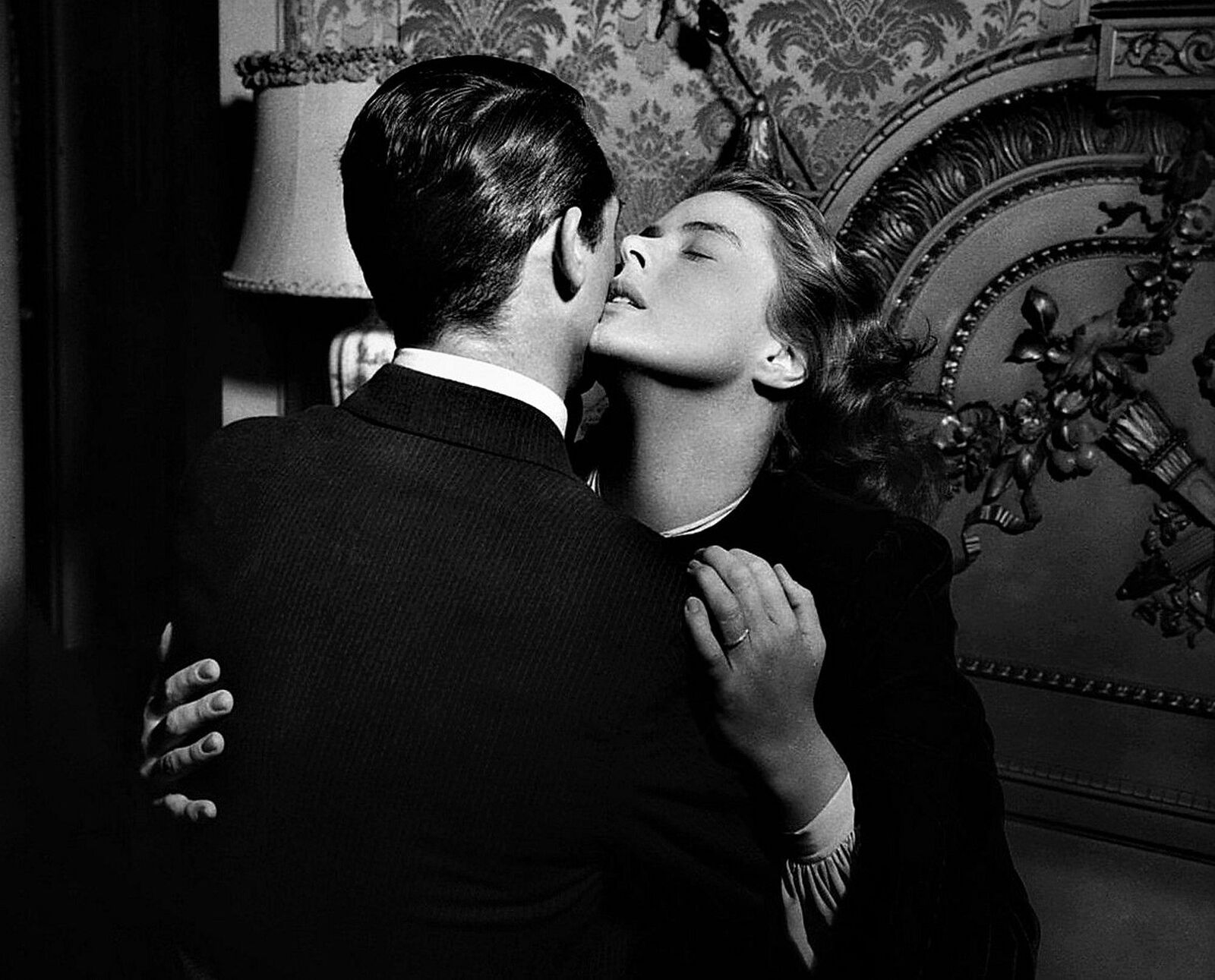
Image context: the cover uses a real 1946 publicity still of Cary Grant and Ingrid Bergman from Notorious. It suits this article because Hitchcock builds the whole film around compressed distance. The characters are repeatedly brought within kissing range, whispering range, and surveillance range at the same time, so a close still tells the truth about the movie's method.[6]
The famous party crane shot turns glamour into mission geometry
The most famous camera move in Notorious remains famous for a good reason, but its real force is often understated.[2] At Sebastian's formal party, Hitchcock begins on a high, seemingly secure view of the gathering and then descends all the way to the key in Alicia's hand.[2] It is an elegant bravura shot, yet "bravura" is not the main point. The movement teaches the viewer how to read the entire house. Grandeur is surface. The actionable reality is miniature. A chandelier, a balcony, a crowd of guests, and a heavily staffed room all finally exist to frame a single object that must not be noticed.
That compression of scale is what makes the sequence morally sharp as well as technically exciting.[2][3] Alicia is not merely carrying evidence of access. She is carrying the proof that romance has already become labor. To possess Sebastian's key is to possess the trust that Devlin's superiors have coldly asked her to win with her body and social performance.[1][3][5] The camera move therefore does two jobs at once. It narrows the house into an espionage map, and it narrows Alicia herself into the pressure point where state work, erotic humiliation, and physical risk meet.
Hitchcock could have underlined that meaning through dialogue, but the shot is more ruthless than dialogue would be.[2] It tells us that the crucial thing in this glittering social world is not a confession, not a gun, not even a face. It is a small portable object that can disappear inside etiquette. Once the film establishes that principle, the viewer begins scanning every later scene the same way. Which object matters now? Which gesture is carrying too much? Which bit of decor is actually a fuse?
The wine-cellar sequence makes desire look like coordinated labor
The descent into the wine cellar is where Notorious turns one of Hitchcock's favorite themes into pure movement.[1][2][4] Devlin and Alicia have to behave like a couple improvising light intimacy while executing a tightly timed search below the party.[2][4] Upstairs, the champagne supply is shrinking; downstairs, every second increases the chance that Sebastian or a servant will notice the missing key.[2][4] Suspense comes from coordination. Their bodies must stay close enough to look natural and efficient enough to avoid panic.
That is why the scene feels less like heroic spying than like dangerous choreography.[2] Devlin's coolness is not enough. Alicia's elegance is not enough. Each depends on the other's timing. When the bottle breaks and the hidden material is exposed, the sequence does not play as a triumphal reveal.[1][2] It plays as a transition from covert danger to domestic imprisonment. The real catastrophe is not that the plot has discovered incriminating evidence. It is that Sebastian now has reason to realize betrayal has entered the house through intimacy.
The sequence also clarifies Hitchcock's unusual generosity toward Sebastian.[3][5] Claude Rains is not shot as a mere monster waiting behind a curtain for the hero to outsmart him. He is a man whose household authority is suddenly shown to be fragile, and that fragility makes him more dangerous. Once his trust has been breached, the house can stop pretending to be a place of hospitality. From this point on, Notorious begins converting courtship architecture into punitive architecture.
The coffee cup works because the film has already taught us to fear ordinary objects
The poisoning section is the film's cruelest stretch because it does not introduce a new visual language. It intensifies the old one.[1][3][5] Angelica Jade Bastien's essay for Criterion is especially useful here because she notes how domestic items in Notorious begin to glow with menace: keys, wine bottles, teacups, all the paraphernalia of cultivated living now carry threat.[3] Hitchcock does not suddenly announce danger with expressionist distortion. He lets the ordinary continue, and then he makes the ordinary lethal.
The coffee cup is the perfect object for that strategy.[1][3] A cup belongs to hosting, convalescence, breakfast, manners, and the fiction that Alicia is now safely installed as Sebastian's wife. Hitchcock turns it into a delivery system for slow erasure. The frightening part is not simply that the coffee is poisoned. The frightening part is that the poisoning arrives through repetition. A tray comes in. A cup is offered. Alicia weakens a little more. The house remains quiet. Routine itself becomes the attack surface.
Bergman's performance is essential to why the scene lands so hard.[3][5] Earlier, Alicia knows how to use speed, wit, drunken candor, and erotic poise. In the poisoning passages, Hitchcock makes the viewer monitor her body the way the earlier party scene made us monitor the key. We watch for hesitation on the staircase, for the effort required to stay upright, for the lag between perception and response. The body becomes another small object under pressure, something that can be carried from room to room and gradually stripped of agency.
The staircase finale wins by slowing everything down
The ending is often remembered as a rescue, but it is crafted as a test of composure rather than action velocity.[2][3][5] Devlin does not burst into the house like an action hero arriving to solve the plot. He has to walk Alicia out under the gaze of Sebastian's associates while Sebastian himself understands that losing her means exposing himself to his fellow conspirators.[1][5] Every stair matters because every stair is public enough to be dangerous and formal enough to prevent open violence.
This is one of Hitchcock's deepest strengths in Notorious.[2] He knows that suspense can intensify when people are forced to stay civilized. The scene does not explode; it constricts. Devlin has to sound calm. Alicia has to remain upright long enough to leave. Sebastian has to choose between calling attention to the betrayal or absorbing a private disaster that will return to him once the car drives away. The film's emotional logic and its staging logic finally become identical: love survives, if it survives at all, only by passing through a corridor of public restraint.
That last descent also completes the movie's object system.[2][3] The key once authorized entry. The cup nearly guarantees death. The staircase becomes the final instrument of judgment. Hitchcock has spent the whole film moving between scale and pressure, and the ending reveals that his thriller is really about the terrifying fragility of managed appearances. Nothing in Notorious is merely decorative. A room is never just a room. A prop is never just a prop. If the film still grips so fiercely, it is because Hitchcock understands that the smallest thing in the frame can carry the whole moral weather of the scene.
Sources
- The Criterion Collection, "Notorious" film page - cast, production notes, and the film's central object pattern of wine bottles, coffee cups, and the key.
- Rudy Behlmer, "Notorious," The Criterion Collection - on the party crane shot, wine-cellar sequence, and staircase finale.
- Angelica Jade Bastien, "Notorious: The Same Hunger," The Criterion Collection - on desire, masks, and the menace of domestic objects.
- BFI, "Notorious (1946)" - film overview, credits, and the party sequence built around the dwindling champagne supply.
- MoMA, "Notorious. 1946. Directed by Alfred Hitchcock" - program note on casting, moral ambiguity, and the film's perverse erotic charge.
- Wikimedia Commons, "File:Cary Grant and Ingrid Bergman Notorious 1946.jpg" - publicity still file page and metadata.