The Haunting is often praised for the simplest possible horror virtue: it does not show the ghost. That is true, but it can undersell Robert Wise's craft. The 1963 film is not frightening because it withholds an image and leaves an empty space where a monster might have been. It is frightening because the whole film has been engineered to make that empty space active. Hill House does not need a visible body because Wise, cinematographer Davis Boulton, production designer Elliot Scott, sound recordists, effects technicians, and Julie Harris's performance make the house behave like an apparatus.[1][2][3]
The production facts are unusually clarifying. AFI records the film as a 112-minute horror feature directed and produced by Wise, written by Nelson Gidding from Shirley Jackson's 1959 novel, photographed by Boulton, edited by Ernest Walter, and designed by Scott.[2] BFI's film page gives the same basic constellation: Wise, Gidding, Harris, Claire Bloom, Richard Johnson, and Russ Tamblyn, with the film positioned as a U.S.-U.K. production.[4] Those credits matter because The Haunting is not a screenplay-driven ghost story with style applied later. It is a collaboration in which camera, sound, set, performance, and practical trickery keep handing agency back to the building.
The House Is Lit Like A Trap, Not A Dungeon
Many haunted-house films lean on darkness as camouflage. Wise's film is stranger. ASC's production history notes that the interior sets were designed with ceilings and a claustrophobic brightness, while the film's fear often comes from spaces that appear readable but feel wrong.[1] That difference is crucial. Hill House is not merely a dark maze. It is an overdesigned environment whose surfaces seem to obey ordinary architecture until the frame begins to contradict them.
TCM's account of Wise's method points to the same logic from another angle. Wise wanted the hallways to appear long, dark, and damp, and he linked the effect to both camera angles and set design.[3] The result is a house that never settles into a stable map. Doors, corridors, nursery walls, staircases, and bedrooms keep looking almost normal, then slightly overextended. The viewer is not simply afraid of what may enter the room. The viewer starts doubting whether the room has agreed to ordinary space in the first place.
That is why the film's widescreen black-and-white format feels so severe. The frame is wide enough to isolate bodies inside architecture, but the rooms rarely feel liberating. Wise's compositions often push people toward edges, doorways, or vertical structures; the building keeps claiming more of the image than the humans can comfortably occupy.[1][3] Horror here begins as a question of proportion. How much room does a person have in a space that seems to be looking back?
The Lens Makes Distance Misbehave
One of the film's strongest technical choices was also a production risk. AFI notes that a November 1962 trade item described The Haunting as the first film photographed with a newly developed Panavision lens, identified at the time as the widest anamorphic lens available.[2] TCM's Wise interview material explains the practical desire behind that choice: he wanted the hallways to stretch and darken beyond expectation.[3] ASC's history adds that Wise and Boulton pushed for an imperfect 30mm anamorphic wide-angle lens because the distortions served the house's emotional geometry.[1]
That imperfection is the point. A clean image might have made Hill House picturesque. The wide-angle pressure makes it unstable. Corners tug. Depth seems too long. A figure can stand in a room and still feel as if the room has not finished arriving around her. The lens does not announce itself as a special effect; it quietly changes the viewer's trust in distance.
This is the craft lesson modern horror often misses when it borrows "old dark house" imagery. Distortion works best when it is not a decorative filter. In The Haunting, it is tied to Eleanor's experience of the building. She is not merely seeing a haunted location; she is being recruited by it. The image bends just enough to make ordinary perception feel susceptible. That is why the camera movements matter too. ASC describes Wise and operator Alan McCabe working through active setups, pans, tracking shots, and low angles that made this one of Wise's most mobile visual designs.[1] The house does not wait to be inspected. It seems to reposition itself while being watched.
Sound Gives The Invisible A Body
The most famous bedroom-door sequence is a masterclass in making absence physical. BFI's 2025 programme note, built around Brian Yuzna's Sight and Sound writing, stresses that the sequence plays through Eleanor's reaction rather than a visible monster.[5] That is accurate, but the reaction only works because the sound has already become spatial. The pounding, scraping, breathing, and pressure outside the door do not merely cue fear. They give the unseen thing weight, direction, and rhythm.
ASC's production history is especially useful here because it describes the sounds as partly "pre-scored" for the actors, with sound gathered in an empty manor house and played during filming so the performers could respond to the terror as a present force.[1] This changes the usual hierarchy. Sound is not just post-production atmosphere layered over completed acting. It becomes part of the acting environment. Harris can react as if the house is actually producing the event because, on set, the event has an acoustic body.
The film's refusal to show the ghost therefore does not leave the audience with nothing. It leaves the audience with sound doing the work of contact. A visible creature could be measured, framed, and eventually demystified. The door noise cannot. It presses against architecture and nerves at the same time. Wise learned from Val Lewton that unseen horror can be stronger than explicit display, but The Haunting turns that lesson into an unusually complete system: the unseen is not vague. It is designed.[1][3]
Practical Effects Keep The Terror Material
The film's most elegant trick is that its supernatural moments often depend on physical simplicity. TCM quotes Wise explaining that the buckling door was laminated wood pushed from the other side by a strong prop man, and that the famous staircase shot used the banister as a track for a small camera rig before the footage was reversed.[3] ASC gives a fuller version of the same craft history, including the staircase rail as a makeshift dolly track and the practical mechanics that made the staircase appear unsafe.[1]
Those details do not reduce the magic. They explain why it lasts. The door buckles because something real is happening to a real object. The staircase frightens because its movement has mass and risk inside it. The effects are not weightless apparitions added to the film; they are stresses applied to wood, metal, railings, and camera movement. Hill House becomes supernatural by making ordinary materials behave just beyond their contract.
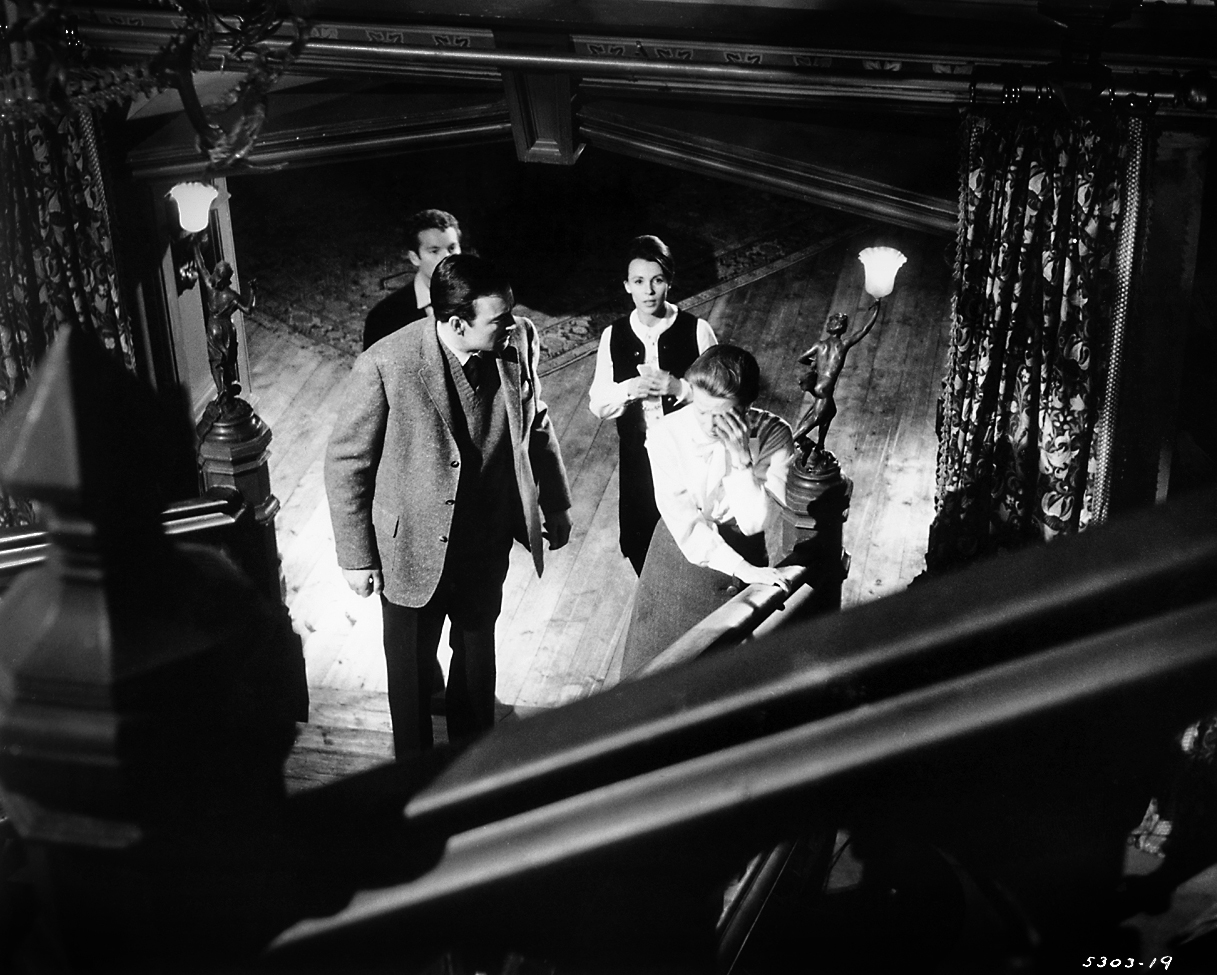
This is also why the ASC still used as the article image fits the piece. The staircase does not simply appear as Gothic decoration. It organizes the frame as a power relation. The railings dominate the foreground, the figures look exposed below, and the high angle lets the house look down before any ghost appears.[1] A lesser film would use the staircase as a place where something happens. Wise uses it as a machine for making looking itself feel unsafe.
Eleanor Turns Architecture Into Voice
The film's deepest effect is not only spatial; it is psychological without becoming a simple "it was all in her mind" puzzle. Penguin Random House's page for Jackson's novel describes Hill House as gathering its powers around a fragile Eleanor and choosing one visitor as its own.[6] Wise's adaptation keeps that pressure, while Gidding's screenplay and Harris's performance let voice-over, reaction, and movement bind Eleanor to the building.[2][5][6]
That binding matters because the film never has to choose crudely between ghost story and mental breakdown. The house is real as cinema. It has camera logic, sound logic, design logic, and editing logic. Eleanor is real as experience. Her loneliness, suggestibility, anger, and desire for belonging give the building a route inward. The terror comes from the fit between them. Hill House seems to understand cinema because cinema has been arranged around Eleanor's vulnerability.
This is why The Haunting still feels modern. It does not ask whether the audience believes in ghosts as a proposition. It asks whether image, sound, space, and performance can make a building feel intentional. The answer is yes, and the answer is mechanical as much as mystical. Wide lenses stretch distance. Sets deny comfort. Sound occupies blank space. Practical effects stress physical objects. Harris's face and voice receive the pressure and return it to us as feeling.
In that sense, the film's restraint is not modesty. It is precision. Wise does not withhold the ghost because he has nothing to show. He withholds the ghost because he has already shown the working system that makes a ghost unnecessary. Hill House is frightening because every part of the filmmaking has learned to behave like the house.
Sources
- George E. Turner, "Elegant Chills: The Haunting," American Cinematographer / ASC - production history, still image context, lens, sound, set, and practical-effects details.
- AFI Catalog, "The Haunting (1963)" - credits, release data, source-novel record, production history, and Panavision lens note.
- Jeff Stafford, "The Haunting (1963)," TCM - Robert Wise comments on the hallways, Panavision look, Val Lewton influence, staircase rig, and buckling-door effect.
- BFI, "The Haunting (1963)" - film page with production country, director, writer, producer, and principal cast.
- BFI Southbank Programme Notes, "The Haunting" - Brian Yuzna's Sight and Sound note and full screening credits.
- Penguin Random House, "The Haunting of Hill House by Shirley Jackson" - publisher page for the 1959 source novel and premise.