Cinerama is easy to misremember as simply "a very wide screen." That understates the invention. Its real importance was that it made cinema into a whole-room machine. A Cinerama show required three synchronized image strips, three projectors, a deeply curved louvered screen, multichannel magnetic sound, exacting booth labor, and a roadshow ritual that told audiences the ordinary movie house had been temporarily replaced by something closer to an attraction.[1][2][3]
That is why This Is Cinerama still matters as an industry story. It did not prove that three-strip cinema would become the new standard. It proved almost the opposite: audiences could be stunned by an immersive format whose operating burden was too heavy to become normal. The format's legacy is therefore not a straight line from 1952 to modern premium screens. It is a recurring bargain in movie technology: make the theater feel physically different, then discover how expensive it is to keep that difference alive.
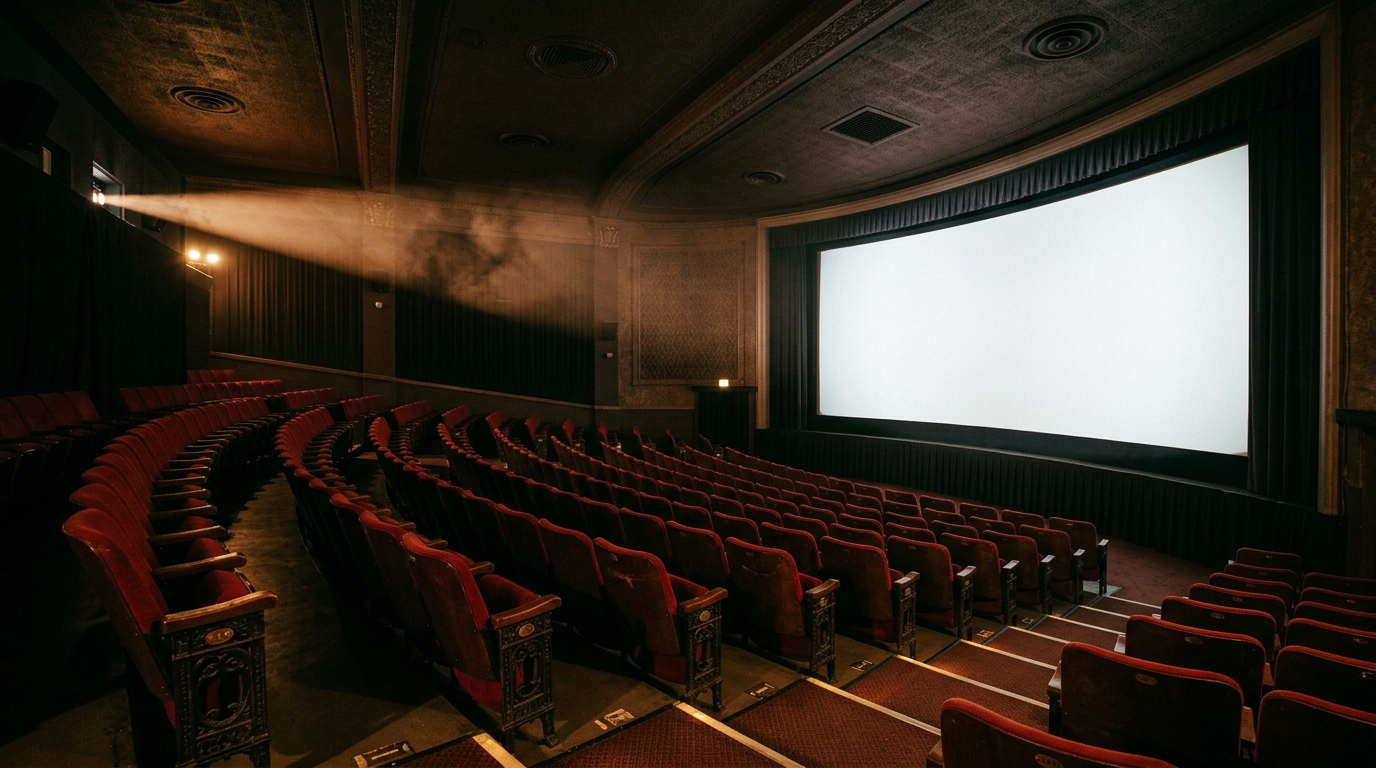
The format began by making itself the subject
The debut was not modest. This Is Cinerama premiered at the Broadway Theatre in New York on September 30, 1952, and UCLA's Film & Television Archive notes that it ran there for 35 weeks.[5] The film's premise was almost brutally direct: do not hide the system inside a conventional story, but make the new system the spectacle. The Library of Congress essay quotes the premiere program's logic: the first picture was a demonstration, and Cinerama itself was meant to be the hero.[2]
That choice explains the film's famous opening strategy. It begins by reminding viewers of ordinary screen history, then opens the curtains into a roller-coaster ride. The point is not plot. The point is bodily comparison. A normal image gives way to peripheral rush, spatial sound, speed, and a screen that seems to wrap itself around the audience. Cinerama's first lesson was that a movie format could be marketed as a sensation before it was marketed as a storytelling tool.[2][5]
The business context sharpened the claim. UCLA places Cinerama among the early-1950s widescreen processes meant to pull viewers away from television and back into theaters.[5] But Cinerama's answer was more extreme than most. It did not merely widen the theatrical image. It asked exhibitors to rebuild the conditions under which the image could exist.
Three panels solved one problem and created several more
The technical package was elegant in concept and stubborn in practice. AFI's production history describes Fred Waller's process as three specially adapted, synchronized 35mm cameras linked in an arc, with three projectors casting the result onto a louvered screen spanning a 146-degree arc.[1] Film Atlas gives the material inventory from the print side: three 35mm films shown simultaneously, each covering one third of the picture width, with six-perforation frames and a separate seven-channel magnetic soundtrack.[3]
Those details matter because Cinerama's image was not a normal frame stretched sideways. It was a negotiated join. Each panel had to match the others in color, density, movement, and projection alignment. Film Atlas notes the care required in grading prints so the panels would match across the screen, down to the preference that negative stock be cut from the same Kodak roll when possible.[3] The spectacle depended on continuity, but the format was constantly producing seams that had to be hidden, softened, or lived with.
The screen was just as specialized. AFI records that the projected picture at the Broadway Theatre measured 75 feet wide and 26 feet high, about three times wider and almost twice as tall as a standard 35mm image.[1] It also describes the screen as thousands of louvered plastic-tape strips arranged across the 146-degree curve.[1] That was not decorative engineering. A deeply curved screen risks bouncing light from one side to the other; the strip construction helped control that cross-reflection so the image would not wash itself out.
Sound made the room bigger too
Cinerama's achievement was not only optical. AFI notes that Hazard Reeves's stereophonic sound system used a separate 35mm magnetic strip and seven banks of speakers around the theater.[1] Film Atlas similarly lists a separate 35mm full-coat magnetic seven-channel soundtrack.[3] The audio system completed the industrial argument: the viewer was not just looking at a wider picture, but sitting inside a coordinated image-and-sound environment.
That coordination is why Cinerama belongs in the same conversation as later premium formats even though its machinery was very different. The format understood that theatrical scale is cumulative. Width, curve, sound direction, reserved-seat anticipation, and the physical opening of the screen all reinforced one another. The theater had to announce that the home screen could not compete.
But every added layer also increased fragility. A normal 35mm show could tolerate a fairly familiar range of projection routines. Cinerama required specialized equipment, careful synchronization, and enough trained staff to keep three image streams and a separate sound stream behaving as one. The Library of Congress essay is blunt about the economics: during its 1950s heyday, Cinerama had little more than a dozen dedicated U.S. theaters, retrofitting was expensive, and the Broadway engagement employed no fewer than seventeen union projectionists.[2]
That is the central paradox. Cinerama made the theater feel irreplaceable by making the theater hard to reproduce.
Narrative filmmaking exposed the camera's bargain
The format was strongest when it could treat the world as spectacle: travel, scenery, speed, ceremony, wide crowds. Dramatic production was harder. UCLA notes that only two fiction films were made in the original process, while the rest were largely travelogue or episodic presentations.[5] The reason was not a lack of ambition. The camera changed how scenes could be staged.
William H. Daniels's American Society of Cinematographers account of How the West Was Won makes the problem concrete. A Cinerama camera was effectively three cameras in one, with three negatives running past three lenses to cover a 143-degree by 55-degree field.[4] Daniels describes the blend line as an everyday production concern and explains that the 27mm lenses, interlocked exposure controls, wide field of view, and close-range photography created lighting and staging problems that ordinary single-camera production did not face.[4]
That meant Cinerama did not simply enlarge Hollywood grammar. It resisted it. Closeups became awkward because the subject had to be unusually near the lens. Sets needed different proportions because the camera saw so much. Exterior light could vary across three panels at once. Actors had to be placed with an awareness of panel joins, not only dramatic blocking.[4]
This is where the format becomes most interesting. Its power came from refusing the normal window-frame relationship between viewer and image. Its weakness came from the same refusal. A system built to engulf the audience was not naturally built for the shot-reverse-shot habits, close facial pressure, and flexible coverage that classical narrative filmmaking had made efficient.
Cinerama lost the standard but won the argument
Cinerama did not become the normal future of movies. The Library of Congress essay says Hollywood quickly absorbed the lesson while avoiding the burden: CinemaScope, VistaVision, SuperScope, Panavision, Technirama, and other processes delivered widescreen scale through cheaper workflows, while also following Cinerama's lead on magnetic sound.[2] Cinerama became a niche novelty, but the industry kept its premise.
That premise was simple and durable. The theater had to be more than a delivery point for a story. It had to be an event format. Even when later systems rejected three strips and three projectors, they kept returning to Cinerama's core insight: sell an experience the living room cannot flatten. Todd-AO tried to get Cinerama-like immersion from one projector. CinemaScope kept the standard 35mm strip and widened the frame. Later 70mm roadshows, giant-screen formats, and premium large-format auditoriums all worked variations on the same pressure.
The lesson is not that bigger is automatically better. Cinerama's own history warns against that lazy conclusion. Bigger can be magnificent and still commercially brittle. The deeper lesson is that movie technology succeeds when the whole chain can support the sensation it advertises. Cinerama's chain was thrilling but heavy: camera, lab, projection, screen, sound, theater labor, ticketing, and audience expectation all had to line up.
That is why Cinerama remains a useful technology story rather than a quaint widescreen footnote. It made the apparatus visible. It showed that immersion was not stored inside a strip of film. Immersion was a coordinated room, and the room had costs.
Sources
- AFI Catalog, "This Is Cinerama" - production history, Fred Waller's process, three synchronized cameras, louvered 146-degree screen, picture size, and seven-bank sound notes.
- Kyle Westphal, "This Is Cinerama," Library of Congress National Film Registry essay - commercial impact, theater costs, projection labor, program-book framing, and successor-format context.
- Film Atlas, "Cinerama (1946-1972)" - print gauge, frame dimensions, aspect-ratio notes, six-perforation panels, color-matching requirements, and seven-channel magnetic sound.
- American Society of Cinematographers, "Cinerama Goes Dramatic for How the West Was Won" - William H. Daniels's production account of the three-lens camera, blend lines, lighting limits, closeups, and staging constraints.
- UCLA Film & Television Archive, "This is Cinerama" - format overview, television-era widescreen context, seven-channel sound, three-camera/three-projector presentation, premiere date, and theatrical run.