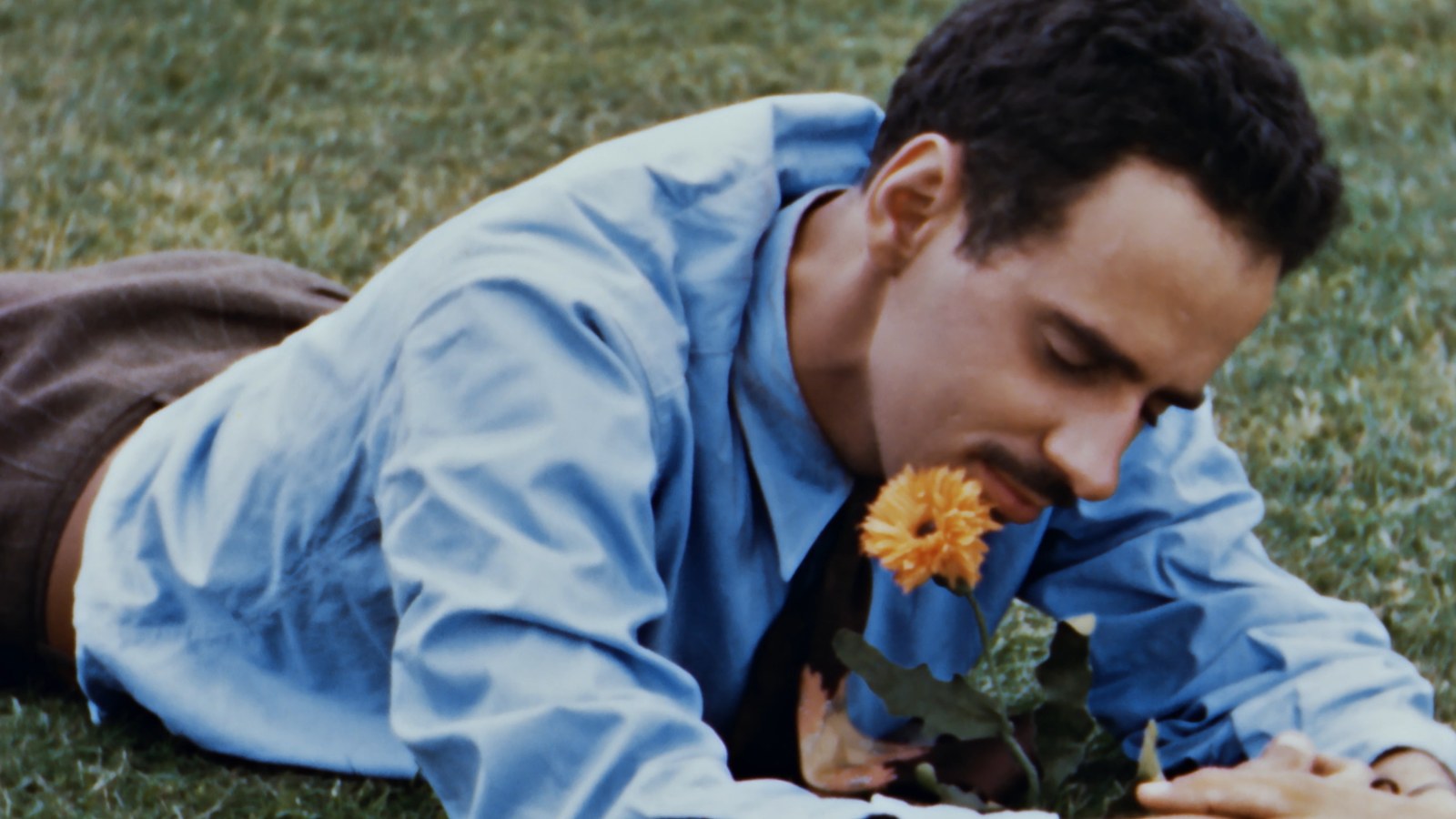
A man flies sideways across a lawn. In the time it takes him to cover a few feet in Norman McLaren’s Neighbours (1952), the actor playing him has come down to earth over and over again. After twenty or thirty jumps he needed a lie-down. Somebody marked where his feet had been so that, after he caught his breath, he could get back up and keep flying. [1][2]
The flight belongs to the happier part of this eight-minute National Film Board of Canada short. A flower has sprung up between two houses, and its scent does extraordinary things to the men who live there. Grant Munro and Jean-Paul Ladouceur play the neighbours. Each wants the flower. Look at how well the actors have to get along to make the quarrel work. [1][2]
What the camera keeps
A jump has several promising instants for a photographer. Catch a man pushing off and you can feel the weight in his legs. Catch him coming down and you can anticipate the jolt. For the flight, the crew kept just the crest of each jump. The actor shifted sideways between leaps. Project those crests in succession and the lawn travels under a man whose feet never touch it. His exhaustion and his rest occupy precisely the same amount of screen time as each landing. All three happen between exposures. [2]
The usual name for animating people this way is pixilation. It can suggest a rather thankless acting job, holding still while someone adjusts your elbow. McLaren tried something like that at first. Then the actors, both animators themselves, found they could move slowly through an action while the camera operator called out each exposure. Now a man could hear how much time he had left to finish a stride. He could decide exactly when to lift his heel. Film scholar Nichola Dobson locates some of the authorship of the characters here, in the performers’ control of their own speed. [2][3]
McLaren gives a lovely piece of rehearsal arithmetic. Suppose a walk starts with thirty frames for the first pace and ends with two for the ninth. The operator starts the count afresh for each pace. Even with long pauses between clicks, the actor can hear the walk running away with him. And when two men approach the flower from different distances, someone can call to the slower one to hurry up. What looks like two equally urgent private desires has required the sort of adjustment a pair of dancers would make. [2]
A change of speed
When the neighbours fight, the rate changes again. Much of the scuffle went through the camera at eight frames per second. Played at twenty-four, a second of movement on the lawn goes by in a third of a second on screen. The men could handle each other gently and still deliver a nasty-looking rush. For especially violent passages the crew slowed the camera further or took individual exposures. Watch a blow with the flight in mind. For one effect the crew throws away every landing. For the other it can keep a whole gesture and shorten the time you have to see it coming. [1][2]
The Canadian nomination for UNESCO’s Memory of the World register places the film’s anger in the years of the Korean War. On this little patch of grass, the dispute turns on where to put a fence. The pickets can shift between exposures just as readily as the deck chairs that slid into place when the men settled down to enjoy their afternoon. Only now each small change takes a little ground from somebody. [1][2][4]
McLaren records how long it took to move the fence between the houses for a single frame. Two or three minutes. It is a curious detail to carry away from such a fast film. Somewhere inside that flash of ill temper are people on their feet in the grass, working together, trying to get a row of pickets to stand up in exactly the wrong place. [2]
Sources
- National Film Board of Canada, Neighbours (1952), film, credits and publicity photograph.
- Norman McLaren, “Further Notes on Neighbours,” in his collected technical notes, pp. 70–71.
- Nichola Dobson, “Dancing to rhythm of the music: Norman McLaren, the body and performance,” Animation Studies.
- Audio-Visual Preservation Trust of Canada, UNESCO Memory of the World nomination for Neighbours, summary and production record.