Spoilers follow, including the ending of Anthony Mann's 1950 film.
T. C. Jeffords pays people with promises bearing his own initials. The IOUs circulate as “T.C.s,” making his reputation something other people must carry around.[5] It is an extravagant expression of self-confidence: even when the rancher parts with money, he wants the money to remain a little like him. A promise postpones the moment when somebody can ask whether he really has enough to give.
In The Furies, that habit extends into the family. Walter Huston's T. C. and Barbara Stanwyck's Vance struggle over her marriage, her dowry, and the enormous New Mexico ranch that gives the film its name.[1] Vance wants authority her father cannot withdraw. Yet the most uncomfortable question is what she will do with that authority once she wins it. Can an inheritance free her from him when possession itself is the lesson he has taught her?
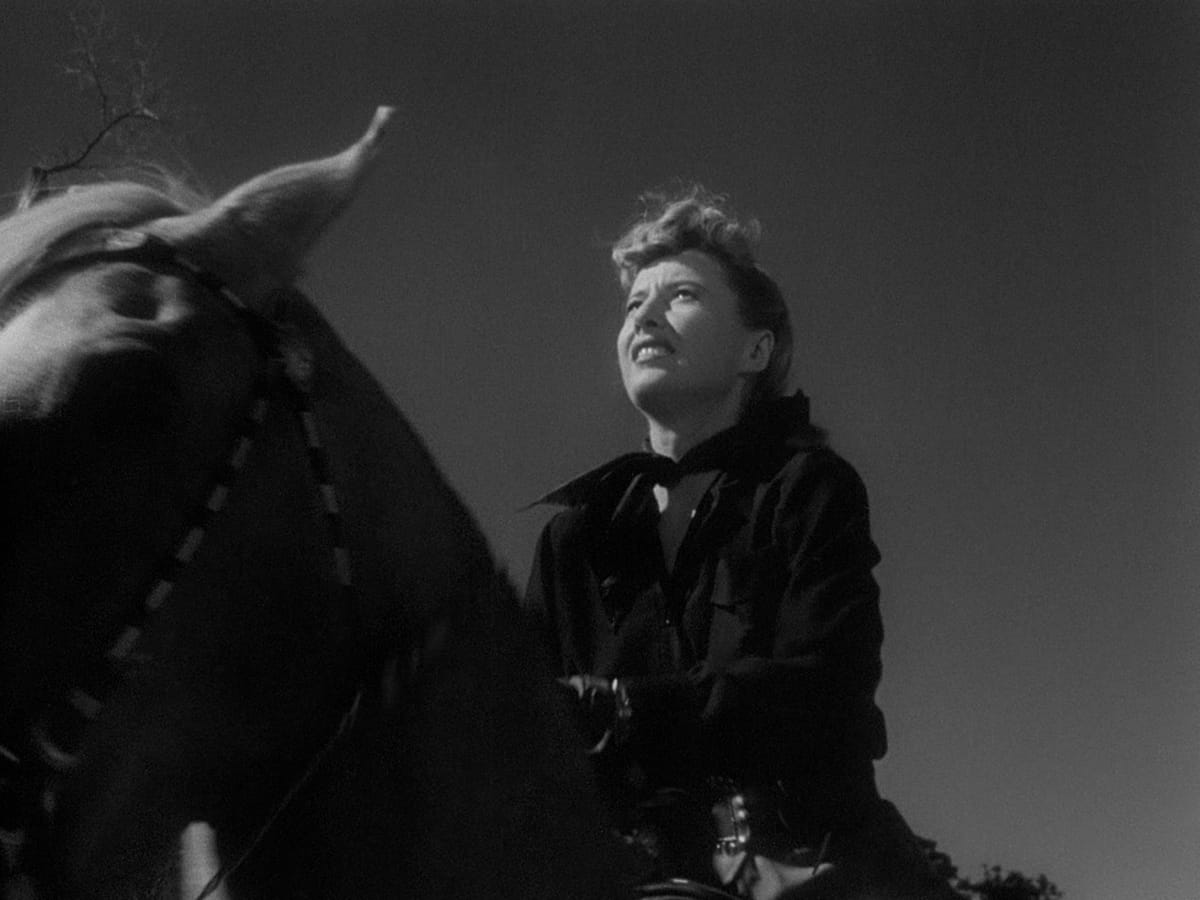
Vance already does the work. UCLA's program note introduces her as the daughter who runs the ranch, an essential distinction in a story about succession.[4] She is neither an outsider demanding admission nor a novice waiting to be trained. Her problem is that competence has not become a secure right. She can manage the property while remaining vulnerable to a decision made in the drawing room. The family calls her capable without accepting the consequences of that judgment.
The opening gives her ambition a more troubling intimacy. She occupies her dead mother's preserved bedroom and wears her clothes and jewelry; Robin Wood draws attention to the scissors she handles there, which will later become a weapon.[3] To my eye, the room makes inheritance look like an act of occupation before any deed changes hands. Vance tries on an established place in the household. She wants to move forward, but the available space has somebody else's shape.
Her treatment of the ranch's occupants reveals how closely she already resembles its owner. When the bank presses for evictions, Vance orders other families burned out while protecting the Herreras because Juan is her childhood friend.[2] Affection creates an exception. It does not create a general protection that someone unknown to her could claim. The distinction matters because it prevents her rebellion from becoming an uncomplicated story of liberation. She can recognize an injustice most clearly when it threatens someone she loves.
That selective tenderness also makes her position precarious. A privilege granted by personal feeling can disappear when the feeling changes, or when someone else gains the ear of the person in charge. Vance understands this insecurity from inside the house. She nevertheless helps impose it beyond the house. The ranch binds its inhabitants together through unequal permissions to stay.
Flo Burnett, played by Judith Anderson, brings that insecurity into Vance's own rooms. The prospect of a new manager threatens her authority; her response is to throw scissors at Flo, permanently injuring her.[4][6] The violence gives a terrible literal form to the wish that a rival could simply be removed. Having felt how easily her place might be taken away, Vance attacks another woman's capacity to inhabit hers.
Flo later refuses to return money T. C. has given her. She believes he would discard her if he recovered his fortune, leaving her injured and alone.[6] Her refusal complicates the familiar accusation that she cares only about money. Money is what could remain after affection fails. For Vance, wealth promises command; for Flo, keeping it offers some protection against abandonment. Neither can confidently treat the household's warmth as a lasting guarantee.
Juan's death makes the limits of Vance's protection unmistakable. After the Herreras surrender, T. C. orders him hanged for stealing a ranch horse.[2] Vance's place beside her father cannot save her friend. The landowner's power has reached beyond deciding who may live on the property to deciding who may live at all. Her eventual financial victory must be measured against that loss, however satisfying its cleverness becomes.
The revenge turns on those little paper substitutes for cash. Vance and Rip Darrow acquire T. C.'s IOUs and use them to pay for his cattle, depriving him of the cash he needs to save the ranch.[6] What previously looked like an extension of his personality becomes a finite obligation. His name comes back to him in a form he cannot spend as he intended. The joke has the exactness of a trap built from its victim's favorite habit.
Vance has learned to make a promise enforceable. Yet her father's admiration introduces a second, less comfortable reward. He accepts defeat, impressed by her achievement, and the family moves toward reconciliation.[2] She has finally done something he can recognize as greatness because it resembles his own appetite for winning. His approval is moving as a release from their struggle. It also makes the struggle look like an entrance examination whose successful candidate will preserve the institution.
Wood objects to the ending's effort to rehabilitate both father and daughter, arguing that its warmth retreats from the damage the film has shown.[3] That criticism catches a real unease. Enjoying Huston's vitality or Stanwyck's triumph does not require believing that either character has repaired what they broke. The performances can make reconciliation attractive while the story leaves reasons to resist it.
Juan's mother supplies the claim that the family celebration cannot absorb: she shoots T. C. After his death, Vance and Rip plan to give his name to a future son.[2] The two gestures pull in opposite directions. One insists that the past still demands an answer; the other prepares to carry it forward as an honor. Vance has won the right to decide what happens on the ranch. The name she chooses leaves open how much of her father will continue to happen there.
Sources
- The Criterion Collection, “The Furies” (1950) — film details, cast, premise, and the official gallery still reproduced here.
- American Film Institute, “The Furies” (1950), AFI Catalog — selective evictions, Juan's death, the financial settlement, and the ending.
- Robin Wood, “The Furies: Mann of the Western.” The Criterion Collection, 23 June 2008 — the mother's bedroom, Vance's conflicting ambitions, and the problematic reconciliation.
- UCLA Film & Television Archive, “The Great Flamarion / The Furies,” 31 January 2014 — Vance's work running the ranch and her violent defense of her authority.
- Elaine Lennon, “Steers, Queers and Pioneers: Barbara Stanwyck's 1950s Westerns, Part 1: Anthony Mann's The Furies.” Offscreen, December 2013 — T. C.'s private currency and the struggle for control.
- Tim Dirks, “The Furies” (1950). Filmsite — Flo's explanation for keeping her money and Vance's use of the IOUs against her father.