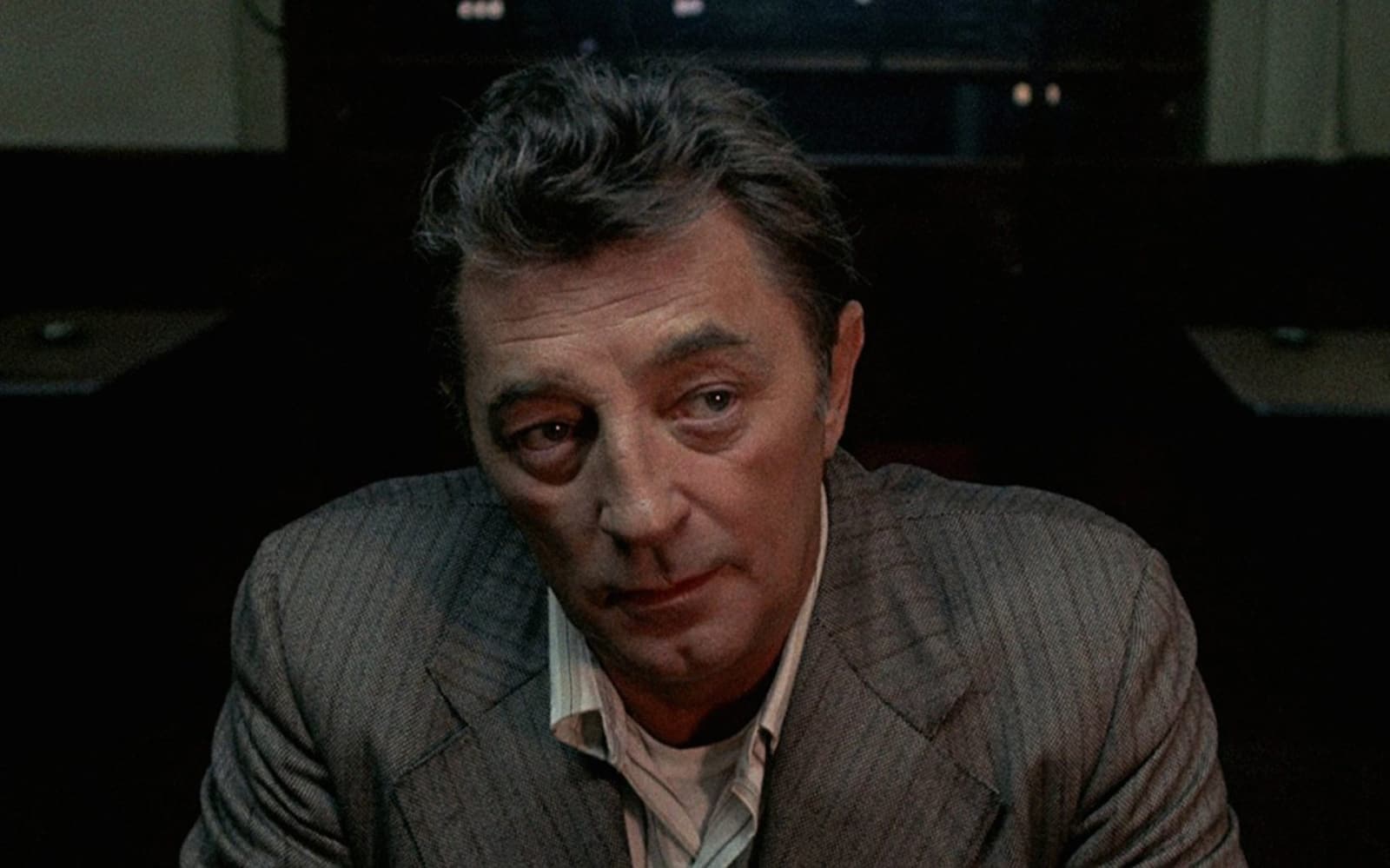
Spoilers follow, including the ending of the 1973 film.
Eddie Coyle has a story about his fingers. Some men put them in a drawer and kicked it shut because he had made a costly mistake. He tells a younger gun dealer about it with the authority of someone explaining the rules of a workplace. In her contemporary review, Sarah M. Wood emphasizes that the anecdote neither directly threatens the listener nor asks for sympathy.[2] Eddie is passing on knowledge. The terrible thing is that his own knowledge has already been paid for, and will not keep him safe.
Peter Yates's The Friends of Eddie Coyle casts Robert Mitchum as a small-time supplier of guns facing another prison term. Adapted from George V. Higgins's novel, it follows his attempts to exchange criminal information for help staying free.[1] Its particular cruelty lies in the unequal obligations hidden inside apparently ordinary conversations. Eddie can give somebody exactly what they ask for without securing anything dependable in return.
Listen to how a delivery deadline becomes a threat. Eddie tells Jackie Brown, played by Steven Keats, that he has made a promise because Jackie made one to him. If that promise fails, somebody will have a problem; Eddie intends that somebody to be Jackie. Kent Jones identifies this exchange as characteristic of a film whose dialogue performs the work of action.[3] The sentence travels down a chain of responsibility. For a moment Eddie sounds powerful because he has found someone beneath him to whom he can pass the danger.
The performance also exposes the limits of that power. He cannot simply demand that the guns appear. He must explain, repeat, make the other man understand. Each extra sentence reveals how much he needs the transaction completed. The audience hears both the warning and the dependence inside it. A threat can be evidence of vulnerability.
Yates gives the bank robberies a related tension. Writing about one of these sequences, director Ben Wheatley points to the gap between orderly preparation and the violence that can undo it.[4] The robbers have a method; watching it work once makes its repetition legible. We can follow a procedure and still fear the instant when someone ceases to cooperate. The film draws suspense from competence without letting competence become reassuring.
That changes how the quieter meetings feel. A coffee-shop conversation is another operation with things that must happen in the right order. A name must be withheld until the right assurance arrives. A request must sound casual enough to conceal its urgency. The robbery sequences make these negotiations feel physical: talk is another way of trying to move dangerous material without setting it off.
Eddie's dealings with Treasury agent Dave Foley expose the weakness in his bargaining position. His information gets Jackie arrested, but the result is insufficient to win the help he needs with his New Hampshire case. Foley wants continuing information.[5] Eddie has spent something he cannot recover while the value of the return remains unsettled. His predicament is especially painful because he understands transactions perfectly well. What he lacks is the power to make the other party settle.
Mitchum's presence gives that predicament weight without making Eddie grand. Geoffrey O'Brien's Film Comment essay notices how completely the actor belongs among the ensemble, and how weariness enters even the funny lines.[6] A joke offers a brief recovery of dignity: Eddie can still tell a story, still hold somebody's attention. Yet attention is a poor substitute for a commitment. Being good company cannot ensure that the person listening will help him afterward.
The rooms and streets allow the same uncomfortable familiarity. Sean Burns's account for WBUR stresses the harsh daylight, barroom windows and uninviting Boston locations.[7] These are places where a conversation can look unremarkable to everyone outside it. Their ordinariness makes the danger harder to isolate. No special chamber announces that an irreversible decision is being made; the men can conduct their business in spaces that other people simply pass through.
By the time Eddie offers information about the bank robbers, Foley has already caught them. Dillon, the bartender played by Peter Boyle, supplied that information. Nevertheless, Eddie is marked for death as the supposed informer.[5] Knowing which betrayal actually happened matters to the viewer. It offers Eddie no protection. The people deciding his fate need a usable explanation more than they need his account of events.
Then comes a night at the hockey. Burns singles out the sadness of Mitchum cheering Bobby Orr at the old Boston Garden.[7] For a little while, Eddie can direct his attention toward a contest whose rules are visible, whose loyalties can be shouted. The pleasure does not have to be false for the occasion to be lethal. His companion can give him an enjoyable evening and still intend to kill him.
Dillon gets Eddie drunk and shoots him during the drive afterward. The final conversation returns to Dillon and Foley, with the agent acknowledging the useful information he received.[5] Eddie's absence has not interrupted their ability to do business. The film ends with people still able to address one another as friends.
The title leaves an uncomfortable question hanging over every earlier exchange: what, precisely, did that word promise? Eddie knew the stories, the habits and the warnings. He could recognize the people around him. What he could never obtain was an obligation that would survive the moment he stopped being useful.
Sources
- The Criterion Collection, “The Friends of Eddie Coyle” (1973) — film details, adaptation, cast and premise.
- Sarah M. Wood, “Coyle's Kind of Friend Nobody Needs.” The Harvard Crimson, 17 August 1973 — contemporary account of Eddie's damaged-fingers story and its delivery.
- Kent Jones, “The Friends of Eddie Coyle: They Were Expendable.” The Criterion Collection, 29 April 2015 — the delivery-deadline exchange, dialogue and ensemble performance.
- Ben Wheatley, “The Mechanics of the Job: One Scene from The Friends of Eddie Coyle.” The Criterion Collection, 27 March 2012 — written commentary on the robbery sequence and the fragility of control.
- American Film Institute, “The Friends of Eddie Coyle” (1973), AFI Catalog — Foley's agency, the two separate informant transactions, the hockey outing, Eddie's death and the final conversation.
- Geoffrey O'Brien, “Encore: The Friends of Eddie Coyle.” Film Comment, March–April 2009 — Mitchum's ensemble performance, weariness and humor.
- Sean Burns, “Honoring Robert Mitchum, Brattle Screens Ultimate Boston Movie: 'Friends Of Eddie Coyle.'” WBUR, 4 August 2017 — Boston locations, Mitchum at the hockey game and the Criterion-supplied film still reproduced here.