Early in The Fits, Toni's face rises into a tight frame with each sit-up, drops away, then returns. Her body supplies the rhythm, but the camera does not reward the effort by chasing her. It waits. The border remains where it is, and a girl has to negotiate her way back into view.
That modest decision contains the craft logic of Anna Rose Holmer's 2015 feature debut. Toni, played by Royalty Hightower, moves between the boys' boxing gym and the girls' drill team inside a Cincinnati community center. Soon, members of the team begin experiencing unexplained convulsions. The film never diagnoses them. Instead, it asks a more cinematic question: what does belonging feel like before it can be explained?
Holmer answers with space, timing, and sound. A wide frame isolates Toni rather than liberating her. An empty room receives attention before a person enters it. A skipped rope leaves an echo that seems to have passed through her body. Boxing punches survive inside dance steps. Made through Biennale College Cinema's microbudget program and premiered at Venice, the film turns production limits into a severe formal vocabulary.[2][6] Its central effect is not that movement looks spontaneous. It is that every movement appears to meet a structure already waiting for it.
Spoiler note: this essay discusses the film's final sequence.
A frame that does not come to the rescue
Holmer came to The Fits with experience in camera departments and in filming dance. Her reference point was not the roaming coverage of a performance documentary but the severe framing of Steve McQueen's Hunger: a body can strain, flail, or leave a precisely chosen composition without the camera automatically following it.[2] That distinction matters. A reactive camera says the performer determines the image. Holmer's patient camera makes body and image feel like separate systems that occasionally align.
Cinematographer Paul Yee and Holmer use the wide screen to create lateral vacancy around Toni. A portrait placed inside that width does not become grand; it becomes exposed. The unused space can hold a dance troupe that has not accepted her, an older girl whose confidence she studies, or simply the pressure of an absent relation. Negative space is therefore not a decorative signature. It is the visible distance between watching a group and knowing how to enter it.[2]
The first practice with the younger recruits makes that distance dynamic. When the planned bleachers were unavailable, the crew rebuilt the scene around blue gym mats and a circular dolly move, keeping Toni at the pivot while Maia and Beezy enter the composition. Yee also argued that the Lioness captains, previously glimpsed obscurely through a window, needed close-ups of their own. In a film that largely reserves that scale for Toni, a close-up becomes a transfer of authority.[2]
The camera's movement is choreographed, but it is seldom prompted by a gesture inside the frame. Holmer described this as a way to create drift: time and gravity seem to advance whether or not Toni is ready.[3] The result is a useful reversal of ordinary dance coverage. Instead of editing just fast enough to make every move land, The Fits lets us see a dancer become half a beat late, enter from the wrong edge, or occupy a frame whose shape has not changed to flatter her. Learning is legible because the image declines to hide friction.
Dead time gives the building a pulse
Editor Saela Davis often cuts to rooms before anyone arrives and stays after the action has spent itself. Holmer called this “dead time,” the material conventional pacing tends to remove. Here it gives the community center an existence independent of Toni. A corridor, locker room, gym, or drained pool seems to wait for the next body, and that waiting turns architecture into pressure.[3]
The production had practical reasons to know the building so intimately. It staged its equipment, cast holding areas, and workspaces inside the active community center, avoiding company moves while working with roughly fifty young performers. Yee arrived two weeks before the shoot and charted the sunlight room by room so a small lighting package could use each space at the right hour.[2] Economy did not merely shrink the map. It made repetition possible: the film can return to a doorway or wall until its emotional temperature changes.
Even outdoors, escape is withheld. The overpass is caged by fencing; the empty pool has sky above it but walls on every side. Holmer's rule was to keep Toni contained until the ending, so exterior space behaves like another room.[3] This is why the film's geography feels larger and tighter at once. We gradually learn the center's routes, yet almost every route bends back into the same social experiment.
There is a real cost to this concentration. In Sight and Sound, Ginette Vincendeau argues that the film's opacity approaches a social vacuum: the girls have little life beyond the athletic and performance spaces the movie gives them, and its celebration of Black girlhood can lean on familiar images of Black bodies as athletes and entertainers.[5] That objection cannot be solved by pointing to elegant framing. The formal narrowness is both the film's strength and its boundary. It makes Toni's immediate sensorium unusually vivid while leaving family histories, neighborhood life, and ambitions outside the center largely unavailable.
The critique also clarifies what the empty frames do—and do not—contain. They make absence palpable, but they cannot automatically turn absence into social depth. The movie is strongest when its restraint reads as Toni's limited access to other people, not as a claim that the room contains everything worth knowing about them.
Sound has to pass through Toni
Because dialogue is sparse and so much action remains outside the frame, sound carries the film's point of view without becoming voice-over. During production, the location recordist and sound designer Chris Foster gathered room tone and “wild” sounds in the gym and locker rooms. In post, the team added exceptionally close Foley: Toni's clothing, each raised breath, even the flight of her braids, which was shaped to suggest wings.[3]
The most revealing sound was discovered through subtraction. Holmer and Foster isolated the reverberation of a skipped rope and heard a model for Toni's inner acoustics—a quiet, cave-like space through which the outside world arrives as a residue. They experimented with sonograms and surgical recordings, avoided the ready-made cliché of a heartbeat, and let breath pierce the mix. Music also changed function during the twelve-week edit: rather than remain mostly within the scene, the score became a version of Toni's interior voice.[2][3]
This design does not tell us what Toni thinks. It establishes the resistance between an event and her reception of it. The drill team may be visible through a window, audible down a corridor, or reduced to a pulse that reaches her before she understands its source. Holmer sometimes circled pages of scripted dialogue and action to be kept offscreen so the shot could remain on Toni's face.[3] We watch listening become an action.
That is crucial to the fits themselves. A diagnostic thriller would privilege clues: Who drank what? Which symptom appeared first? What did the doctor miss? The Fits lets those questions circulate, but its soundscape refuses to promote them into a solution. A convulsion is also a rupture in the building's established rhythm, an event heard and repeated through witnesses. The uncertainty is formal before it is symbolic.
The movement was built by a group
Royalty Hightower was already an accomplished member of Cincinnati's Q-Kidz Dance Team. The craft problem was therefore not teaching a novice to dance; it was helping a skilled dancer perform the effort of not yet knowing. Movement consultant Celia Rowlson-Hall broke routines into stages Hightower could inhabit awkwardly, while Q-Kidz captains Mariah and Chariah Jones helped create the drill choreography and stand battles. Toni's physical vocabulary was designed to carry punches and boxing patterns at first, then absorb turns and hair flips without erasing the strength that preceded them.[4]
This progression keeps the movie from drawing a simple line between “masculine” boxing and “feminine” dance. Both practices demand counting, repetition, balance, endurance, and an awareness of other bodies. What changes is the social direction of the effort. Boxing lets Toni train beside her brother while remaining in her own lane. Drill asks her to preserve force while matching a formation.
The fits complicate that formation because no two bodies perform them identically. The production worked with the real team and choreographed the attacks rather than treating them as uncontrolled improvisation.[5] That sounds paradoxical only if choreography is mistaken for uniformity. A score can organize difference. Each fit belongs to one performer, yet its passage from girl to girl creates a collective pattern no character can fully read.
The method behind the camera matters here. Holmer and producer Lisa Kjerulff brought Q-Kidz coach Marquicia Jones-Woods into the production, cast about forty-five team members, and invited the girls to test dialogue and movement against their own experience. Holmer was explicit that the filmmakers were outsiders to Cincinnati's West End and needed to keep listening rather than claim authority over the cast's lives.[2][4] Collaboration does not cancel the limitation Vincendeau identifies, but it prevents “community” from being only a theme imposed after the fact. The group helped construct the gestures by which the film imagines a group.
The ending breaks the rule without escaping the room
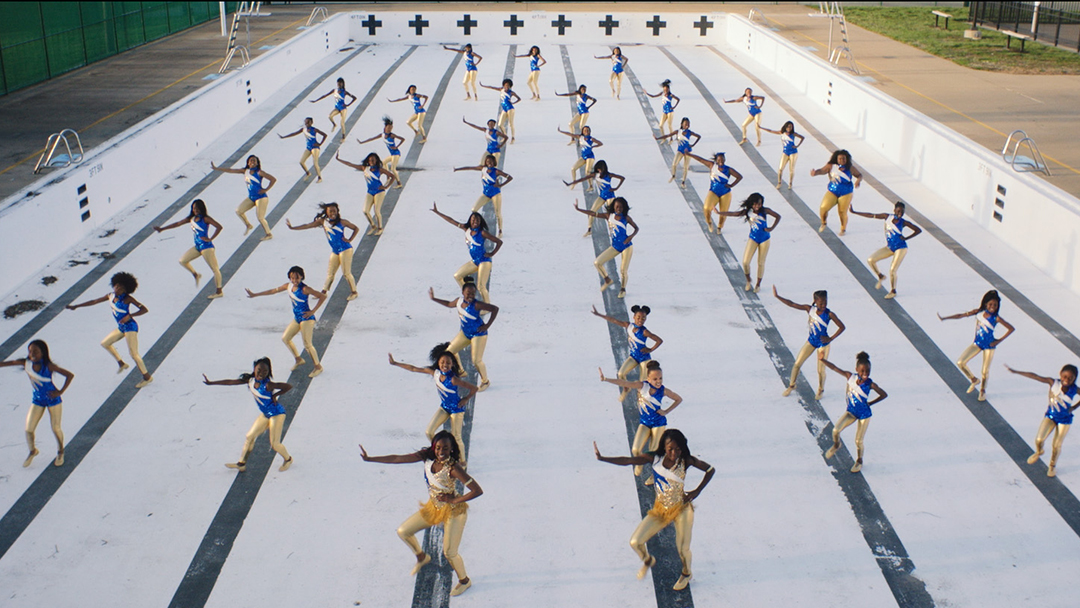
Near the end, Toni enters the drained pool alone. The film then breaks its realism: she seems to rise, convulse, and move through a final passage in which the Lionesses perform across the center's familiar spaces. The gym, stairs, boxing ring, overpass, and pool stop functioning as compartments and become parts of one impossible stage.
The screenplay rendered this moment only as “Time stops but doesn't stop.” Holmer, Yee, and the crew tested camera rigs until they found a restrained way to suspend ordinary weight without making the film's world suddenly glossy. Even then, the sequence refuses to settle whose experience we are seeing. It could be Toni's interior image; it could be shared by the watching girls; it could be cinema briefly making both possibilities true.[2]
The official still above captures the most expansive version of that ambiguity. Dozens of dancers occupy the drained pool in ordered rows, using lane markings as a score. The vacancy that once made Toni look isolated has become capacity. Yet the pool has not ceased to be a container. The film does not turn belonging into limitless freedom; it imagines a formation large enough to hold an individual without making every body identical.[1]
That is why the ending feels stranger than a victorious dance contest. There is no judging panel, trophy, or public audience to certify Toni's arrival. The familiar rooms themselves receive the performance. Her fit may be initiation, fear, desire, surrender, transformation, or several of those at once. The craft supplies a shared rhythm and withholds the final label.
The Fits makes empty space part of the choreography because it never treats space as the neutral background of a moving body. Frames wait, rooms recur, sound crosses thresholds, and formations acquire meaning by leaving a place open for someone who is not yet synchronized. Toni does not conquer that system, and the camera does not rescue her from it. By the last image, she has changed her relation to its timing. The room is still there. It can finally move with her.
Sources
- Oscilloscope Laboratories, The Fits official site — distributor synopsis, film context, and official gallery source for the article image.
- Scott Macaulay, “Precision Moves: Anna Rose Holmer, Lisa Kjerulff and Saela Davis on The Fits,” Filmmaker Magazine, April 21, 2016 — production process, framing rules, location strategy, collaboration, editing, sound, and the final sequence.
- Alex Heeney, “Anna Rose Holmer on The Fits,” Seventh Row, February 2, 2016 — director interview on empty-room cuts, intentional camera movement, offscreen action, location sound, Foley, breath, and subjective acoustics.
- J. Lauren Alvarez, “Meet the Cincinnati Dance Squad Behind The Fits,” Vice, June 7, 2016 — Q-Kidz casting, choreography by Mariah and Chariah Jones and Celia Rowlson-Hall, and the progression from boxing gestures into drill movement.
- Ginette Vincendeau, “Film of the week: The Fits explores the feints and bounds of girlhood,” Sight and Sound / British Film Institute, February 23, 2017 — credits, formal analysis, embodied performance, and critique of the film's social narrowness.
- La Biennale di Venezia, “Biennale College Cinema / International: the Call for the 9th edition is now open,” May 8, 2020 — official account of The Fits as a 2015 Biennale College microbudget feature and its Venice premiere context.