Most films let a cut finish one thing before another begins. A door closes; a street or building appears; a new scene announces its location and starts its own sentence. In Juraj Herz's The Cremator, a sentence can begin at a reception and end in a picture gallery. Karel Kopfrkingl's face fills the frame, his honeyed voice continues, and only when the camera pulls back do we discover that the room has changed around him.
That transition is more than a flourish. It is the film's moral mechanism. Kopfrkingl, played by Rudolf Hrušínský, manages a crematorium in late-1930s Prague and wraps death in a vocabulary of beauty, hygiene, duty, and release. As Nazi power approaches, its language does not have to break into his life. It joins a speech already in progress. Herz and editor Jaromír Janáček make that continuity physical: home, workplace, brothel, party office, fairground, and murder scene can become adjacent spaces inside one soothing monologue.[2][3]
The 1969 film is often described through its obvious shocks—extreme close-ups, split faces, rapid montage, and a fisheye lens that bends rooms around Kopfrkingl's head.[2][3] Its quieter trick is more disturbing. The cuts work perfectly; the viewer's ethical reorientation arrives late.
Spoiler note: this essay discusses the murders of Kopfrkingl's wife and son and the film's final movement toward the Holocaust.
The cut refuses to close the sentence
At a crematorium reception, Kopfrkingl's wife responds to his romantic self-image by proposing a more elegant name for him. The film cuts to his close-up as he begins explaining his love of beauty. His eyes shift; the camera retreats; paintings now surround him. The reply that seemed to belong to a marital exchange has carried him into a shop, where he is choosing a picture for the family bathroom.[2]
Other transitions use the same trap. At the fairground, Kopfrkingl rolls up his sleeve; the next image completes the gesture at a doctor's office. He praises his family while visiting a prostitute, then finishes the thought at home. A dark dress can fill the image and yield to his dark suit elsewhere. Music and speech keep flowing, so the new location arrives as a delayed fact rather than a declared beginning.[2][3]
Ordinary continuity editing is designed to make separate shots feel like one stable space. The Cremator reverses the bargain. Its images are disjunctive, but Kopfrkingl makes them sound continuous. The device puts the viewer inside his associative privilege: if his sentence has not ended, then he behaves as though nothing essential has changed.
That privilege matters. A new setting might otherwise bring a new social rule, a different witness, or a chance to reconsider what has just been said. Kopfrkingl's voice cancels the reset. His private vanity can flow into a business pitch; his business language can enter the family home; the language of domestic care can survive a murder. The film does not hide where he is forever. It withholds orientation just long enough for his rhetoric to get there first.
Euphemism furnishes every room
Kopfrkingl rarely uses a plain noun when a ceremonial one will do. The crematorium becomes a humane institution for releasing souls. His home is blessed, his occupation noble, his wife and children angelic. He speaks of suffering most insistently when he is learning to cause it. Hrušínský delivers these embellishments with the same smooth precision whether he is welcoming clients, moralizing about cigarettes, arranging a corpse's hair, or imagining industrial killing.[2][3]
The language is not simply a mask over a secret brute. It is how he converts other people into objects he can improve, classify, decorate, or dispose of. A pet name replaces a person's chosen identity. A sermon replaces grief. Cleanliness replaces responsibility. Liberation replaces death. By the time his old army acquaintance Reinke offers Nazi belonging, professional advancement, and access to a racially ordered world, Kopfrkingl already possesses a grammar capable of making domination sound benevolent.[2][4][5]
Reinke supplies new categories—German blood, Jewish ancestry, Party loyalty—but he does not invent Kopfrkingl's habit of renaming desire as principle. That is why the film is not a tidy conversion story in which an ordinary man suddenly becomes monstrous. The first sequence already fractures faces against zoo animals, pushes the camera too close, and distorts the family in a curved mirror. Kopfrkingl's later politics enlarge a structure of attention that was present before the recruitment began.[2][4][5]
The rooms share that structure. Lace curtains, tiled walls, paintings, coffins, mechanical amusements, and polished interiors all look arranged for his approval. Even people can resemble dolls or specimens. Herz's training in puppetry registers in the chamber-of-horrors performers and in the protagonist himself: smooth hair, round face, controlled gestures, a voice that seems almost detachable from the body.[2][4] Respectability is not the safe world fascism destroys here. It is one of the display cases in which fascist logic learns to pose.
Smooth passage, warped geometry
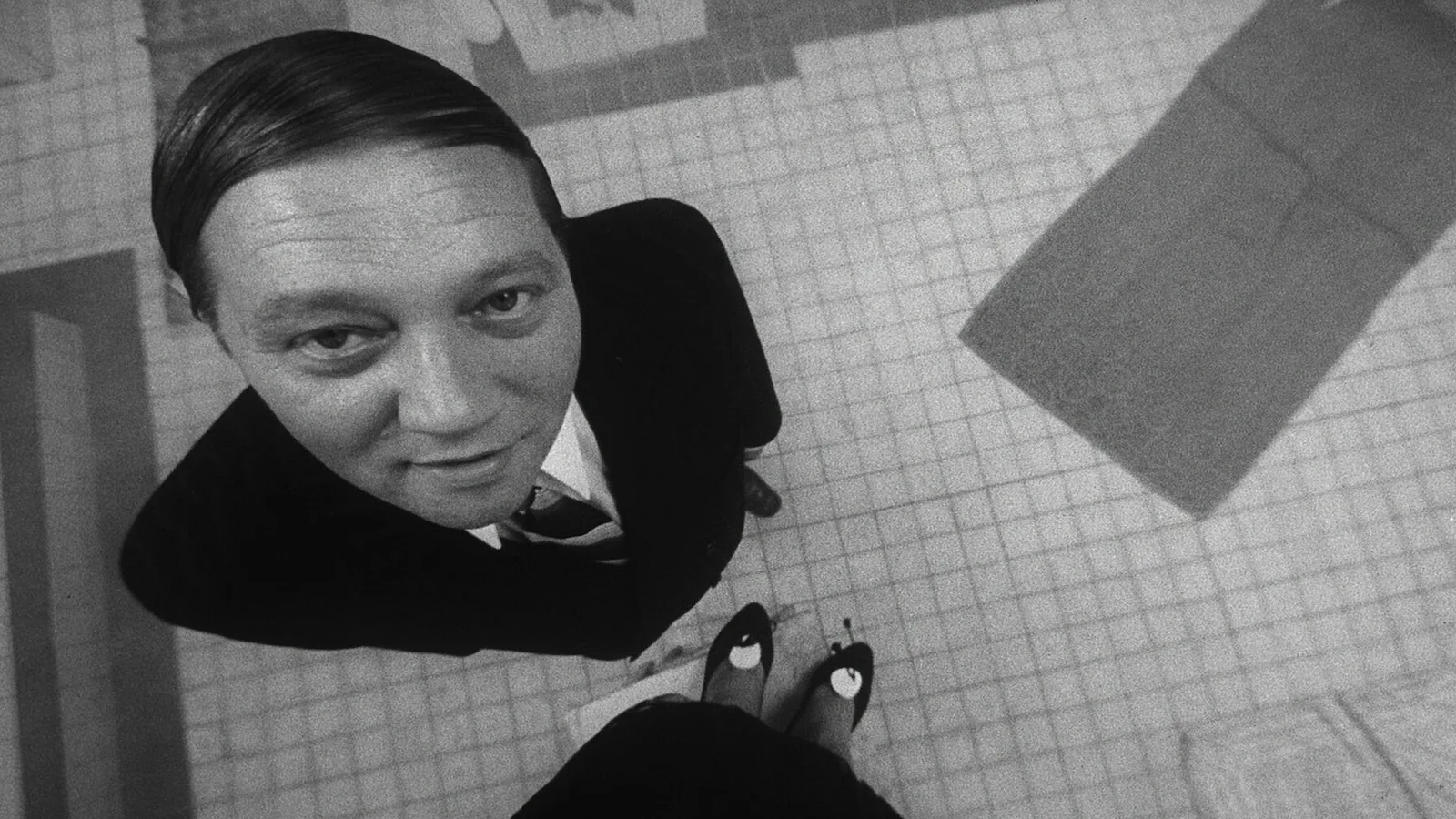
The official Czech National Film Archive still used above catches the film's two visual systems meeting. Kopfrkingl stands on a tiled floor, but a steep, distorting angle makes his head swell toward the camera while his black suit contracts into a neat cutout below. The grid should stabilize the room. Instead it measures how far the image has bent around him.[1]
Herz and cinematographer Stanislav Milota use fisheye distortion alongside extreme close-ups and skewed angles, concentrating the most globular views around Kopfrkingl's peaks of self-enchantment and madness.[2][5] The lens announces what the seamless transitions conceal: this consciousness is not a neutral corridor between places.
The contrast is exact. Scene changes are often almost frictionless, while individual images can be violently warped. One method allows corruption to travel without declaring a border; the other reveals the pressure that travel has placed on perception. Smoothness and distortion are not rival styles. They divide the labor of the film.
The opening credits establish the arrangement. Photographic faces and body parts split, slide, and pile up, turning identity into movable pieces. Afterward, Kopfrkingl's speech tries to restore polish, continuity, and order. It never truly repairs what the credits have shown. His orderly world is assembled from fragments, and the edit can rearrange those fragments as readily as he rearranges moral terms.[2][4]
This essay refers to the restored presentation completed in 2019 by the Karlovy Vary International Film Festival with the Czech National Film Archive, the Czech Film Fund, and Prague postproduction studios. The restoration deliberately retained marks created during shooting and laboratory work in order to stay close to the film's original 1969 appearance.[1] That choice is especially valuable for a movie in which optical strain, high-contrast texture, and the physical character of a transition are part of the argument, not damage to be polished away.
The voice crosses before the body does
Zdeněk Liška's score helps Kopfrkingl pass through walls. Female voices hover with an almost devotional calm; waltz rhythms make ceremony feel light enough to repeat. The music often crosses a cut instead of granting the new scene a fresh emotional key. Hrušínský's measured speech does the same. Sound lays one continuous surface over spaces that the image has already exchanged.[2][3]
The effect is not that every scene feels identical. It is that no scene is guaranteed an independent conscience. At home, the crematorium's language survives. At the crematorium, domestic endearments survive. In political company, spiritual release and technical efficiency become compatible. Kopfrkingl does not need to shout to make these worlds agree; repetition does most of the work.
His voice eventually becomes harsher and more openly messianic, but the film refuses to treat that change as the first sign of danger. The danger was the earlier consistency. The same tone that made cruelty sound like solicitude also made each escalation feel like a clarification of what he had always meant. A raised voice would at least mark a threshold. Kopfrkingl's gentleness erases it.
That is why the film's black comedy remains inseparable from its horror. His phrases are too ornate for the mundane transactions around them, and his manners are so complete that they become absurd. Laughter recognizes the excess. Horror arrives when the surrounding institutions begin rewarding it.
Fascism finds a prepared syntax
The Cremator was made during the political opening of the Prague Spring, with production straddling the Warsaw Pact invasion of August 1968. After its release, the film disappeared from domestic circulation and did not return until communist rule had ended.[2][4] Its references to “the Party” remain pointedly generic, allowing the film's account of ideological capture to look beyond one uniform.[2][3]
The historical setting is still precise. As Czechoslovakia is broken apart and occupied, Reinke teaches Kopfrkingl which ancestry counts, which acquaintances can be denounced, and which ambitions the new order will sponsor. Yet the film's form keeps responsibility from being displaced entirely onto a persuasive recruiter. Kopfrkingl's language of purity, speed, deliverance, and professional duty makes the offer intelligible. Fascism gives that language an administrative scale.[2][4]
His wife's Jewish family background becomes an obstacle to advancement; he hangs her in the spotless bathroom. His son becomes another obstacle; the crematorium absorbs the killing. Finally, his expertise is recruited toward vastly larger furnaces. The progression is appalling because each step crosses a real boundary while his vocabulary insists that it has merely improved a process.[2][4]
Herz could have punctuated those steps with dramatic breaks: the seduction, the decision, the fall. Instead he builds a corridor. The rooms change, the political stakes widen, bodies disappear, and one sentence keeps finding a place to finish. The form does not absolve Kopfrkingl by trapping him inside delusion. It shows how actively he uses delusion to keep seeing himself as cultivated, useful, and merciful.
The most frightening cut in The Cremator is therefore not a burst of montage or a face broken apart. It is the cut that feels reasonable. It lets a reassuring voice reach the next room before judgment does—and when the frame finally opens, the new order is already standing there.
Sources
- Czech National Film Archive, “The Cremator” — official credits, 2019 restoration provenance, presentation notes, and source page for the archival film still.
- Adam Schofield, “A Black Pearl of the Deep: Juraj Herz's The Cremator,” Senses of Cinema, May 2007 — close analysis of the gallery, doctor's-office, and clothing transitions, music, propaganda, and Prague Spring subtext.
- Jonathan Romney, “Film of the Week: The Cremator,” Film Comment, July 24, 2019 — analysis of Hrušínský's voice, Liška's score, sound, editing, and the film's mock-genteel horror.
- Nick Pinkerton, “Who Makes the Nazis?” Metrograph Journal, April 5, 2024 — essay on Kopfrkingl's prepared authoritarian habits, the film's interiors, puppetry, political chronology, and fragmented visual field.
- Robert Birkholc, “Between Biedermeier and the Horror of the Holocaust: Film Representation of a Necrophiliac's Perspective in Juraj Herz's The Cremator,” Załącznik Kulturoznawczy 5, 2018 — peer-reviewed analysis of subjective narration, framing, editing, and Kopfrkingl's self-image.