Francis Ford Coppola’s The Conversation (1974) is often praised for being “ahead of its time” about surveillance. That is true, but it can flatten what actually makes the film disturbing. The movie’s real technical achievement is not prediction. It is that sound design and editing refuse to treat recorded audio as stable evidence. The more Harry Caul listens, the less secure meaning becomes.
Spoiler note: this essay discusses the film’s central reveal and several late scenes.
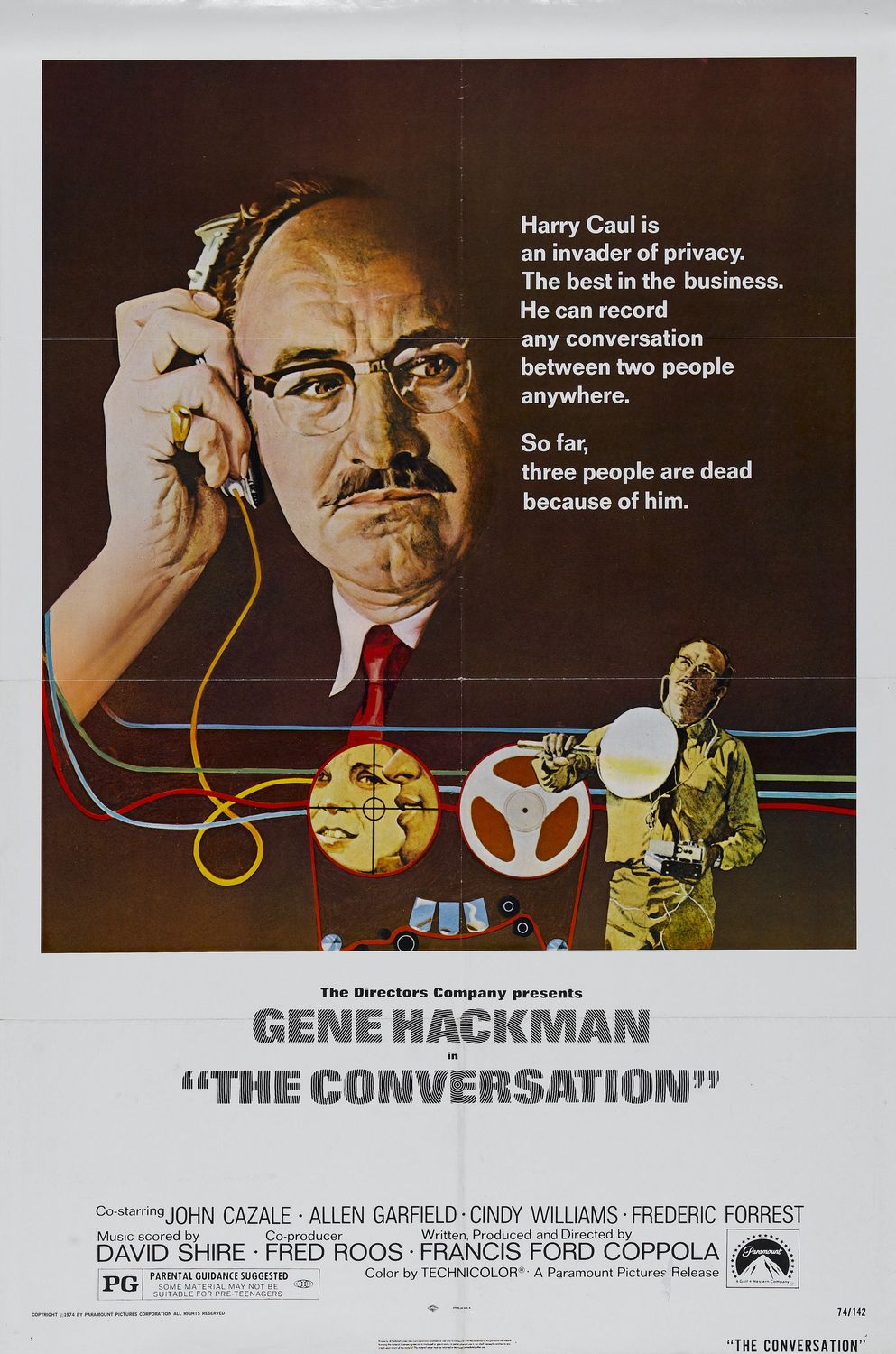
Image context: the cover image uses the official 1974 theatrical poster as a release-era anchor, not as scene evidence for the craft breakdown below.
The core wager: information arrives damaged
Coppola wrote the script from an idea he had been developing in the late 1960s, well before Watergate made surveillance a mass political obsession.[1][2] By the time the film premiered in 1974, won the Palme d’Or at Cannes, and later picked up three Oscar nominations, its subject already felt uncannily current.[3][4] But the film’s lasting force comes from a narrower craft decision: it is built around damaged transmission.
Harry is a professional listener, yet the movie keeps putting him in contact with voices that are partial, distorted, overheard, replayed, or mis-stressed. Surveillance here does not produce omniscience. It produces labor: filtering, splicing, isolating, and guessing.
That is why the film still feels modern in 2026. Many contemporary thrillers treat captured data as decisive once enough resolution is added. The Conversation works harder. It shows that more signal can still leave interpretation unstable if context, emphasis, and motive are missing.
Union Square: documentary crowd, broken signal
The opening Union Square sequence explains the whole film’s operating system. Walter Murch later described it as a documentary-like scene, and in his 2022 interview he noted that apart from the leads and a few planted performers, roughly 90 percent of the people on screen were simply captured in the square.[5] That matters because the crowd is not background texture. It is a sound problem.
Murch also explained that the distorted voice effect in this opening was created by running dialogue through an analog ARP synthesizer, chopping it into harsh, glitchy fragments before digital audio even existed in commercial film practice.[5] The result is crucial. We do not enter the story through clean exposition; we enter through interference.
That interference changes point of view. At first the high-angle image can feel neutral, almost godlike. Then the film reveals that this apparent overview is actually tied to flawed surveillance capture. A wide public space becomes an acoustic maze. The scene does not announce mastery. It announces that the entire movie will be about the distance between recording and understanding.
Harry’s workshop: editing as interpretive pressure
The film’s most radical technical choice may be how it treats Harry’s workspace. Instead of turning the tape-analysis scenes into procedural clarity, Coppola and Murch make them visually discontinuous and cognitively tense.
Murch has spoken about these scenes as places where cuts are deliberately emphasized: Harry’s face, his hands, tape reels, photographs, speaker cones, fragments of remembered imagery.[6] There is very little comforting overlap from shot to shot. The audience has to build connection across separated pieces, just as Harry does.
This is why the workshop material never plays like a conventional thriller “lab.” The point is not that the expert will solve the puzzle because the machine is good enough. The point is that every replay changes interpretive weight. Intonation shifts. A pause feels heavier. One phrase begins to drag the rest of the conversation behind it.
The production limits intensify that feeling. In the same 2022 conversation, Murch recalled having only six tracks available at once for the final mix, plus various premix workarounds.[5] Limitation becomes style here: the soundtrack does not present infinite forensic depth; it presents layers that must be selected, prioritized, and doubted.
Repetition is the real special effect
Many films use repeated dialogue as a memory cue. The Conversation uses it as an argument about how meaning mutates under pressure. The same recorded exchange keeps returning, but not as stable truth. It comes back with new stress, new phrasing weight, and new emotional framing as Harry’s fear reorganizes what he thinks he heard.
This is where the film’s craft is more severe than its premise. It does not merely tell us that audio can be manipulated. It demonstrates that perception itself is a manipulative medium. A listener can falsify meaning without ever forging the tape.
That is why the movie’s famous line works so powerfully in retrospect. The revelation is not just a script twist. It is the payoff of the entire sound structure: emphasis was always the battlefield. Harry did not fail because he lacked access to the recording. He failed because he mistook possession of the recording for comprehension.
The cleanest way to hear the method is to notice how little the words themselves need to change. A line that first lands like a warning later lands like intent because the stress moves. Coppola and Murch turn prosody into plot, which is why the climax feels earned instead of gimmicky: the film has been teaching you, all along, that surveillance audio is not neutral until somebody decides where the sentence really leans.
A 3-minute rewatch drill: hear the misreading engine in action
If you want the article's argument to click fast on a rewatch, run this short sequence test:
- Step 1 (Union Square opening): watch once with eyes on framing, then once with eyes off-screen; notice how much narrative weight is carried by damaged audio texture rather than visible action.[5]
- Step 2 (workshop replay scenes): track only pauses and stress shifts in the key line; meaning migrates even when wording barely changes.[5][6]
- Step 3 (final apartment teardown): listen for how environmental sound collapses from investigative clarity into paranoid residue.
That small exercise is usually enough to show why the film is less “surveillance predicts the future” and more “recording does not cancel interpretation.”
The film can do normal space — which is why its harsher spaces matter
One of the smartest choices in the movie is that it does not keep every scene in the same acoustic mode. Murch contrasted the flatter, more collage-like workshop scenes with the party at Harry’s lab, which he described as a more traditionally three-dimensional social space.[5] That contrast matters.
The film proves it can render convivial, overlapping room dynamics when it wants to. Which means the harsher fragmentation elsewhere is fully intentional. When Harry is alone with the tapes, the world narrows into evidence fragments. When other bodies enter the room, depth and social flow partially return. Technique tracks psychology.
The same logic carries into the ending. By the time Harry tears apart his apartment after learning he himself has been overheard, the film has completed its reversal: the man who trusted recording technology has been reduced to pure acoustic paranoia. He cannot find the device. He cannot stabilize the space. All he can do is keep sounding out the room with his own saxophone.
That final image is devastating because it strips surveillance cinema down to one residue: after all the machines, reels, mics, and filters, what remains is a lonely person testing whether any private frequency is left.
Why this craft still feels alive in 2026
The Conversation ran 113 minutes, cost about $1.6 million, grossed roughly $4.9 million worldwide across releases, and entered the National Film Registry in 1995.[2][7][8] Those facts help place it historically. They do not explain why filmmakers, editors, and sound designers still study it.
The deeper reason is that the movie solved a problem many contemporary films still dodge: how do you make information-heavy cinema feel less certain as more information arrives? Coppola and Murch answered with a design built on distortion, replay, fragmentation, and acoustic subjectivity.
That answer remains hard to improve on. The Conversation understands that technology does not just extend perception. It also extends misreading. The film’s craft is memorable because it turns that insight into texture, rhythm, and dread rather than a thesis statement.
Sources
- Cinephilia & Beyond — “Francis Ford Coppola’s Paranoia-Ridden Tale of Surveillance, Guilt and Isolation”
- Wikipedia overview — The Conversation (release, credits, production context)
- Festival de Cannes — The Conversation (1974 selection / award listing)
- Oscars.org — 47th Academy Awards (films released in 1974)
- IndieWire — “The Conversation: Francis Ford Coppola & Walter Murch's Collaboration”
- FilmSound.org — “In Conversation with Walter Murch”
- Box Office Mojo — The Conversation
- Library of Congress / National Film Registry titles list
- IMP Awards — The Conversation official theatrical poster page