People keep describing Flow with one headline fact: it was made in Blender. That is true, but it is also too shallow to be useful. The better industry reading is that Flow treated open-source software as a production architecture.
What matters is not simply that Blender was cheaper than a conventional studio stack. What matters is that director Gints Zilbalodis could keep previs, camera exploration, layout, lighting, look development, and final rendering inside one tool environment that moved at his speed. In a film with no dialogue, floating camera logic, and a world built around water, that continuity changed who could make decisions, when they could make them, and how many handoffs the production had to survive. Because speech is not carrying the story, camera movement and spatial continuity have to do even more narrative work than usual, which makes iteration speed more valuable than the Blender headline alone suggests.
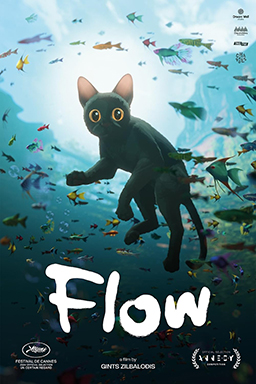
Image context: the cover uses the official poster, which is relevant here because it advertises the film’s actual selling proposition—silhouette, motion, flooded space, and group choreography—more than star voice work or dialogue beats. That makes it a good visual cue for an argument about production architecture rather than just software branding.
The commercial signal was not tiny, even if the team was
Art & Object reported Flow at roughly $3.7 million in budget. Box Office Mojo lists $30.9 million worldwide gross. The Oscars site confirms that the film went on to win Best Animated Feature at the 97th Academy Awards.
That combination matters because it shows a small independent production not merely finishing a feature, but converting a modest-cost pipeline into global cultural reach. The film also moved through Cannes and awards season with enough force to make its tooling story legible to the wider industry. In other words: this was not an “interesting software anecdote” attached to an obscure release. It was a visible market event.
But the real lesson is still upstream of box office. Flow suggests that a compact team can compete above its weight when software reduces translation loss between stages of production.
Blender’s real advantage here was decision compression
In Blender’s production interview, Zilbalodis says he switched from Maya to Blender in 2019 largely because of EEVEE, the real-time renderer. He describes speed as decisive not only for rendering but for file handling, lighting setup, and camera work, because lighting affected camera placement and the feel of the shot while he was still discovering the scene.
That sounds technical, but its production consequence is strategic: if camera, blocking, atmosphere, and lighting can all be tested inside a fast loop, a director does not have to wait for a slower downstream department chain before judging whether a sequence actually works.
The same interview gives the strongest evidence for why the loop held. Production took about five and a half years. The full team was around 15–20 people, but at any given time often only three to five were active. Many animators reportedly switched to Blender in less than a week. The final film was rendered entirely in Blender with EEVEE, with 4K frames taking about 0.5 to 10 seconds each, no render farm, and final output completed on Zilbalodis’s own PC.
That is not a cute indie footnote. It means the film’s visual decision-making stayed unusually close to authorship. The pipeline did not just lower software cost; it lowered organizational drag.
Why the camera style and the tool choice reinforced each other
Cartoon Brew’s interview helps explain why this mattered aesthetically. Zilbalodis says he built the animatic chronologically, exploring space with the camera rather than relying on traditional storyboards. He keyframed camera motion, then layered in handheld movement patterns for standing, walking, and running. He wanted the camera to feel like it was inside the world rather than observing safely from outside.
That method fits Blender’s strengths unusually well. A production built around exploratory camera movement gains far more from real-time iteration than one built around rigid locked-off shot planning. Flow is therefore a technology story in a stricter sense than “made with open source.” The film’s formal language—gliding movement, environmental continuity, discovered staging—was aligned with the software’s speed characteristics.
This is where many industry summaries miss the point. The important question is not “Can Blender make feature animation?” That answer is obviously yes. The important question is “What kinds of films gain the most when previs and near-final image live close together?” Flow gives one answer: films whose emotional force depends on camera exploration, atmosphere, and tonal continuity more than on hyper-complex photoreal surface simulation.
Small core, selective scale-up
The production was not purely solitary, and that matters too. Blender’s interview notes that Latvia handled core development work while French and Belgian partners joined later for character animation and other specialized tasks. Cartoon Brew describes roughly 20 character animators participating during the larger animation phase.
So the operational lesson is not “one auteur can do everything.” It is closer to this: a stable core can keep the visual grammar coherent, then attach specialist capacity where the bottlenecks are most real. That is a very different production topology from a large studio where every stage is departmentalized from the start.
The advantage of that topology is coherence. The risk is key-person concentration. If too much taste, tooling knowledge, and final decision authority sit with one person, the project can move beautifully—until that person becomes the bottleneck.
The boundary conditions are stricter than the success story makes them look
This model is powerful, but it is not universal.
First, Flow had a visual style that benefited from stylization and atmospheric softness. Not every project can accept the same tradeoffs. Second, the timeline was long; five-plus years is not a casual efficiency win. Third, the pipeline still depended on technically strong collaborators for water effects, shaders, rigging, and animation support. Open source removed licensing friction, but it did not remove craft density.
There is also a leadership condition. Zilbalodis was not just directing; he was integrating camera, lighting, and scene logic at a granular level. If a project’s creative leadership is more distributed, the same toolchain may not produce the same speed advantage because the real bottleneck becomes review structure, not software.
So the portable lesson is narrower than the hype version. Open-source tools are most strategically powerful when they match the production’s authorship pattern, visual target, and review cadence.
Which productions are actually a fit for this model?
Flow is most portable when three things line up.
Best fit 1: director-led animated features where camera logic is part of authorship
If the director is still discovering the film through movement, blocking, and atmosphere—not just approving finished departmental work—then a unified fast loop is a genuine multiplier.
Best fit 2: stylized projects where continuity of mood beats maximal surface complexity
Films that win through world feel, spatial drift, tonal coherence, and timing often gain more from rapid integrated iteration than from the most elaborate heavyweight simulation stack.
Best fit 3: small-core productions that need fewer handoffs more than they need bigger departments
When the project’s main enemy is translation loss between stages, Blender-style compression can be strategically stronger than a nominally more powerful but slower organizational chain.
The weak fit is just as important: if the project depends on highly distributed authorship, hard departmental boundaries, or a visual target that requires extensive specialized simulation and review gates, then the Flow lesson should be borrowed selectively rather than copied whole.
What producers should actually take from Flow
Three practical filters matter more than generic enthusiasm:
- Loop-speed test: does the project gain real value when previs, camera, look-dev, and final-lighting decisions happen in one fast environment?
- Authorship test: is there a creative lead who can productively exploit that speed without becoming a failure point?
- Specialist test: can the production still attach high-skill support for the few domains where tool freedom does not eliminate complexity?
If the answer to all three is yes, then Flow is not just an inspirational case. It is a production model. If the answer is no, adopting Blender as a badge may change costs without changing outcomes. The portable asset here is not “use Blender” in the abstract. It is “remove approval latency where the film’s meaning is actually being made.”
A useful red-flag version is this: if the film will still be approved through slow committee handoffs between previs, layout, lighting, and final look review, then swapping software will not recreate the Flow advantage. The gain came from collapsing decision latency, not from putting a cheaper logo on the same departmental relay race.
That is why Flow still matters in 2026. It did not prove that software alone democratizes cinema. It proved something more concrete: when tool choice, visual form, and team shape line up, a small film can remove enough friction to compete in arenas that used to belong almost entirely to bigger machines.
Sources
- Blender — “Making Flow – Interview with director Gints Zilbalodis”
- Cartoon Brew — “Gints Zilbalodis On The Improvisational Filmmaking Style Of ‘Flow’”
- Art & Object — “'Flow' Director Gints Zilbalodis Discusses His Open-Source Animated Film”
- Box Office Mojo — Flow totals and market breakdown
- Oscars — The 97th Academy Awards (2025)
- Wikipedia file page for poster used