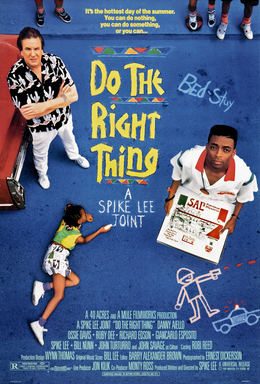
Spike Lee’s Do the Right Thing (1989) is often discussed as a film about racial tension, and that description is true but too blunt. What gives the movie its lasting force is the way it treats one Bedford-Stuyvesant block as a living system under load. Heat, music, storefront ownership, rumor, insult, and police presence do not sit in separate thematic buckets. They stack, circulate, and eventually overload the neighborhood’s ability to hold disagreement without catastrophe.[1][2][3]
That is why the film still feels urgent in 2026. It does not ask viewers to admire an abstract civics lesson. It shows how coexistence can fail when every ordinary thing on a block—noise, weather, property, pride, and response time—starts acting like a political instrument.
Spoiler note: this essay discusses the film’s ending, including Radio Raheem’s death, Mookie’s trash-can throw, and the closing epilogue quotations.
Heat is not scenery; it is a pressure multiplier
The movie’s premise is simple: it unfolds on an extreme-heat day in Brooklyn.[1][4][5] But Lee does not use weather as decorative realism. He uses it as a pressure multiplier that alters how bodies occupy space. People lean out of windows, sprawl on stoops, argue in the open, search for breeze, and react faster than they would in a cooler, more buffered city rhythm.
Lee also makes heat visible rather than merely reportable. The red-orange palette, the baked walls, and the confrontational closeness of many framings keep the block looking as if it has already been pushed a few degrees past comfort before the decisive arguments even begin. Temperature becomes an image system as well as a plot condition.
That matters because the film’s conflicts are not born from nowhere. Sal’s pizzeria, Radio Raheem’s boombox, Buggin’ Out’s grievance over the Wall of Fame, the teenagers opening the hydrant, the patrol cops moving through the block—none of these are isolated “issues.” They become combustible because the film keeps everyone in public, visible, sweating, and acoustically exposed to one another.
Lee’s formal choice is sharp: the block never feels like a neutral backdrop. It feels like a chamber in which temperature lowers the threshold for insult and reaction. In that sense, Do the Right Thing is less interested in “a bad day” than in the mechanics of reduced tolerance.
Sound is how the film maps territory
If heat loads the system, sound tells us who is trying to control it. Mister Señor Love Daddy’s radio voice, Public Enemy’s “Fight the Power,” the direct-to-camera racial slur montage, storefront arguments, and shouted sidewalk commentary all make the block feel sonically contested.[1][4][6]
Radio Raheem’s boombox is the clearest example. It is not just a character accessory and not just a musical cue for viewers. It is a moving territorial claim. Every time Raheem carries that music through the street, he makes sound into presence: you will hear me before you negotiate with me, before you classify me, before you pretend this block belongs to somebody else.
Lee makes that territorial function even clearer by how he frames public speech elsewhere on the block. Mister Señor Love Daddy’s radio patter sounds loose and playful, but it also behaves like a temporary civic signal system, measuring mood while amplifying it; the direct-to-camera slur montage pushes the same idea into uglier form, turning speech into a weapon that redraws the social map in real time. On this block, sound is never neutral background. It is one of the ways power names the room.
That is why Sal’s destruction of the boombox with a baseball bat lands so hard. The act is not merely a business owner demanding quiet in his shop. It is an attempt to reassert who gets to define the acoustic order of the neighborhood. The conflict is no longer only about manners. It becomes a sovereignty question: whose rhythm sets the terms of public life on this block?
Sal’s Wall of Fame is a property dispute and a symbolic governance dispute at the same time
The most analytically useful argument in the film is not the biggest explosion at the end. It is the earlier fight over representation inside Sal’s pizzeria. Buggin’ Out objects that a restaurant serving a mostly Black neighborhood displays only Italian American celebrities on its wall; Sal answers with the logic of ownership—this is my place, so I decide what goes on it.[1][4]
The scene still works because both sides are talking about more than decoration. Sal is defending private property and personal authorship. Buggin’ Out is challenging the idea that a business can extract daily loyalty from a neighborhood while refusing symbolic reciprocity. The wall becomes a map of who counts, who is visible, and who gets to narrate the block’s identity.
That is one reason the film has aged so well. Long before current debates about platform governance, neighborhood branding, and community capture, Lee had already framed the central question with brutal clarity: when a place depends on one public, can it keep claiming cultural neutrality while displaying another?
The police turn a neighborhood argument into state violence
The film’s final movement matters because it changes the scale of force. Up to the confrontation at Sal’s, the block is full of insult, ego, and threatened violence, but the conflict is still legible as a neighborhood dispute. Once the police intervene and Radio Raheem is killed during restraint, the film crosses into a different register.[1][4]
That shift is crucial. The earlier argument is over noise, respect, ownership, and belonging. The police response converts that unstable but still social conflict into an irreversible event backed by the state. After Raheem is killed, no one on the block is arguing over wall space or store policy anymore. The system has been redefined by an act of official force.
This is why readings that reduce the ending to a single question—was Mookie right or wrong to throw the trash can?—can feel too small for the film Lee built. The point is not that moral judgment disappears. The point is that judgment now takes place after the arrival of an asymmetrical violence that has already changed the terms of the scene.
The film refuses clean bookkeeping on purpose
Mookie’s throw through the pizzeria window remains controversial because the film does not hand viewers one approved ledger. Instead it closes with the famous paired quotations from Martin Luther King Jr. and Malcolm X, forcing the audience to sit with incompatible moral vocabularies rather than a settled answer.[1][4][6]
That refusal is one of the movie’s deepest strengths. A weaker film would resolve the block into innocence on one side and guilt on the other. Do the Right Thing does something harder. It keeps showing that private grievance, communal anger, commercial dependency, and police power do not fit into one neat moral ledger. The title remains a wound because every character believes, at some point, that they are defending some legitimate principle—dignity, property, order, self-respect, survival.
The tragedy is that these principles do not meet on equal terms.
The closing quotations are an aftershock, not a debate-club balance patch
Lee’s paired ending quotations from Martin Luther King Jr. and Malcolm X matter because they do not function like a tidy “both sides” appendix.[1][4][6] They arrive after the neighborhood’s social vocabulary has already been broken by state violence, and they force the audience to confront the fact that moral language does not return to the scene on equal footing. One quotation speaks from the discipline of nonviolence; the other speaks from the pressure of self-defense and political realism. Placing them together does not solve the movie’s argument. It keeps the wound open.
That structural choice is one more reason the film lasts. The ending refuses to let viewers leave with the satisfaction of a completed civic lesson. Instead it asks whether any local ethic can remain intact once the block has passed from contested coexistence into officially sanctioned force.
Why it still bites in 2026
The movie’s standing is measurable. It premiered at Cannes in May 1989, opened in the United States on June 30, ran 120 minutes, and turned a reported $6.2 million budget into roughly $37.3 million worldwide.[1][2][5] It received two Academy Award nominations and has since been canonized by critics and institutions alike.[3][4][6] But those honors are only the surface explanation for its durability.
The deeper reason is structural. Do the Right Thing understands that civic breakdown rarely arrives as pure ideology. It arrives through local mechanics: who controls the room, who gets heard, who is visibly protected, whose property is treated as sacred, whose body is treated as disposable, and how fast escalation outruns repair.
That is why the film still feels contemporary. It does not tell us that conflict exists. It shows how a neighborhood becomes a crisis sensor when heat, sound, commerce, and coercive authority are all routed through the same block.
90-second rewatch drill
If you revisit the film with this essay’s argument in mind, test three things in sequence:
- Track who gets to set the sound floor: note every moment when music, radio patter, street shouting, or silence changes who appears to own the block.
- Watch how heat pushes everyone outward: stoops, sidewalks, hydrants, open windows, and storefront thresholds matter because the movie keeps conflict in shared air instead of private rooms.
- Split the ending into two escalations: first the neighborhood argument over respect and territory, then the state escalation that makes the moral ledger impossible to keep neat.
Sources
- Wikipedia — Do the Right Thing (release dates, cast, production context, plot, soundtrack, National Film Registry note)
- Box Office Mojo — Do the Right Thing grosses and release summary
- Oscars.org — The 62nd Academy Awards (1990), nominations for Do the Right Thing
- Encyclopaedia Britannica — Do the Right Thing background, inspirations, and reception context
- Festival de Cannes — film entry for Do the Right Thing
- BFI — Do the Right Thing (film page and critical overview)
- Wikipedia file page — poster source used in this article