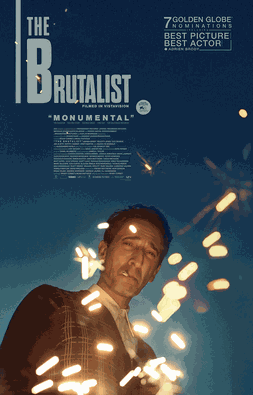
The easiest way to misread The Brutalist is to split it into two incompatible headlines. One headline says Brady Corbet and cinematographer Lol Crawley revived VistaVision, pushed a low-budget prestige film toward large-format theatricality, and built a near-four-hour event around film grain, architecture, and scale. The other says the production used AI-assisted dialogue work in post, inviting suspicion that an ostensibly artisanal movie still crossed an invisible line.
The more useful industry reading is that these are not opposite stories. They are the same story. The Brutalist shows how contemporary prestige cinema is increasingly built from hybrid workflows in which old capture formats, lean financing structures, specialized post pipelines, and narrowly scoped machine assistance all have to coexist inside one authorship model.
Why VistaVision was a production decision, not just a romantic one
The film’s analog identity is real, but it was never just cinephile theater. In Crawley’s Filmmaker interview, he explains that VistaVision offered a way to get a much larger image area than standard 35mm without paying full 65mm costs. Because 35mm stock runs horizontally through the camera in eight perforations, the format yields more than twice the image area of ordinary 35mm while preserving a wider field of view. That mattered for a movie built around quarries, facades, interiors, and the physical authority of architecture.
IndieWire’s craft coverage adds the next practical point: the wider field of view let Crawley photograph buildings with rectilinear lenses rather than forcing architecture through more visibly distorting wide-angle glass. In other words, VistaVision was not merely a vintage badge. It solved a representational problem specific to this movie’s subject. That is the right test for any premium-format choice: it should change what the film can show, not simply advertise the director’s taste.
Just as important, the format choice sat inside severe budget discipline. Kodak’s production write-up and multiple trade reports describe a film made for under $10 million, shot in just 34 days, after a prep-and-location strategy built around Hungary, Italy, and small New York pickup work. The production also did not fetishize purity for its own sake. Crawley told Filmmaker that the movie mixed majority-VistaVision photography with standard 35mm, some 16mm, and DigiBeta material where the format or shooting conditions demanded it.
That is the first big lesson. The film’s “analog authenticity” was already a managed blend. The team chose the expensive format where it generated meaning, then stepped down to cheaper or more practical formats when the shot required it.
The event was engineered across capture, finish, and exhibition
Kodak notes that the VistaVision rushes were scanned for post with an eye toward 70mm prints, the most practical exhibition format for approximating the original image height on film. IndieWire framed the 70mm bookings as the route that most closely matched how Corbet and Crawley wanted audiences to encounter the movie. The planned 15-minute intermission was part of that same design logic: not a gimmick added after the fact, but a release-shaping choice that helped position the title as a destination screening rather than background content.
That framing mattered commercially. Box Office Mojo lists $50,450,120 worldwide for the title, with $16,279,129 domestic and $34,170,991 international. For a three-and-a-half-hour period drama made for less than $10 million, those numbers suggest that theatrical framing was not merely awards-season decoration. It was part of the product architecture. Motion Picture Association reporting also notes that A24 reportedly paid around $10 million for distribution rights after Venice, which means the film’s event identity likely mattered not only to moviegoers but to downstream deal economics.
So the movie’s technical stack worked in layers:
- VistaVision gave the film an image identity tied to architecture and scale.
- The 70mm pathway translated that identity into a premium theatrical promise.
- The intermission and runtime turned the promise into an event.
- A24 then sold the event rather than apologizing for the film’s length or severity.
That combination is why The Brutalist matters as an industry case. It shows that format, release framing, and distributor conviction can still create disproportionate value even for non-franchise adult cinema.
Where the real controversy begins
The post-production argument arrived because editor Dávid Jancsó discussed using Respeecher tools to refine parts of Adrien Brody’s and Felicity Jones’s Hungarian dialogue. The Hollywood Reporter summarized Corbet’s response clearly: no English dialogue was changed, the actors’ performances remained their own, and the intervention was limited to Hungarian-language dialogue editing, specifically certain vowels and letters, after months of dialect work with coach Tanera Marshall.
That still leaves a legitimate question. If the movie wants to present itself as painstakingly human-made, why use AI assistance at all?
The answer, again, is production reality. Jancsó told The Hollywood Reporter that the job was closer to dialogue editing than performance replacement, and that the team had too much Hungarian dialogue to keep doing everything the slow way under an already constrained post schedule. Respeecher’s own case study, which obviously reflects the vendor’s perspective and should be read that way, describes an iterative workflow involving human sound specialists, repeated revisions, and a Hungarian advisor rather than a one-click substitution model.
That does not make every skepticism disappear. It does clarify the boundary at stake. The key issue is not whether software touched the film at all. Modern cinema is saturated with software. The real issue is whether the intervention changes authorship, alters performance meaning, or quietly expands beyond a corrective function into synthetic replacement.
By the filmmakers’ account, The Brutalist tried to keep the intervention on the corrective side of that line: preserve the actors’ English-language performances, preserve their emotional delivery, and correct small non-native pronunciation elements in Hungarian. You can still debate whether the line was placed correctly. But it is a debate about scope, authorship, and disclosure, not about a pure analog world being violated by a suddenly digital one.
The mixed-tool future is already here
This is why The Brutalist feels more consequential than a one-off controversy. The film is a compact demonstration of where prestige filmmaking is headed when budgets remain tight but aesthetic ambition remains high.
The model looks something like this:
- choose one or two expensive craft decisions that audiences can actually perceive;
- protect those decisions with disciplined scheduling and international financing structures;
- allow controlled technical compromise in less visible parts of the workflow;
- disclose the compromises early enough that the film still owns its authorship story.
Motion Picture Association reporting on the producers also underlines how essential financing architecture was here. The team stacked multiple tax incentives, kept departments lean, and chose locations whose built environment reduced set-spend pressure. That context matters because it explains why the film could afford VistaVision in the first place: the money saved elsewhere financed the splurge where it counted onscreen.
Seen this way, the production’s analog grandeur and its algorithmic dialogue repair are not philosophical enemies. They are neighboring decisions inside the same resource-allocation system.
What other filmmakers should take from it
There is a temptation to treat The Brutalist either as a heroic defense of celluloid or as proof that AI contamination has reached even the most prestigious corners of cinema. Neither reading is especially useful.
The more durable takeaway is operational. If filmmakers want to borrow anything from this example, they should borrow the decision framework:
- Spend on the layer the audience can immediately feel. In this case, image scale, texture, and theatrical form.
- Use cheaper or faster tools only where they do not rewrite authorship. Corrective language refinement is a narrower claim than performance generation.
- Define the boundary before the crisis arrives. If you cannot explain exactly what a tool changed, you are already in trouble.
- Assume disclosure is part of the production design. In 2026, workflow secrecy is not a sustainable strategy.
That last point may be the most important. The Brutalist worked because the film itself was strong enough to survive the debate, but the debate still revealed a new pressure point for awards cinema. Prestige films are no longer judged only on what tools they used; they are judged on whether the relationship between tool, craft, and authorship was legible.
A useful audit for future hybrid-workflow debates is narrow and concrete: was the tool applied to an audience-facing expressive layer or to a corrective back-end layer, did it preserve or replace the actor’s authored performance, and was the boundary disclosed early enough to be intelligible rather than defensively reconstructed later. The Brutalist does not end that argument, but it does make those questions more useful than analog-purity rhetoric.
That is the industry story here. VistaVision got audiences in the door. The post-production dispute showed where the next set of arguments will live.
A quick theater-side checklist
If you watch The Brutalist with this workflow argument in mind, three things become easier to separate.
- What VistaVision is buying you. Look at how facades, interiors, and faces hold scale and texture; that is where the expensive decision is supposed to pay back.
- What the dialogue correction did and did not touch. The useful question is whether the intervention stayed at accent refinement or crossed into performance substitution.
- What disclosure does to authorship. Notice whether learning about the post pipeline changes your reading of the performances, or mainly changes your standard for what producers must explain in advance.
That is a better way to let the controversy land on the film itself instead of floating above it as a culture-war slogan.
Sources
- Filmmaker — Lol Crawley on shooting The Brutalist (mostly) in VistaVision
- Kodak Motion Picture blog — The Brutalist production, format, stocks, schedule, and 70mm path
- IndieWire — Why The Brutalist should be seen in VistaVision and 70mm
- Motion Picture Association — producers on financing, tax rebates, A24 deal, runtime, and controversy context
- The Hollywood Reporter — Corbet’s response to the AI-backlash controversy and limits of the dialogue edits
- Box Office Mojo — worldwide, domestic, and international grosses
- Wikipedia file page for poster used