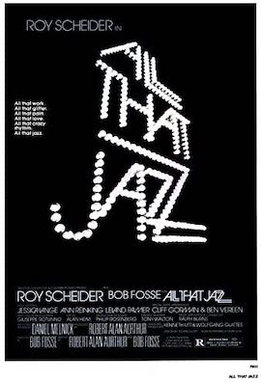
Spoiler note: this piece discusses the ending of All That Jazz in detail.
Bob Fosse’s All That Jazz (released December 1979, runtime 123 minutes) is often filed under two labels that each flatten the movie: autobiographical confession and backstage musical spectacle. Both are true, and both are incomplete. The stronger reading is formal: the film is about a man who believes editing can control death, then discovers that editing can only stage death, not negotiate with it.
Joe Gideon’s famous morning ritual—eye drops, pills, cigarette, Vivaldi, mirror, “It’s showtime, folks”—is not character color. It is the first machine the film builds. That machine has one rule: if rhythm does not break, identity does not break. The problem is that Gideon is trying to run the same machine across three incompatible systems at once: body, production, and fantasy.
The body keeps issuing failures; production keeps demanding completion; fantasy keeps promising symbolic closure. Fosse’s major achievement is to let these systems overlap in one cutting logic without pretending they can be reconciled.
“Fosse time” is not style garnish; it is the subject
In a 2009 New York Times interview, editor Alan Heim described the movie’s temporal strategy as “Fosse time”: flashbacks, flash-forwards, memory, fantasy, rehearsal, and present-tense labor cut into one continuous mental current. Heim said the team had already discovered on Lenny that fragmenting chronology could make character legible faster and with more force; All That Jazz pushes that method from technique to worldview.
That distinction matters because the film is not merely nonlinear. It is perspectival. Every temporal jump is keyed to Gideon’s cognitive load, not to audience convenience. The result is that chronology behaves like pulse: accelerate, skip, recover, collapse. Time in this movie is not calendar time; it is operating pressure.
This is why the film can move from auditions to edit room to erotic fantasy to childhood memory without feeling random. The ordering principle is not “what happened next.” The ordering principle is “what this mind can tolerate next.”
The audition montage: labor market, desire market, and replacement panic
The opening audition block is often remembered for kinetic pleasure, but the sequence is also brutal industrial description. Hundreds of bodies are compressed into selection events; sexuality, precision, and exhaustion are priced in real time; rejection is normalized as workflow.
Fosse shoots and cuts this with contradictory signals: seduction and depersonalization, virtuosity and disposability. That contradiction becomes the film’s baseline economic reality. Gideon is both choreographer and labor extractor, both artist and throughput manager.
Seen this way, the film’s self-portrait is less “great man in crisis” than “system operator who has internalized the system so fully he can no longer distinguish appetite from schedule.” It is not accidental that Gideon can only relax inside task loops. Idleness, for him, reads as extinction.
The real hinge is the surgery crosscut
The decisive movement in All That Jazz is not the final “Bye Bye Life” number; it is the earlier montage that crosscuts open-heart surgery, production logistics, and the increasingly hallucinatory performance space. Here the film states its thesis without dialogue: spectacle and procedure are structurally similar because both require segmentation, hierarchy, and disciplined bodies.
Fosse and Heim are not saying theatre equals hospital in any literal ethical sense. They are showing that Gideon experiences both through the same control grammar. In rehearsal he disassembles gesture and recombines it for effect; in surgery his own body is disassembled and recombined for survival. The formal echo is terrifying because it is exact.
This is also where the autobiographical layer becomes analytically useful rather than gossipy. Multiple accounts around Fosse’s 1974 heart attack and surgery, while he was simultaneously handling Lenny and Chicago, clarify why the film keeps folding professional process into mortality process. The movie’s medical imagery is not metaphor imported from outside; it is process memory recoded as musical cinema.
“Bye Bye Life” is an authorship test, not a redemption arc
The ending is frequently treated as catharsis: the artist accepts death, stages one last number, exits with grace. That reading captures the emotional surface and misses the strategic core.
“Bye Bye Life” is Gideon’s final attempt to preserve authorship under total biological loss. He cannot direct his organs; he can still direct framing. He cannot negotiate prognosis; he can still choreograph farewell. The number is therefore not simply acceptance. It is jurisdictional compression: as reality strips domains away, he concentrates agency where cinema still permits it.
Fosse’s cruelty and brilliance are that he grants this performance its full theatrical power, then cuts to the body bag. No transcendence hedge, no mystical softening. The film allows Gideon his authored ending and immediately marks authorship’s terminal boundary.
That hard cut is the whole argument.
Why this film still scans as contemporary
By institutional metrics, All That Jazz was already validated at scale: 9 Oscar nominations and 4 wins at the 52nd Academy Awards, a Palme d’Or (ex aequo) at Cannes in 1980, and National Film Registry induction in 2001. But awards legacy is not why the film remains urgent.
It remains urgent because it maps a modern elite-work pathology with almost embarrassing precision: convert every feeling into deliverable cadence; convert every crisis into production design; treat self-destruction as proof of professional seriousness. The movie’s formal intelligence is that it never lectures this pathology. It makes us inhabit the tempo that produces it.
Even the business envelope reinforces the paradox. Contemporary references often cite roughly $12 million budget and about $37.8 million worldwide box office—strong but not superhero-scale returns. The film is not a triumph of maximal market capture; it is a triumph of concentrated formal risk inside a commercial frame still recognizable as studio-era distribution.
A practical way to watch it now
If you revisit All That Jazz in 2026, one viewing strategy pays off quickly:
- Track every time Gideon uses rhythm to avoid silence.
- Track every cut where work-space and death-space borrow the same visual logic.
- Track where the film gives him control and where it explicitly revokes control.
By the end, the movie looks less like a self-mythologizing showbiz memoir and more like a precision study of late-stage performance identity: when life has been organized as continuous showtime, death first appears not as darkness, but as a scheduling problem.
Then the film removes the illusion.
Sources
- Wikipedia — All That Jazz (film) (release date, runtime, production context, budget/box-office references, awards overview)
- The New York Times (Matt Zoller Seitz, 2009) — “All That Fosse: All Those Echoes of ‘All That Jazz’” (Alan Heim quotes on “Fosse time” and temporal construction)
- The Hollywood Reporter (2020) — Alan Heim interview on editing collaboration with Bob Fosse
- American Cinematographer / ASC — “ShotDeck Drop: All That Jazz” (Rotunno interview excerpts; cinematography workflow notes)
- Oscars.org — 52nd Academy Awards (1980) nominee/winner record for All That Jazz
- Festival de Cannes — All That Jazz page (Palme d’Or ex-aequo, 1980)
- Library of Congress — Complete National Film Registry listing (includes All That Jazz, inducted 2001)
- Wikipedia file page for poster used (asset provenance)
- Vanity Fair — “How Bob Fosse’s Near-Death Experience Inspired All That Jazz” (1974 heart-attack production context and creator interviews)