If classic Hollywood romance often promises harmony, screwball comedy promises collision first. The genre’s lovers do not drift toward each other by way of tenderness, shared values, or lyrical inevitability. They argue, interrupt, impersonate, evade, trap, and embarrass one another into recognition. That is why screwball still feels so alive. It treats attraction as a systems problem: put desire under pressure from class difference, social performance, professional competition, and bad timing, then watch whether a couple can invent a livable rhythm inside the chaos.[1][2]
That rhythm is the genre’s real achievement. Critics often summarize screwball through “battle of the sexes,” fast talk, and farce, and those markers are real enough.[1][2] But the deeper structure is more technical. Screwball comedy takes institutions that should stabilize romance—marriage, wealth, work, propriety, expertise, inheritance—and turns them into comic stress tests. A spoiled heiress has to learn the price of travel. A paleontologist loses control of his own body around a woman who moves faster than his categories. An editor and reporter discover that professional tempo is inseparable from erotic tempo. A con artist teaches a brewery heir that upper-class innocence is its own kind of idiocy.[3][4][5][6]
Seen that way, screwball is less a subgenre of light romance than a machine for redistributing power. It thrived during the Depression-era studio system because it could stage fantasies of class crossing and gender renegotiation without openly abandoning the demand for couplehood.[1][2][3] It lets wealth become ridiculous, masculinity become unstable, and female initiative become narratively central, all while steering the story back toward union. The ending says “marriage,” but the body of the film says something more unruly: hierarchy has to be humiliated before intimacy can work.
Why screwball needed speed
The most obvious surface trait of screwball comedy is speed: fast repartee, abrupt reversals, cramped plotting, mistaken identities, and bodies constantly being moved into spaces they did not choose.[1][2] That speed is not decorative. It is how the genre strips social position of its dignity.
In conventional prestige melodrama, money gives people room. In screwball, money gives them absurdity. Wealth produces overbuilt houses, incompetent fiancés, pampered habits, and legal or social obstacles that must be broken by velocity. The genre’s lovers are usually not meeting on neutral ground. They are thrown together across status lines or through asymmetries of confidence, and comic speed is what stops those asymmetries from hardening into fixed rank.[1][2][3]
The Depression context matters here. Britannica’s broad account of the form and the standard critical summaries collected on the screwball-comedy page both point to the genre’s recurring class mismatch, madcap motion, and “funny spoofing of love” as defining traits.[1][2] Those are not separate features. They belong to one mechanism. When the rich can no longer remain insulated, when professionals lose control of the frame, when women seize initiative, when desire gets routed through buses, newsrooms, ocean liners, and hotel rooms, romance stops being a sentimental reward and becomes a renegotiation of who gets to set the terms.
That is why the genre so often prefers travel, work, and public inconvenience over private courtship. Lovers become legible to each other when the world stops protecting their self-concepts.
It Happened One Night: class comes down to road level
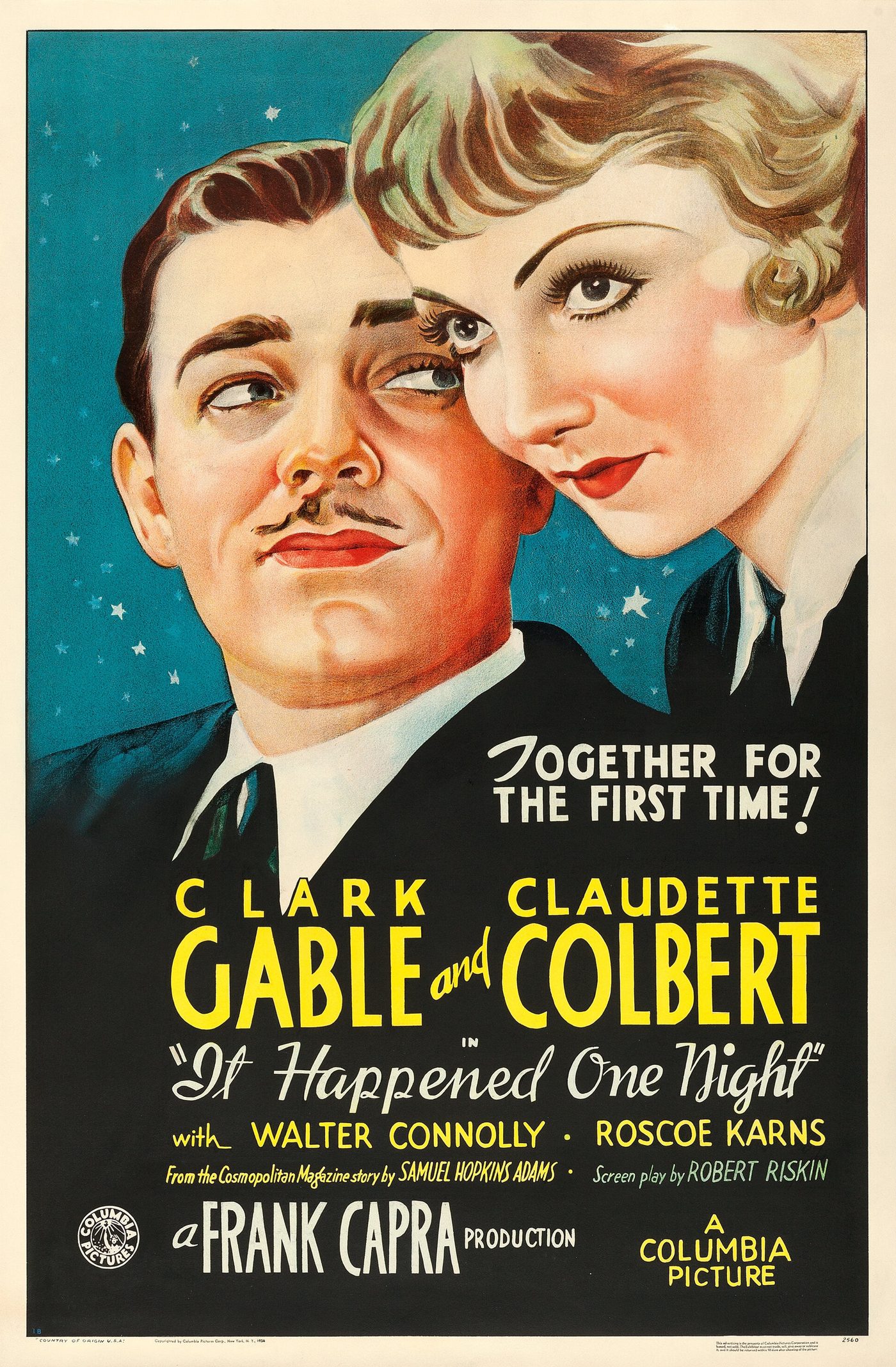
Frank Capra’s It Happened One Night (1934) is not the first thing every historian agrees on, but it remains the most useful anchor for the genre because it makes the screwball bargain so plain.[1][3] An heiress, Ellie Andrews, flees paternal control and ends up crossing the country with a reporter, Peter Warne, who needs the story as much as she needs mobility.[3] That setup does more than create romantic friction. It converts class into logistics.
Ellie cannot remain a decorative rich girl once the movie forces her onto buses, into crowded cabins, and onto roads where money stops functioning as invisible infrastructure.[3] Peter, meanwhile, does not simply guide her toward “real life”; he also becomes ridiculous in the process. His authority depends on a performance of competence that the film repeatedly punctures. The couple’s famous hitchhiking sequence captures the genre’s intelligence in miniature. Peter’s masculine know-how fails. Ellie lifts her skirt, exposes a leg, and a car stops almost instantly.[3] Screwball does this constantly: it hands narrative leverage to women not through solemn empowerment rhetoric but through comic demonstrations that masculine procedure is slower than feminine improvisation.
The “Walls of Jericho” motel scenes show another core screwball device. The blanket separating the pair is at once chastity gag, class divider, and theatrical prop.[3] The film does not deny desire. It puts desire under rules, then makes those rules part of the flirtation. Romance emerges not from lyrical confession but from negotiated cohabitation under duress. By the time the wall falls in the ending image, what matters is not merely sexual consummation. What matters is that glamour has been forced to learn reciprocity.
Bringing Up Baby: expertise dissolves under comic pressure
Howard Hawks’s Bringing Up Baby (1938) pushes screwball away from road comedy and toward total destabilization.[4] If Capra’s film makes class mobile, Hawks’s film makes expertise helpless. David Huxley is a paleontologist, which means he begins as a man of system, order, and sequence; Susan Vance is the genre’s opposite force, a woman whose energy turns every stable category into a trapdoor.[4]
The film’s brilliance lies in how completely it relocates romantic authority. David may possess scientific legitimacy, but the movie cares far more about who can survive accelerated contingency. Susan can. David cannot. A dinner jacket gets shredded; a dinosaur bone becomes a recurring catastrophe; a leopard named Baby turns respectability into farce.[4] The point is not simply that Susan is “chaotic.” It is that the world David thinks he inhabits—professional, rational, male, orderly—proves laughably fragile once desire enters it.
This is one reason screwball heroines feel so modern. They are not just witty. They are agents of frame collapse. They expose how much masculine identity depends on environments being politely predictable. In Bringing Up Baby, love becomes possible only after expertise has been deprived of its prestige. David does not win Susan by mastering disorder. He has to be remade by it.
That dynamic also clarifies why physical comedy matters so much in screwball. People fall, tear clothing, hide, run, improvise, and get trapped because embodiment is where status breaks down fastest. Social rank can survive a drawing room speech. It struggles to survive a ripped tuxedo and a leopard on the loose.
His Girl Friday: remarriage runs on professional tempo
If It Happened One Night is the road movie version of screwball and Bringing Up Baby is the chaos-engine version, His Girl Friday (1940) shows the genre at its most verbally compressed.[5] Howard Hawks and screenwriter Charles Lederer turn The Front Page into a screwball masterpiece largely by changing Hildy Johnson into a woman and making her the ex-wife of editor Walter Burns.[5] That single change fuses professional competition and erotic competition so tightly that the couple can hardly be discussed in separate categories.
The usual summary of the film is that it is “fast,” and that is true without being sufficient.[5] What matters is what the speed does. Overlapping dialogue does not merely create excitement; it becomes proof that Walter and Hildy belong to the same temporal world. Bruce, the fiancé waiting outside the newspaper machine, is not just dull because he is nice. He is dull because he is too slow for the social metabolism the film values. Walter and Hildy injure, manipulate, and outmaneuver each other, yet the movie treats their shared tempo as a form of intimate knowledge.[5]
This is one of screwball comedy’s strangest and most enduring ideas: compatibility is audible before it is moral. A couple may be terrible for social order and still be cinematically inevitable because they think, speak, and improvise at the same speed. Romance is no longer a soft refuge from work. It is discovered through work, especially when work reveals appetite, cunning, stamina, and attention.
That is why remarriage becomes such a powerful screwball pattern. The genre often prefers couples who already know too much about each other, because the point is not innocence but re-calibration. In His Girl Friday, divorce does not signal emotional closure. It becomes the condition for testing whether the pair’s mutual damage is also mutual form.
The Lady Eve: humiliation is the true equalizer
Preston Sturges’s The Lady Eve (1941) may be the sharpest demonstration that screwball’s deepest instrument is humiliation.[6] Jean Harrington is not merely smarter than Charles Pike; she understands performance itself better than he does. Charles, for all his money, lives inside a fantasy of masculine seriousness that the film delights in dismantling.[6]
The famous sequence in which Barbara Stanwyck’s Jean studies Henry Fonda’s Charles on the ocean liner is exemplary screwball observation. She reads him as type before he can even begin to present himself as person. Later, once he rejects her and she returns in disguise as the aristocratic “Lady Eve,” the film turns his gullibility into a structural joke.[6] Screwball often depends on disguise and masquerade, but in Sturges the point is less mistaken identity than the arrogance of men who believe social polish guarantees perception.
Humiliation matters because the genre cannot produce equality by sermon. It has to do it by comic force. Men slip on deck chairs, lose arguments, misread women, and fail to control rooms; women seize narrative initiative, but they also risk vulnerability, exposure, and emotional injury. The genre’s balance comes from making everyone look foolish, though not always equally. If romance arrives, it does so after each person has been stripped of the self-flattering story they brought into the frame.
What screwball comedy solved that romance still hasn’t
The reason screwball comedy keeps resurfacing in later romantic comedies, newsroom stories, and “enemies-to-lovers” structures is that it found a cleaner way to dramatize attraction than sincerity alone can provide.[1][2] It understood that desire is often easiest to perceive when two people are forced to negotiate competence, embarrassment, and status in public. It also understood that modern intimacy is inseparable from infrastructure: transportation, labor, money, institutions, schedules, class scripts.
That is why the genre can feel more contemporary than many respectable love stories. Its romances are not built on abstract compatibility. They are built on friction between two operating systems. One person is too rich, too rigid, too sheltered, too proud, too fast, too manipulative, too professionally committed, too unable to stop performing. The film then asks whether mutual transformation is possible without draining either figure of force.
Screwball’s answer is more severe than it first appears. Love is not what happens after the masks come off. Love is what happens when two people discover they can keep pace with each other even after the masks fail.
That is also why the genre’s endings should be read carefully. Marriage in screwball is rarely a return to order in the conservative sense. It is a negotiated truce after social scripts have been broken, tested, and partially rewritten. The couple survives not because hierarchy has been restored, but because hierarchy has been rendered comic enough to live with.
A one-night starter map
If you want to sample the genre without turning it into homework, the cleanest entry path is to match the film to the mechanism you most want to see:
- Start with It Happened One Night if you want to watch class get dragged onto public transport and roadside logistics.
- Start with Bringing Up Baby if you want the purest chaos-engine version, where expertise and bodily control dissolve together.
- Start with His Girl Friday if you want to hear remarriage happen at newsroom tempo.
- Start with The Lady Eve if you want the sharpest lesson in humiliation, disguise, and bad male perception.
90-second rewatch drill
If you revisit screwball comedy with this frame in mind, watch for three things:
- Track how status is turned into inconvenience: buses, jobs, editors, hotel rooms, ocean liners, and family wealth all become comic machines that expose power rather than secure it.
- Watch female initiative as narrative engineering: the heroine does not merely react; she redirects tempo, space, and the terms of misrecognition.
- Listen for compatibility in rhythm before sentiment: the decisive bond often appears first as shared speed, verbal aggression, or improvisational fluency.
Sources
- Encyclopaedia Britannica — screwball comedy overview and related genre context
- Wikipedia — screwball comedy: Depression-era context, battle-of-the-sexes framing, and core formal traits
- Encyclopaedia Britannica — It Happened One Night (film by Capra, 1934)
- Encyclopaedia Britannica — Bringing Up Baby
- Encyclopaedia Britannica — His Girl Friday
- Encyclopaedia Britannica — The Lady Eve
- Wikipedia file page — poster source used in this article